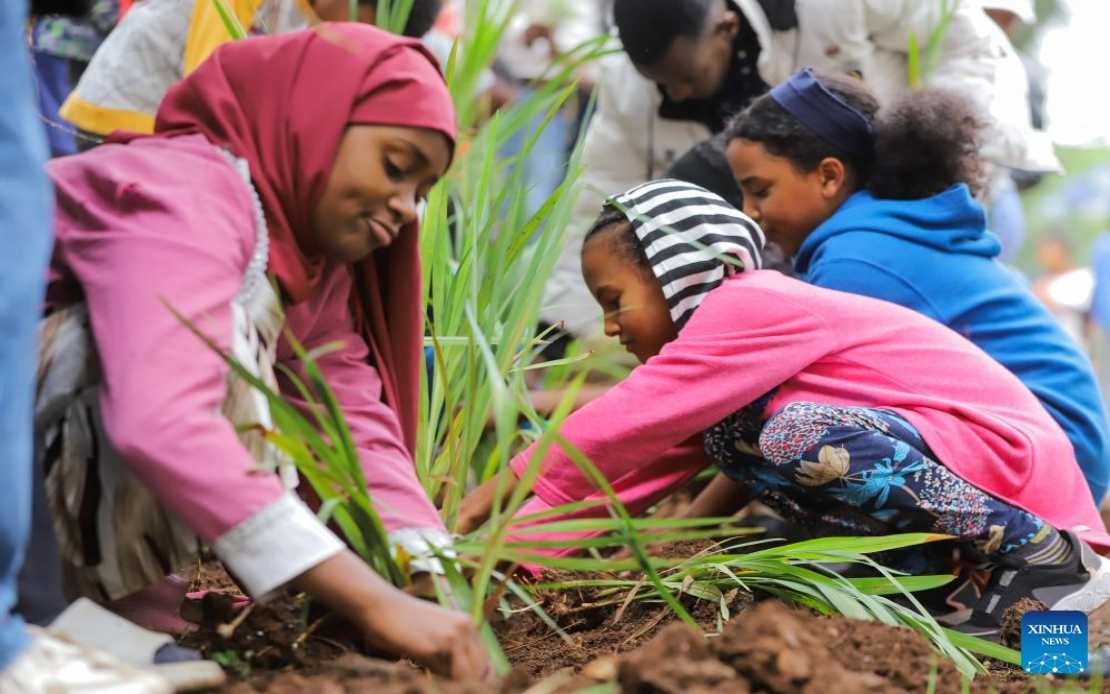
Ethiopia demonstrated remarkable environmental commitment on Monday when millions of citizens and foreign residents joined a coordinated nationwide tree-planting campaign designed to establish 800 million seedlings in a single day. The ambitious undertaking represents a significant escalation of the country's flagship environmental program, initiated by Prime Minister Abiy Ahmed in 2019, and underscores East Africa's determination to reverse decades of deforestation and ecological degradation through mass public mobilisation.
The Green Legacy Initiative, now in its eighth year of implementation, has evolved into one of Africa's most visible climate action programmes. This year's edition targets the planting of more than 8 billion seedlings across Ethiopia's diverse landscapes during the rainy season, substantially advancing the overarching goal of reaching 50 billion trees since the programme's inception. The scale of the operation reflects an understanding that environmental restoration demands not merely government policy but sustained popular participation across all layers of society.
Participants ranged from schoolchildren to healthcare workers, demonstrating the initiative's capacity to unite Ethiopians across professional and generational lines. Thirteen-year-old Edilawit Legesse, participating for her third consecutive year, planted seedlings in the Alembank neighbourhood on Addis Ababa's periphery, exemplifying youth engagement with long-term environmental stewardship. Her involvement illustrates how the campaign has become embedded in Ethiopian civic culture, with young people viewing tree-planting as a meaningful contribution to national development rather than a tokenistic exercise.
Healthcare professionals also mobilised for the campaign, with groups such as the nursing staff at Addis Ababa's local hospital coordinating collective planting efforts near Entoto Mountain. These organised workplace participation strategies demonstrate how institutions have integrated environmental action into their operational cultures. Such coordination suggests the campaign's success rests partly on institutional capacity and workplace mobilisation, factors often overlooked in analyses of environmental initiatives in developing nations.
Prime Minister Abiy framed the campaign as transcending environmental technical necessity to become a unifying national moment. His characterisation of the event as "a moment when Ethiopians from all walks of life come together to create a lasting legacy for generations to come" positions tree-planting within Ethiopia's broader nation-building narrative. This rhetorical strategy connects environmental restoration to historical continuity and intergenerational responsibility, potentially sustaining political backing for the initiative beyond its immediate measurable outcomes.
The initiative addresses multiple interconnected challenges simultaneously. Deforestation has historically undermined Ethiopia's ecological stability, contributing to soil erosion, water scarcity, and reduced agricultural productivity across the highlands and lowlands. By framing reforestation as central to building a "green, lower-middle-income economy," the government articulates an economic rationale alongside environmental and climate justifications. This multi-dimensional approach may prove more politically durable than single-issue environmental messaging in a context where poverty reduction and economic development remain pressing national priorities.
From a Southeast Asian perspective, Ethiopia's approach offers instructive lessons for climate-vulnerable economies in the region. Nations like Malaysia, Indonesia, and Thailand face comparable deforestation pressures driven by agricultural expansion, urban development, and infrastructure projects. Ethiopia's strategy of coupling large-scale tree-planting with symbolic national mobilisation events demonstrates how environmental initiatives can achieve political salience and popular participation rather than remaining technocratic exercises implemented by government agencies with limited public engagement.
However, the initiative's long-term sustainability remains subject to critical questions. Mass tree-planting campaigns generate immediate quantifiable metrics—800 million trees in one day produces compelling statistics for international climate diplomacy and domestic political communication. Yet survival rates, species diversity, and ecosystem functionality depend on sustained post-planting maintenance, adaptive management, and protection against competing land uses. Many developing countries have launched ambitious afforestation programmes that encountered difficulties translating initial planting achievements into lasting forest cover increases.
The programme's focus on the rainy season reflects ecological realism, as Ethiopian climate patterns determine successful germination and establishment rates. However, climate change increasingly disrupts historical rainfall patterns across East Africa, introducing uncertainty into planting schedules and species selection strategies. Future iterations may require ongoing adjustment of implementation approaches as environmental conditions shift unpredictably.
Financial sustainability represents another consideration. While the campaign mobilises volunteer labour effectively, maintaining nurseries, distributing seedlings, and protecting young trees requires sustained public investment. As Ethiopia navigates economic pressures and competing budgetary demands, environmental spending may face constraints despite rhetorical commitment. Regional comparisons suggest that even well-intentioned governments sometimes reduce environmental investments when fiscal pressures intensify or political attention shifts toward other priorities.
The initiative's international dimensions merit attention as well. Foreign nationals participated alongside Ethiopian citizens, suggesting the campaign attracts diaspora involvement and international goodwill. This soft power dimension strengthens Ethiopia's climate diplomacy credentials ahead of continued negotiations around climate finance and Just Transition mechanisms. For Southeast Asian nations similarly positioned as vulnerable to climate impacts while pursuing development objectives, Ethiopia's example indicates how environmental initiatives can generate diplomatic advantages alongside environmental and economic benefits.
Looking forward, the programme's success will be measured not merely by seedlings planted in dramatic single-day events but by forest cover restoration across years and decades. The Green Legacy Initiative represents a generational commitment, with Edilawit Legesse and her peers expected to witness the maturation of trees planted during their childhood. This temporal dimension—linking present action to distant outcomes visible only to future generations—constitutes perhaps the initiative's most important dimension, embedding environmental responsibility within Ethiopian national identity and intergenerational obligation.

