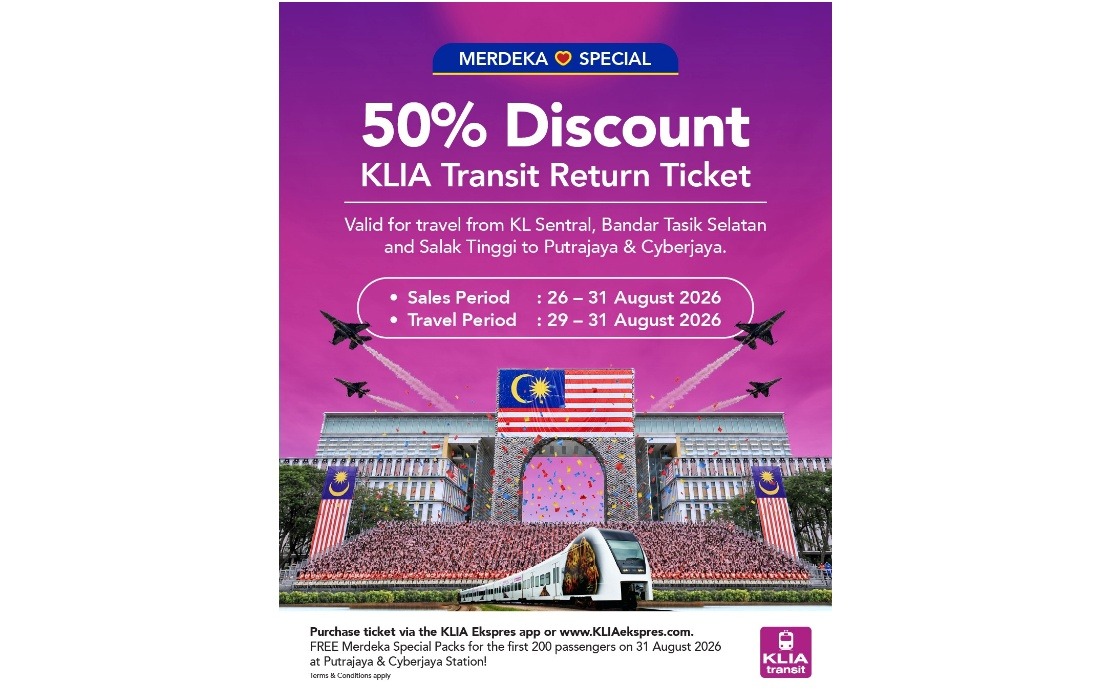
Express Rail Link Sdn Bhd (ERL) has unveiled a significant fare concession timed to coincide with Malaysia's 69th National Day celebrations, extending a 50 per cent reduction on KLIA Transit return tickets to Putrajaya and Cyberjaya Station. The initiative aims to remove financial barriers for families and individuals wishing to participate in the slate of commemorative events scheduled across the federal capital over the long weekend, particularly the rehearsals and main parade programme for the country's 2026 National Day observance.
The promotional pricing structure accommodates both adult and child passengers, with children aged six to fifteen eligible for the discounted rate alongside their adult companions. Notably, youngsters aged five and below are permitted to travel without charge whenever accompanying a paid adult ticket holder, though this facility is capped at a maximum of three children per adult passenger. This tiered arrangement appears designed to encourage family participation in what is typically one of Malaysia's most significant annual civic celebrations, removing potential cost impediments for households with multiple children.
Procurement of discounted fares occurs exclusively through digital channels, specifically the KLIA Ekspres mobile application and the company's official website. The booking window opens on August 26 and extends through August 31, while the travel period itself spans August 29 through 31. Critically, the promotional pricing excludes journeys terminating at KLIA Terminal 1 and Terminal 2, restricting the discount strictly to the Putrajaya and Cyberjaya Station destination, thus focusing incentives on visitors accessing the National Day events rather than airport users.
Beyond the fare reduction, ERL has announced an additional promotional giveaway targeting early arrivals at Putrajaya and Cyberjaya Station on August 31, the principal parade date. The first 200 passengers to reach the station that day will receive exclusive Merdeka Pack bundles, adding a commemorative element to the journey itself. This approach leverages the rail operator's position as a mobility enabler while simultaneously creating a tangible incentive for advance planning and timely arrival.
For visitors arriving at Putrajaya, the transportation infrastructure includes complementary shuttle bus services operated jointly by Prasarana and Perbadanan Putrajaya, facilitating onward movement from the Putrajaya Sentral interchange to various event venues throughout the federal territory. This coordinated approach between transport operators suggests advance planning to manage anticipated congestion and distribute visitor flows across multiple access points and routes within the city.
The National Day programme extends across the three-day window, with preliminary activities commencing on August 29 through a full-dress rehearsal of the parade formations, protocol, and ceremonial components. This rehearsal offers Malaysian residents an opportunity to witness the main spectacle in preparation before the official parade on August 31, potentially distributing viewer attendance across multiple days and reducing single-day crowd concentrations. The rehearsal also enables participants, dignitaries, and security personnel to conduct final operational validations before the formal event.
Complementing the headline parade events, Putrajaya will host thematic attractions including Riuh Merdeka and the Ambang Merdeka 2026 celebration, expanding the visitor experience beyond the parade itself. These programmes typically feature cultural performances, historical exhibitions, interactive installations, and commercial activities that extend the festivities throughout the federal capital, encouraging longer stays and greater visitor engagement with the commemorative programming.
For Malaysian and Southeast Asian readers, this promotion reflects how transport operators are increasingly integrating civic engagement with commercial strategy, using infrastructure to facilitate participation in national events. The rail link's role in connecting Kuala Lumpur's international airport with Putrajaya positions it as a critical corridor for both domestic and visiting audiences, and the promotional pricing recognises this connectivity's value in enabling broader public participation in state occasions. The August 29-31 timing capitalises on a long weekend configuration that typically maximises travel and leisure activity in Malaysia.
The advance of these arrangements for a 2026 parade event also indicates that federal authorities are undertaking substantial preparatory activities and communications several years ahead of the celebration, suggesting the 2026 National Day holds particular significance or organisational complexity. This early promotional activity generates sustained media attention and anticipation, potentially establishing attendance benchmarks or participation targets that justify the infrastructure investment and coordination across multiple public agencies and private operators.
For regional readers, Malaysia's approach to integrating transport pricing with national celebrations illustrates broader patterns across Southeast Asia wherein governments and state enterprises leverage public infrastructure to encourage civic participation while managing transportation demand. ERL's coordination with Prasarana and Perbadanan Putrajaya demonstrates the importance of seamless multimodal integration in festival management, ensuring that rail accessibility translates into actual venue access rather than creating intermediate transport bottlenecks.

