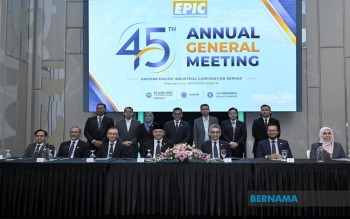
Eastern Pacific Industrial Corp Bhd (EPIC) has unveiled an ambitious five-year roadmap that would nearly double its annual revenue to RM700 million whilst elevating its net asset value to RM1 billion by the close of the 2020s decade. The oil and gas integrated solutions provider outlined these objectives under its newly minted EPIC Strategic Business Plan 2025-2030, which hinges on geographical diversification and strategic expansion across its traditional hydrocarbon sector, port operations and the burgeoning renewable energy landscape.
The Terengganu-based conglomerate's chief executive, Dr Ts Muhtar Suhaili, framed the targets as attainable given the company's momentum in recent years. Current revenues of RM411.9 million would need to climb seventy percent over the decade-long period to meet the 2030 goal, while the net asset value expansion from approximately RM700 million to RM1 billion reflects the company's confidence in its operational capabilities and market positioning. These projections arrive as EPIC demonstrated robust financial health in its latest reporting cycle, underscoring management's conviction that the expansion blueprint is grounded in tangible commercial prospects rather than speculative ambition.
EPIC's 2025 financial performance established a fresh platform for this growth trajectory. The group recorded net profit of RM20.6 million for the year ended December 31, 2025, a notable twenty-four percent improvement from RM16.6 million in the preceding period. Revenue expansion proved equally impressive, climbing to RM411.9 million from RM403.8 million previously, marking the latest chapter in a consistent growth narrative that commenced in 2022. This upward arc reflects the company's deepening integration into Malaysia's energy infrastructure ecosystem and its widening service portfolio across multiple segments of the hydrocarbon value chain.
Several catalysts drove the recent financial outperformance. The acquisition of Rahar Niaga Sdn Bhd supplemented organic growth, whilst newly awarded contracts—specifically the Pan Malaysia Maintenance, Commissioning and Modification arrangement plus related Hook-Up and Commissioning work—expanded the revenue base. Additionally, improved maritime traffic patterns, evidenced by higher offshore rig arrivals and elevated cargo throughput, benefited EPIC's port and logistics operations. These developments collectively demonstrate how EPIC is capturing growth across multiple revenue streams within the energy and maritime sectors.
Muhtar projected that 2026 would deliver yet another record-setting year, buoyed by the company's expanding contract portfolio and geographic reach. EPIC's confirmed contract value in its oil and gas operations ranges between RM1.3 billion and RM1.5 billion, though actual revenue realisation hinges on the timely issuance of work orders and purchase orders by clients. The breadth of this contract backlog provides substantial revenue visibility and suggests the company has secured substantial engagement from its principal client, Petronas, across multiple regions. Notably, EPIC has secured work in Terengganu (its historical stronghold), southern Peninsular Malaysia including the major refining centres of Pengerang and Melaka, and has recently penetrated the Sabah market, signalling successful market expansion beyond traditional operating zones.
Renewable energy represents a critical pillar of EPIC's medium-term strategy. The company is pursuing participation in a hybrid hydro-solar development in Kenyir alongside its parent entity, Terengganu Inc, positioning itself to capture growth in Malaysia's energy transition journey. As the nation accelerates its renewable energy deployment targets under the Energy Transition Roadmap, companies with established operational capabilities and project execution experience hold competitive advantages in securing contracts. EPIC's participation in this bidding process reflects management's intention to diversify beyond conventional hydrocarbon services and establish credentials in the clean energy space, a sector expected to command increasing capital investment throughout the region over the coming decade.
Geographic expansion beyond Malaysia's borders forms another strategic pillar. The board has mandated management to evaluate and pursue opportunities across neighbouring Southeast Asian markets as integral to the 2030 ambition, whilst simultaneously monitoring developments in West Asia despite current geopolitical complexities. This regional orientation reflects broader trends among Malaysian mid-cap energy services firms seeking to leverage their expertise and scale operations across the Asia-Pacific domain where energy infrastructure investment remains substantial. The careful balancing of Southeast Asian expansion with selective West Asian exposure demonstrates a measured approach to international growth, acknowledging both opportunity and risk.
EPIC's recent corporate action illustrates this international expansion philosophy in practice. Earlier this year, EPIC's subsidiary EPIC OG Sdn Bhd formalised a collaboration with Begas Energy Sdn Bhd to provide project management services for Terminal Turnaround, Maintenance and Modification operations in Sabah. This arrangement consolidates EPIC's positioning in East Malaysia, a region with substantial offshore petroleum reserves and ongoing infrastructure development requirements. The partnership approach—leveraging local expertise whilst deploying EPIC's technical capabilities—represents a pragmatic entry mechanism into markets where established relationships and regulatory familiarity carry premium value.
The RM700 million revenue and RM1 billion NAV targets, whilst ambitious, appear calibrated within realistic parameters given EPIC's current trajectory and the underpinning contract portfolio. The company's demonstrated execution capability across multiple O&G service lines, coupled with strategic investments in renewable energy and geographic diversification, provides multiple avenues for value creation. For Malaysian investors and stakeholders tracking the nation's energy sector development, EPIC's expanded ambitions reflect the broader maturation of domestic energy services capacity and the growing competitiveness of Malaysian firms in regional energy markets. The company's ability to execute this strategic plan will offer important insights into the health of Malaysia's downstream energy services ecosystem and the competitive positioning of homegrown enterprises within Asia's energy infrastructure landscape.

