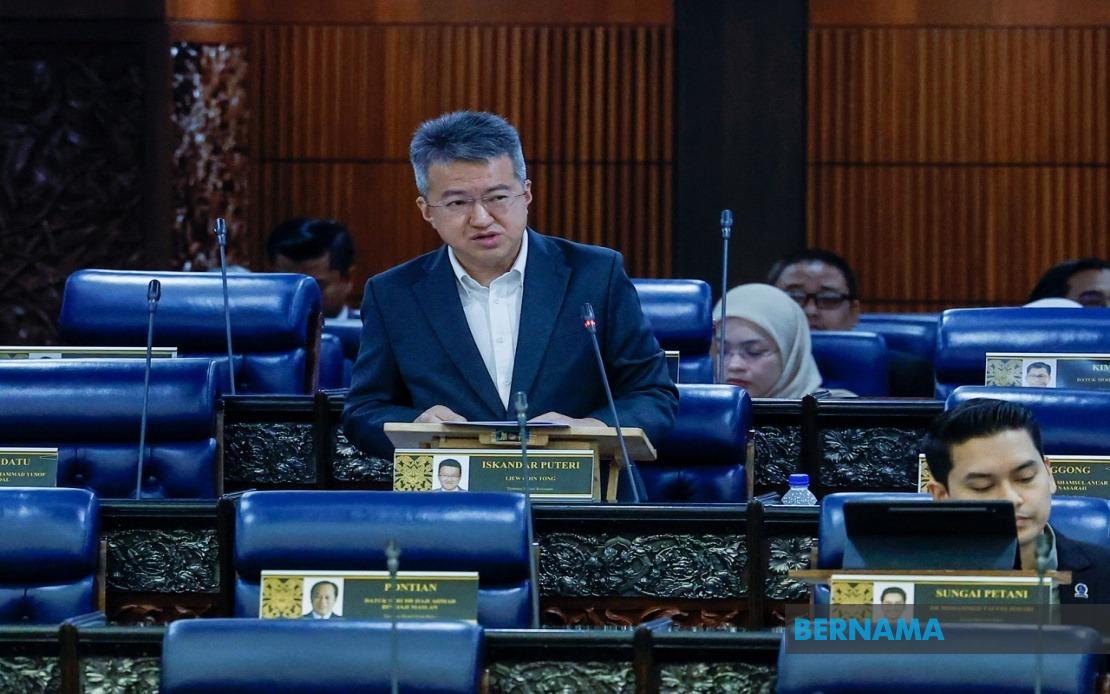
Malaysia's Employees Provident Fund has made solid progress in helping members transfer surplus retirement savings to their families through the i-Legasi scheme, with 63 approved applications distributing RM46.3 million to 86 beneficiaries since the programme launched earlier this year, Deputy Finance Minister Liew Chin Tong disclosed during parliamentary proceedings today.
The i-Legasi initiative, introduced on February 1, represents a targeted response to a longstanding concern among Malaysian workers: ensuring that accumulated retirement funds benefit family members when they exceed what an individual actually needs. Under the scheme's framework, EPF contributors aged 55 and above who have built retirement savings beyond the Adequate Savings benchmark of RM650,000 gain the flexibility to transfer a portion of their accumulated balance into the EPF accounts of immediate family members, provided those relatives meet eligibility criteria.
The concept underscores a significant shift in Malaysia's approach to retirement planning. Rather than viewing excess savings as funds destined solely for the original contributor, policymakers recognised that allowing transfers to family accounts could simultaneously address two pressing issues: enabling retirees to pass wealth to dependents while channelling additional resources into the formal retirement system of younger household members. This dual benefit explains why the government classified i-Legasi as a mechanism for strengthening overall retirement adequacy across the population.
Liew's parliamentary response came in reply to concerns raised by Datuk Seri Aminuddin Harun from Port Dickson, who highlighted the interconnected pressures facing Malaysian workers as the nation approaches demographic transition. With Malaysia projected to become an aged society by 2030—a milestone when the elderly population exceeds 7 per cent—policymakers must grapple with the reality that many current workers lack sufficient savings to sustain themselves through retirement. Simultaneously, Malaysia's rising cost of living erodes purchasing power, making it harder for younger workers to accumulate their own retirement nest eggs while supporting household expenses.
Data presented by Liew reveals encouraging momentum in the broader retirement adequacy landscape. As of May 31 this year, approximately 3.04 million active EPF members aged between 18 and 60 had achieved the Basic Savings target appropriate for their age, which stands at RM390,000 by age 60. This cohort represents 38.3 per cent of the 7.94 million members in that age bracket. The year-on-year comparison demonstrates tangible improvement: the proportion jumped from 35 per cent, representing 2.71 million members, recorded during the same period last year. While still indicating that nearly two-thirds of working-age contributors fall short of the Basic Savings benchmark, the upward trajectory suggests that government initiatives and increased awareness are yielding results.
The improvement in savings adequacy statistics reflects multiple policy initiatives operating in concert. Beyond i-Legasi, the EPF has introduced various mechanisms designed to encourage contribution discipline and enhance the appeal of retirement savings. Enhanced contribution incentives and strengthened social protection measures work to make the savings journey more accessible and attractive, particularly for lower-income workers who struggle to divert resources toward retirement planning amid immediate financial pressures.
For Malaysian readers, the i-Legasi statistics carry particular significance in the context of family-oriented financial planning. Southeast Asian societies traditionally rely on multi-generational household economics, where parents support adult children while simultaneously building retirement security. The scheme acknowledges this reality by formalising intra-family wealth transfers within the EPF framework, thereby ensuring that such transfers generate formal retirement account credits rather than remaining as informal cash transfers outside the structured system.
The RM46.3 million distributed to date, while representing only early-stage adoption, signals genuine take-up among the target demographic. The fact that 63 applications benefited 86 individual beneficiaries indicates that participating members often transferred funds to multiple family members, spreading wealth across the household. This pattern aligns with policy intent: rather than concentrating excess savings in a single heir, i-Legasi facilitates modest distributions that individually strengthen multiple family members' retirement positions without depleting any single contributor's security.
Looking ahead, the government and EPF have committed to intensifying collaboration on comprehensive retirement adequacy frameworks. This commitment extends beyond i-Legasi to encompass broader policy architecture aimed at making retirement savings more achievable and secure across demographic groups. The emphasis on holistic policymaking acknowledges that no single initiative can address the systemic challenge of inadequate retirement savings, particularly when inflation erodes purchasing power and life expectancy continues extending the retirement funding horizon.
For younger Malaysians still accumulating savings, schemes like i-Legasi's beneficiary provisions offer practical pathways to initial capital accumulation. A family member receiving a transfer credit can compound that advantage through decades of additional contributions and investment returns. Over time, such interventions compound across the population, gradually raising the baseline retirement adequacy standard.
The trajectory of i-Legasi adoption remains fluid, and policymakers will likely monitor application patterns closely to identify barriers preventing more workers from utilising the scheme. Some eligible members may lack awareness, others may face documentation challenges, and some may prefer alternative estate planning approaches. Addressing such obstacles through communication campaigns and administrative streamlining could substantially increase participation rates.
Ultimately, Malaysia's experience with i-Legasi illustrates a pragmatic approach to retirement adequacy: rather than imposing mandatory burden on current workers, the scheme leverages existing surplus savings to strengthen family-level retirement security. As the nation approaches an aged demographic structure, such flexible, family-centric mechanisms may prove increasingly valuable in maintaining both individual retirement resilience and intergenerational financial stability across Malaysian society.

