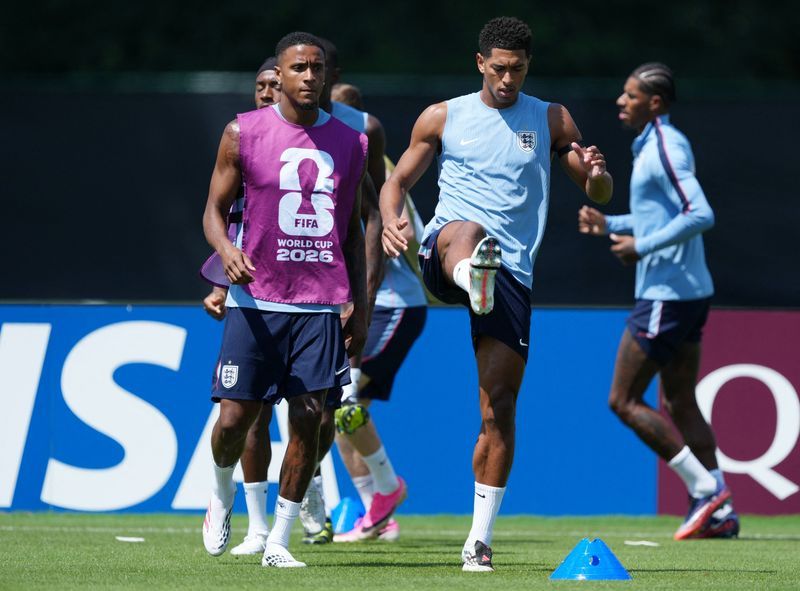
England's players are presenting a united front as they prepare for Wednesday's World Cup semi-final against Argentina in Atlanta, deliberately shutting out the swirling media commentary that has accompanied their passage through the tournament. Defender Ezri Konsa articulated this stance directly, acknowledging that scrutiny of the squad is inevitable at this level but insisting the team has developed the mental discipline to ignore external distractions and focus entirely on the challenge ahead.
The English contingent has weathered considerable speculation following their quarter-final victory over Norway, where manager Thomas Tuchel and midfielder Jude Bellingham engaged in a public exchange of views about the team's performance and tactical approach. Tuchel expressed dissatisfaction with how the side had played, while Bellingham, who scored both goals in the 2-1 extra-time triumph, pushed back with pointed questioning of whether the German coach fully grasped the physical and technical demands of performing at such intensity against elite opponents. Such friction at a critical tournament stage would typically generate weeks of analysis about squad morale and managerial credibility.
Yet Konsa's comments suggest the squad has moved swiftly past this moment rather than allowing it to fester. The defender noted that players of England's experience understand the territory comes with international football, and that maturity includes the capacity to isolate themselves from noise while maintaining internal cohesion. His framing presents the incident not as evidence of dysfunction but as a normal part of tournament pressure that a professional group can navigate without fracturing.
Marc Guehi, fellow member of England's defensive line, reinforced this narrative while offering a warmer assessment of Tuchel's impact since his appointment. Guehi credited the manager with fostering an environment characterized by strong collective belief and commitment to shared objectives, suggesting that rather than driving wedges between individuals, the coaching regime has actually tightened bonds. His claim that this represents the tightest the squad has ever been carries particular weight given England's well-documented history of squad tensions and faction-building during major tournaments.
Guehi's observation that the Norway match aftermath "brought everyone together" rather than splitting the group inverts the conventional tournament narrative where discord spreads. This framing positions Tuchel's implicit criticism and Bellingham's response as cathartic rather than corrosive, as if the public airing of different perspectives actually cleansed the group of potential resentments. Whether this optimistic interpretation reflects genuine squad psychology or represents public-facing messaging remains difficult to assess from outside, but its consistency across multiple players suggests at minimum that fractious divisions are not visible at the surface.
When Tuchel was subsequently asked about these player endorsements, he anchored his response in philosophy rather than defending his management style. The German coach spoke of reinforcing the notion that football remains fundamentally a collective endeavor, emphasizing that the World Cup tournament itself had demonstrated how elite performers across all nations had subordinated individual achievement to team objectives and national representation. This rhetorical positioning frames the squad's togetherness not as something he uniquely created but as a manifestation of deeper sporting values that he has simply helped channel.
Tuchel's broader commentary on squad mentality focused on resilience and refusal to surrender, qualities he identified as central to England's identity. He portrayed the team as possessing an exceptional psychological framework, one built through closed-door work rather than visible drama, and expressed pride in their capacity to commit fully to every match situation without capitulating when circumstances become difficult. This characterization positions England not as a group unified despite recent friction but as one whose fundamental character is defined by determination and togetherness.
The tournament trajectory now points toward a potential final rematch with Spain, who convincingly dispatched France 2-0 in their semi-final on Tuesday. That Euro 2024 final result, in which Spain prevailed, remains a recent reference point for both nations. The possibility of facing Spain again carries psychological weight, as tournament repeat narratives tend to frame subsequent encounters through the lens of previous outcomes.
Curiously, Guehi's admission that he slept through Spain's victory rather than studying their performance offers an inadvertent insight into England's tournament approach. The squad appears consciously avoiding the detailed video analysis and strategic previewing that has become standard practice, instead trusting preparation already conducted and maintaining mental freshness. Whether this represents deliberate psychological strategy or simply the logistical reality of travel and fatigue remains unclear, but it indicates a squad confident enough to approach the semi-final without last-minute tactical reconnaissance.
As England moves toward this decisive encounter with Argentina, the narrative arc has shifted from internal tension to proclaimed unity. The squad's public messaging emphasizes that external noise, whether critical analysis of performance or speculation about internal divisions, remains peripheral to their focus and preparation. For Malaysian and Southeast Asian observers watching this World Cup unfold, the England example illustrates how modern tournament football increasingly involves managing media scrutiny and perception as skillfully as executing tactical instructions on the pitch.

