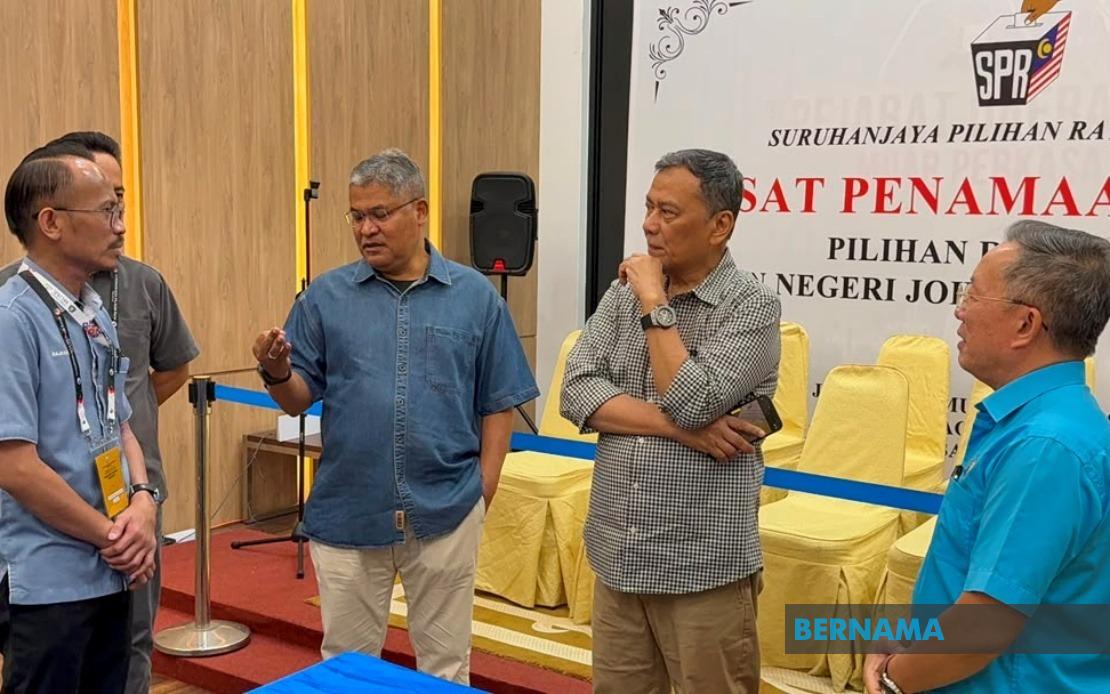
The Election Commission is putting the finishing touches on logistical and procedural arrangements to facilitate tomorrow's candidate nomination process for the Johor state election, with field inspections confirming that nomination centres across the state have moved beyond major construction work into final technical refinements. A survey by election officials found that returning officers at various Candidate Nomination Centres, or PPCs in Malaysian parlance, have largely completed their layout configurations and operational simulations with partner agencies, signalling readiness for what promises to be a consequential day in Johor's electoral cycle.
At the Perling state constituency centre housed in Dewan Jubli Intan Hall, returning officer Nazatul Shima Mohamad expressed confidence that all systems are primed for the nomination exercise. Her statement underscored the collaborative spirit among government bodies and local authorities in ensuring procedural efficiency, while also serving as a public reminder to prospective candidates about the practical requirements they must fulfil. Candidates have been advised to arrive early, bring identification and financial deposits, and cooperate fully with poll workers to prevent delays that could compromise the integrity of the nomination timeline.
Security planning has emerged as a central focus given the anticipated convergence of party supporters at nomination venues. At the Kota Iskandar centre in Iskandar Puteri's municipal hall, returning officer Shahrulizam Abdul Rashid outlined a detailed crowd management strategy developed in coordination with police authorities. The approach includes strategic road closures in the immediate vicinity of nomination facilities, designation of a 50-metre buffer zone around the centres themselves, and deployment of tents and barriers to physically separate supporters of competing parties. This layered security architecture reflects lessons learned from previous Malaysian electoral exercises and aims to balance the right of citizens to publicly support candidates with the necessity of maintaining order and preventing inter-party friction.
Public behaviour remains a key variable in the success of tomorrow's exercise. The Election Commission and police have appealed to voters attending nomination events to exercise restraint and avoid inflammatory conduct that might escalate tensions between supporters of rival factions. This messaging recognises that while party activism is a legitimate expression of democratic engagement, the nomination period requires a heightened level of institutional stability to allow the formal registration of candidates to proceed without disruption. The emphasis on prudence suggests that authorities are mindful of potential flashpoints that could undermine public confidence in electoral processes.
The logistical scope of tomorrow's nomination process reflects the scale of Johor's electorate and the decentralised nature of Malaysia's electoral administration. The Exercise will unfold simultaneously across 56 nomination centres statewide between 9 and 10 in the morning, after which returning officers will announce the official list of candidates deemed eligible to contest. This compressed timeline requires military-style coordination to prevent bottlenecks or procedural failures that could complicate the subsequent campaign and voting phases. The successful management of such a complex operation depends on frontline poll workers being thoroughly briefed, equipped with correct documentation, and empowered to resolve common queries without escalating them to senior officials.
The electoral roll for this Johor contest encompasses 2,727,926 registered voters, a figure that encompasses three distinct categories: 2,703,175 ordinary citizens, 12,041 military personnel and their spouses, and 12,710 police personnel and spouses. The inclusion of uniformed services and their families reflects Malaysia's historical practice of extending voting rights to defence and security personnel, a feature that distinguishes Malaysian electoral administration from some Commonwealth democracies. The precise maintenance of these separate voter rolls adds administrative complexity but reflects constitutional provisions regarding the participation of government servants in the democratic process.
The election cycle itself follows a compressed schedule that has become standard in Malaysian state-level contests. The Johor State Legislative Assembly was dissolved on June 1, establishing the nomination process for tomorrow as the formal starting point of the candidate selection phase. Early voting has been scheduled for July 7, providing a mechanism for voters unable to participate on polling day, while the main ballot casting will occur on July 11. This two-week interval between nomination and polling allows candidates time to campaign and voters to make informed choices, though some critics argue that the condensed timeframe limits the depth of policy discussion compared to longer campaign periods in other democracies.
For Malaysia's broader political landscape, the Johor election carries significance beyond the state's borders. Johor, as one of Malaysia's most populous states and a traditional stronghold of certain political coalitions, serves as a bellwether for national political sentiment. The composition of the Johor state assembly following July 11 may influence calculations at the federal level regarding coalition stability and the viability of different political alignments. Election watchers across Southeast Asia often view Johor contests as indicators of whether ruling coalitions maintain their grip on power or face erosion from opposition advances, making tomorrow's nomination process part of a larger political narrative with implications reaching beyond state boundaries.
The Election Commission's confidence in its preparedness, expressed through the statements of individual returning officers, represents institutional messaging designed to assure both candidates and the general public that tomorrow will proceed without major disruption. However, electoral administration in Malaysia, like elsewhere, depends ultimately on the professionalism and impartiality of thousands of frontline workers operating under pressure in an environment charged with political significance. The success of the nomination process will be measured not merely by the absence of major incidents but by the perception among all political competitors that procedures were applied fairly and consistently across all nomination centres.
As nomination day approaches, the Election Commission's public communications strategy has shifted toward practical guidance for voters and candidates while maintaining the institutional neutrality that is fundamental to electoral legitimacy. The emphasis on early arrival, proper documentation, and cooperative behaviour reflects a recognition that electoral credibility depends on processes being perceived as orderly and rule-governed rather than subject to arbitrary interpretation by officials. Tomorrow's exercise will test whether the months of planning and preparation translate into a nomination process that satisfies the competing demands of administrative efficiency, security, fairness, and public confidence in Malaysia's democratic institutions.

