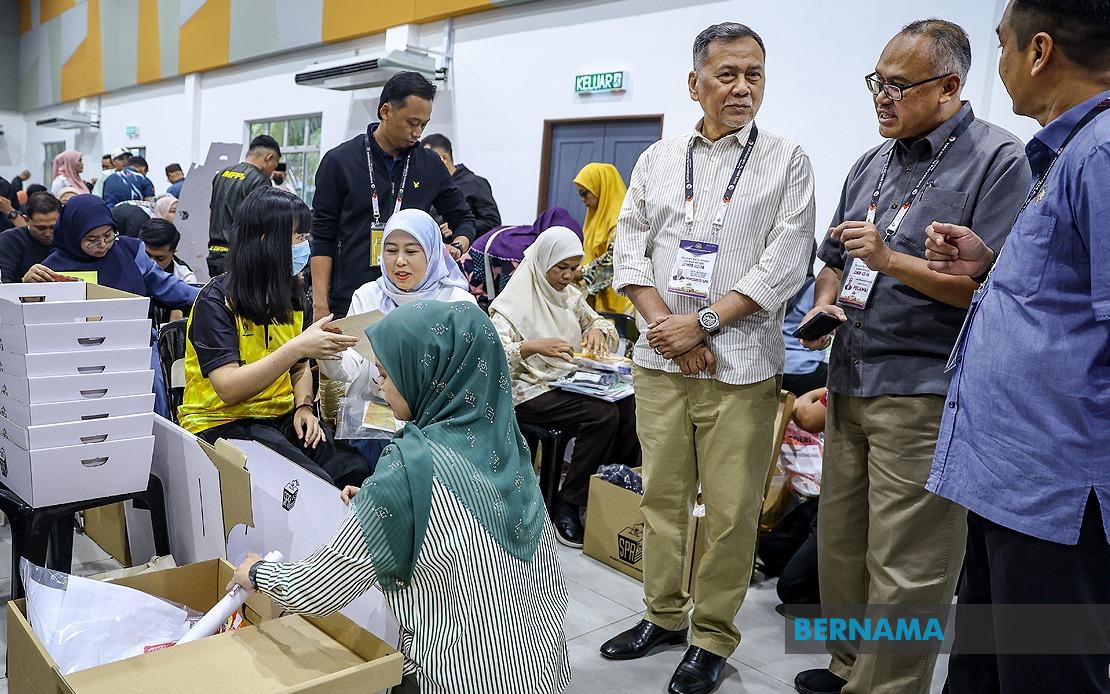
The Election Commission has completed exhaustive final preparations across Johor, with personnel at all polling and tallying centres working through the day to ensure the state election machinery is functioning flawlessly when voting commences tomorrow. Election Commission Chairman Datuk Seri Ramlan Harun underscored the significance of these last-minute checks, noting that comprehensive inspections of ballot boxes and voting equipment across all 56 state seats have been concluded and certified as ready for deployment.
Ramlan stressed that these verification procedures rank among the most vital safeguards for ensuring a seamless polling day and enabling the 2.7 million registered voters across Johor to exercise their democratic right without disruption. Speaking after personally observing the ballot box verification process at the Sultan Ibrahim Jubilee Hall in Pontian and the Permas Multipurpose Hall in Kukup, he reported that virtually all Returning Officers managing the 56 constituency centres had completed their assigned preparation tasks.
Visits to various polling centres revealed the meticulous groundwork underway across the state. At Sekolah Kebangsaan Bukit Mutiara in Johor Bahru, Election Commission staff were actively engaged in labelling materials, positioning furniture, and erecting direction signboards to guide voters efficiently through the voting process. The Puteri Wangsa constituency polling centre supervisor, Mohd Rasib Ngadiman, detailed how twelve classrooms had been converted into separate polling streams, with 74 Election Commission personnel supported by twelve police officers coordinating the operation. The commission had additionally provisioned wheelchairs specifically for elderly citizens and voters with disabilities, reflecting efforts to ensure accessibility across the franchise.
In Kluang, meticulous preparations at Sekolah Kebangsaan Kampong Melayu reflected similar attention to detail, with thirty personnel establishing five polling streams designed to manage approximately three thousand voters in the Mahkota constituency. The Batu Pahat locality, specifically the polling centre at Sekolah Menengah Kebangsaan Dato' Seth in Yong Peng, gave particular emphasis to establishing comfortable facilities for elderly voters, younger first-time participants, and individuals with disabilities. These logistical considerations reveal how electoral authorities are addressing the practical dimensions of accommodating diverse voter populations across the sprawling state.
Unique challenges emerged in maritime constituencies, particularly in Mersing. The Tenggaroh constituency encompasses four islands—Pulau Aur, Pulau Pemanggil, Pulau Sibu, and Pulau Tinggi—requiring that ballot boxes be transported via the Mersing Jetty. This operation mobilised approximately fifty Election Commission personnel, accompanied by security escorts from the Marine Police Force and Mersing district police headquarters, emphasising the security protocols surrounding election materials even in remote areas. Tenggaroh's Returning Officer, Jamil Hasni Abdullah, highlighted how these maritime logistical complexities demanded substantial coordination to guarantee the integrity and safety of voting materials.
Election Commission officials issued guidance to voters to support an efficient polling experience. Voters were encouraged to arrive during their designated time slots to prevent congestion at centres, to carry their identity cards for verification purposes, and to adhere closely to the instructions provided by election officials. These reminders reflect recognition that voter compliance with procedural guidelines materially contributes to reducing delays and processing bottlenecks.
The competitive landscape for this election reflects Johor's political diversity. A total of 172 candidates are contesting the 56 state seats, with the two major coalitions—Pakatan Harapan and Barisan Nasional—fielding complete slates across all constituencies. Perikatan Nasional is presenting 33 candidates, while Parti Bersama Malaysia contests 15 seats. Smaller political entities including the Malaysian United Democratic Alliance with four candidates, the Malaysian Orang Asli Party and the Socialist Party of Malaysia each fielding single representatives, and six independent candidates, together create a multi-polar contest that extends beyond the traditional two-coalition framework. This spread of candidates amplifies the significance of election administration competence, as the tallying process must accurately account for votes distributed across numerous competing parties and independent hopefuls.
The scale of electoral administration required for Johor's election underscores the logistical complexity inherent in modern Malaysian elections. Managing participation across 2.7 million registered voters necessitates coordinated effort spanning dozens of constituencies with varying geographic characteristics, from urban concentrations to island communities. The Election Commission's advance preparation, encompassing everything from basic infrastructure like polling booths and furniture to specialised provisions for elderly and disabled voters, represents the institutional foundation upon which electoral integrity rests. Without meticulous attention to these preparatory details, the actual voting process would encounter friction and inefficiency that could undermine confidence in the electoral outcome.
Ramlan's personal inspection visits to multiple polling centres and his public confirmation that preparations were substantially complete signal election leadership's commitment to transparency and stakeholder confidence. When electoral authorities publicly demonstrate their readiness and invite observation of their preparations, they provide tangible reassurance to political parties, election observers, and the voting public that the process will meet professional standards. In the Malaysian political context, where elections carry substantial weight in determining state and federal governance, public confidence in the administrative mechanics of voting and counting directly influences the democratic legitimacy of electoral outcomes.
The detailed attention to accessibility and comfort for diverse voter categories—elderly citizens, persons with disabilities, and young voters—reflects contemporary electoral best practices. Creating inclusive polling environments extends voting rights beyond mere formal franchise to practical opportunity. Providing wheelchairs and accessible facilities removes barriers that might otherwise prevent eligible citizens from participating. This inclusive approach strengthens democratic representation by ensuring that electoral outcomes reflect the actual preferences of the broadest possible cross-section of the qualified electorate.
As Johor voters prepare to head to polling centres tomorrow, the Election Commission's completion of final preparations establishes the administrative groundwork for what promises to be a significant political moment for the southern state. The diversity of competing parties and candidates ensures that the election outcome carries implications for political configurations not merely within Johor but potentially for national coalition dynamics as well. The thoroughness with which the Election Commission has executed its preparatory mandate will substantially influence whether tomorrow's election unfolds as a model of professional administration or encounters logistical disruptions that could cloud the legitimacy of results.

