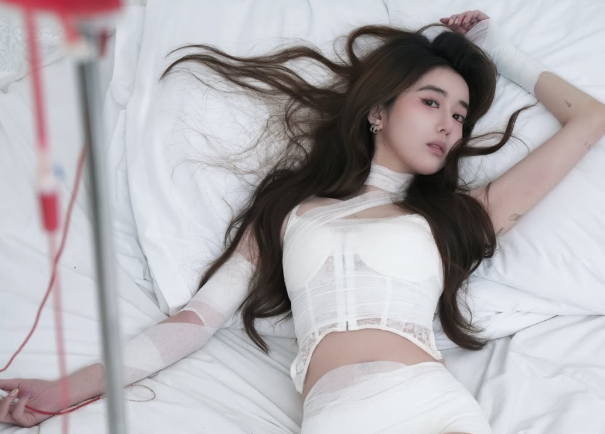
Singaporean actress Eleanor Lee has pulled back the curtain on the less glamorous side of entertainment production, revealing a serious accident that occurred during filming in China six years ago. The incident, which took place in 2018 while shooting a Chinese drama, saw the 26-year-old actress fall from a moving truck and sustain injuries to her head and back. Lee shared the behind-the-scenes footage on the Chinese social media platform Xiaohongshu on July 7, offering followers an unflinching look at the occupational hazards that actors face in pursuit of their craft.
According to the video documentation, Lee and her co-star, established Chinese actor Yang Le, were attempting to board a truck that was positioned to begin moving. The sequence appears routine enough in its conception—two performers climbing onto a vehicle as part of a scripted scene. However, the execution went tragically awry when the truck commenced its movement before Lee had fully secured her position on board. The sudden motion threw her off balance, and she tumbled from the vehicle, with Yang, aged 39, also losing his grip on the truck as he attempted to shield her from the fall.
The physical consequences of the mishap were immediately apparent and alarming. Lee struck both her head and back upon impact, while Yang sustained an injury to his arm in his efforts to protect his colleague. In her account accompanying the footage, Lee described the moment with striking candour, recalling how "everything went black" and she found herself unable to breathe in the seconds following the accident. The incident underscores the very real dangers embedded within on-set production work, particularly when stunts and physical sequences are involved without sufficient safety protocols or when equipment malfunctions occur.
What emerged as equally significant as the accident itself was the immediate response from those surrounding the scene. Crew members and fellow actors rushed to assist Lee, with five individuals carefully lifting her and positioning her on a platform where she could lie flat on her back. Other team members provided comfort and support to Yang, offering him a box to rest upon. Lee's recollection of these moments reveals an individual experiencing genuine physical distress—she hyperventilated as her body processed the trauma, while her co-star remained bent over, nursing his injuries and likely processing the shock of the incident.
What particularly resonated with Lee throughout this ordeal was the human dimension of the response. Despite her evident pain and the frightening nature of her condition, the extras and supporting cast members on set responded with immediate compassion. They not only physically assisted her but also held her hand and helped coach her through the hyperventilation, providing emotional anchoring during a moment of genuine crisis. This collective care appears to have strengthened Lee's resolve, even as she grappled with her injuries and the natural impulse to seek medical attention.
Perhaps most striking was Lee's determination to continue working despite the severity of her condition. After stabilizing, she immediately stood up and refused hospital treatment, instead insisting on completing the scene they had been filming. This decision speaks to the pressures that exist within entertainment production—the awareness that delays impact not only scheduling but also the wellbeing of dozens of crew members and fellow actors whose livelihoods depend on the production staying on track. Lee's willingness to push through injury reflects the often unspoken professional expectations that pervade film and television sets.
The production ultimately granted her a single day of rest before resuming work, a small concession to her physical state. Lee expressed gratitude for this reprieve and, more importantly, emphasized that fortunately no cast or crew members sustained serious long-term injuries from the accident. However, her reflection on the incident carries deeper significance than mere relief at escaping tragedy. She noted that while accidents are inherent occupational risks within her industry, many such incidents go unrecorded and unseen by the public, remaining invisible within the machinery of entertainment production.
This disclosure connects to a broader commentary Lee has made about the entertainment industry's carefully curated public image. The glamorous, polished performances and behind-the-scenes content that dominate social media represent merely the surface of what actors experience. Beneath that veneer lies a reality of exhaustion, risk, and physical sacrifice that rarely makes its way into the narrative that audiences consume. Lee's decision to share unvarnished footage of her accident and its aftermath represents a deliberate effort to document and acknowledge the labour that underpins entertainment.
This is not the first time Lee has revealed the challenging realities of working on ambitious Chinese productions. In 2023, she shared additional behind-the-scenes footage from a Chinese fantasy film in which she and co-star Chen Xingxu were suspended in mid-air using wire and pulley systems designed to simulate flight. During this particular sequence, a mechanical malfunction caused Lee to be jerked backwards while airborne, a terrifying moment that could have resulted in serious injury. Both performers were safely lowered to the ground so production staff could assess their conditions before filming resumed.
The pattern of these revelations suggests that Lee is becoming increasingly vocal about advocating for greater acknowledgment of on-set hazards and the physical toll that production work exacts. By documenting and sharing these incidents, she contributes to a growing conversation within the industry about safety standards, worker protections, and the gap between public perception and production reality. For audiences in Southeast Asia, where many regional actors work across borders in international productions, Lee's testimony carries particular relevance.
Her willingness to speak candidly about these experiences also raises important questions about occupational safety in film and television production, particularly in regions where regulations and oversight may vary significantly from Western standards. As the entertainment industry continues to grow across Asia, with increasing numbers of regional talent working on ambitious productions in China and elsewhere, the experiences of performers like Lee highlight the need for consistent safety protocols and protective measures that prioritize worker wellbeing alongside artistic ambition.

