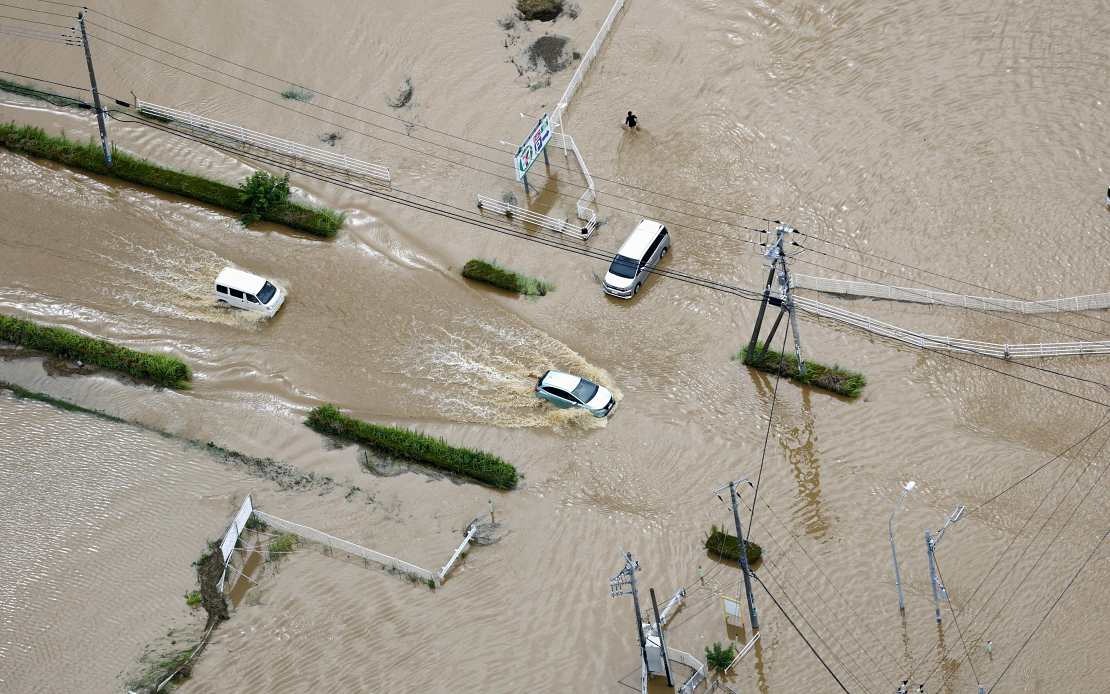
Japan's Chiba Prefecture faced a catastrophic weather event on Friday as unprecedented rainfall claimed eight lives across multiple municipalities and forced over 100,000 residents to evacuate their homes. The deaths were recorded in the cities of Chiba, Kashiwa, Ichikawa, Sakura and Yachiyo, while authorities reported four additional people sustaining minor injuries from the deluge that pounded eastern Japan through the early morning hours.
The scale of the rainfall shattered historical records for the region. According to the Japan Meteorological Agency (JMA), Chiba City itself received 348 millimetres of precipitation between midnight and 1.40 am on Friday—a volume representing roughly three times the municipality's typical total rainfall for the entire month of August compressed into just twelve hours. This exceptional concentration of water in such a brief timespan overwhelmed drainage infrastructure and natural water courses, creating dangerous flash flooding and debris flows across the prefecture.
Responseding to the severity of the situation, the JMA had issued its highest-level emergency warning for several areas within Chiba Prefecture, placing certain zones at Level 5 alert status for both heavy rainfall and landslide risk. This maximum alert classification signals imminent danger to life and property, prompting authorities to recommend immediate evacuation from affected zones. As conditions began to stabilize by Friday morning, meteorological officials downgraded these warnings to Level 4 or lower across the prefecture, though experts cautioned that additional significant rainfall remained possible.
The humanitarian toll extended beyond the confirmed fatalities. As of 11 am local time Friday, evacuation orders remained active for approximately 102,600 people scattered across Chiba Prefecture, representing a massive displacement of residents from their homes and communities. This large-scale evacuation reflects the unpredictable nature of the flooding and the continued concerns authorities held regarding further deterioration of conditions and potential secondary hazards such as additional landslides or structural collapses.
The disaster severely disrupted transportation networks across the region. Narita Airport, located within Chiba Prefecture, experienced major operational challenges as the intense rainfall and associated flooding paralyzed both train and bus services serving the facility. Approximately 7,000 passengers found themselves stranded overnight at the airport, unable to depart on scheduled flights or reach ground transportation. This disruption highlighted how extreme weather events in Japan's densely populated areas create cascading effects on critical infrastructure and commerce far beyond the immediate impact zone.
For Malaysian and Southeast Asian observers, this event carries particular significance given the region's own vulnerability to extreme precipitation events and flooding. Climate patterns affecting Japan's temperate zones increasingly mirror weather phenomena occurring across Southeast Asia, where monsoon systems and tropical storms regularly produce similar torrential conditions. The Japanese experience demonstrates both the challenges faced by even highly developed nations with advanced warning systems when confronted by unprecedented rainfall, and the importance of maintaining robust evacuation protocols and emergency response capabilities.
The response infrastructure mobilized in Japan underscores the scale of modern disaster management in developed economies. The rapid deployment of evacuation orders, the coordination between the JMA, local prefectural governments, and the Fire and Disaster Management Agency, and the ability to track real-time impacts across multiple affected cities all reflect institutional maturity in crisis response. However, the fact that eight deaths still occurred despite these systems demonstrates the inherent dangers posed by natural disasters that exceed historical precedent—a concern that should resonate with policymakers throughout Southeast Asia as climate variability increases.
The concentration of deaths across five separate municipalities suggests that the rainfall's impact was neither uniformly distributed nor easily predictable by location alone. Some areas experienced more severe flooding or landslide activity than others, indicating that even within a single prefecture, microclimatic conditions and local topography created varying degrees of hazard. This geographic variability complicates disaster response and evacuation planning, requiring authorities to make rapid decisions about which areas face the greatest immediate danger based on incomplete real-time information.
Authorities maintained public warnings about the possibility of further severe weather in the coming hours, urging residents and displaced persons to remain alert and follow official guidance. The downgrade from Level 5 warnings did not signal an all-clear situation but rather a moderation of the most extreme risk category. Weather officials emphasized that conditions remained dangerous and that additional rainfall could reignite flash flooding or trigger additional landslides in areas already saturated and destabilized by the initial deluge.
The incident highlights how climate change and increasing weather volatility are challenging historical baselines used for infrastructure design and emergency preparedness. Chiba City's previous August rainfall records became irrelevant when the actual precipitation tripled the monthly average in half a day. This reality forces Japanese planners and those throughout Asia to reconsider assumptions about what constitutes a "one-in-a-hundred-year" event and how to prepare for scenarios that shatter historical experience. For regional governments watching Japan's response and recovery, the lessons learned from this disaster will inform policy discussions about resilience, warning systems, and the need for adaptive management strategies in an era of intensifying extreme weather.

