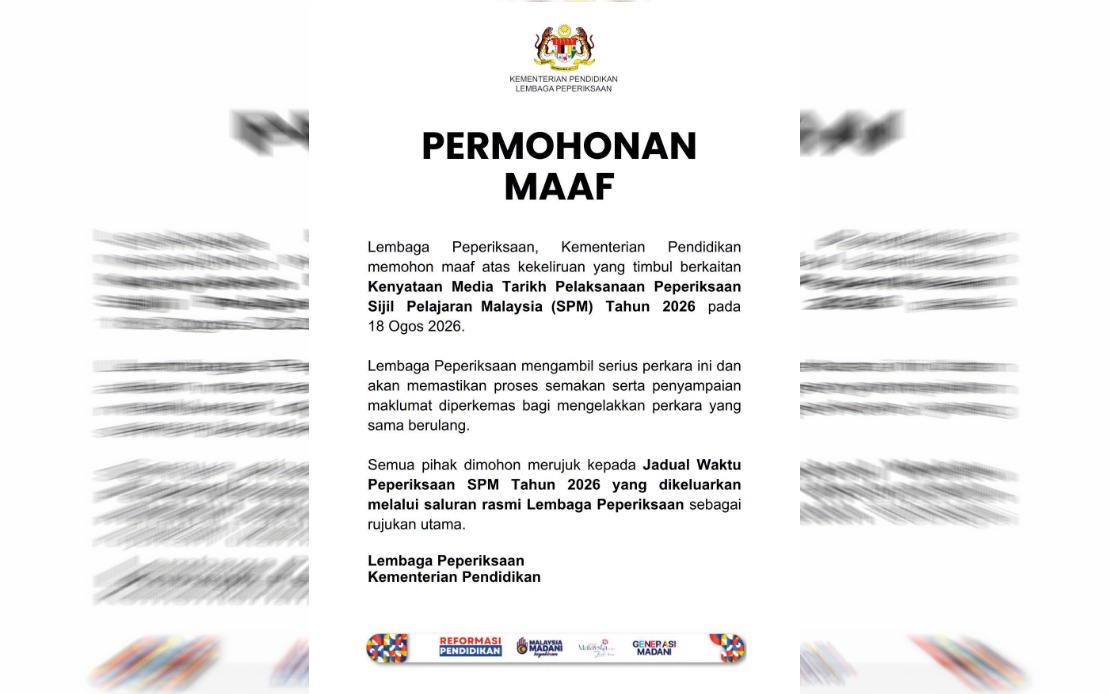
The Examination Board under Malaysia's Ministry of Education has issued an apology following confusion created by a press release distributed yesterday regarding the implementation dates for the 2026 Sijil Pelajaran Malaysia (SPM) examination. The board's clarification statement, released today in Kuala Lumpur, underscores the significance of maintaining clear communication channels when disseminating critical information affecting hundreds of thousands of students and their families across the nation.
In its official statement, the Examination Board acknowledged that the matter warrants serious attention and committed to reviewing its procedures for both internal verification and public communication. The board has pledged to implement streamlined processes designed to prevent similar instances of miscommunication in the future. This commitment reflects growing recognition within Malaysia's education administration that accurate and timely dissemination of examination schedules is fundamental to ensuring students can prepare effectively and institutions can organise resources appropriately.
The confusion appears to have stemmed from discrepancies or ambiguities in yesterday's press release, which prompted the board to issue a subsequent clarification today. Rather than allowing conflicting information to circulate, the board has directed all stakeholders to rely exclusively on the official 2026 SPM Examination Timetable distributed through its authorised channels. This approach aims to establish a single, authoritative source of reference that schools, students, parents, and education professionals can confidently consult.
The scale of the 2026 SPM examination underscores why clarity is essential. A total of 420,879 candidates have registered to participate in the examination, seated across 3,334 examination centres distributed nationwide. This represents a substantial cohort of Malaysian students whose educational progression hinges on their SPM performance. Any confusion regarding examination dates could disrupt study schedules, affect travel arrangements, and create unnecessary anxiety among candidates and their households.
The 2026 SPM examination is scheduled to commence on November 23 and conclude on December 17, spanning a period of approximately four weeks. This timeline allows the Examination Board to administer papers across multiple subjects while managing the logistics of coordinating activities at thousands of examination centres. Students and schools now have clarity regarding this timeframe, enabling them to structure their final preparation and revision schedules accordingly.
The incident highlights the broader challenges education systems face in managing communication across multiple layers of stakeholders. Information must cascade from the ministry through the Examination Board to state education offices, schools, administrators, and ultimately to students and parents. At each stage, the potential for misinterpretation or transmission errors exists. The board's commitment to streamlined information delivery processes suggests recognition that the current system may have contained inefficiencies or check-points that failed to catch the error before public dissemination.
For Malaysian schools, the clarification provides much-needed certainty as they begin planning their academic calendars and allocating resources for the final examination period. Teachers can now confidently schedule revision sessions and mock examinations within the confirmed timeframe. School administrators can coordinate with examination invigilators and arrange facilities without fear that the examination schedule might shift, which could disrupt other planned activities or examination centre arrangements.
Parents and students have equally significant reasons to appreciate the clarification. Malaysian families often arrange their schedules around SPM dates, particularly in cases where candidates require additional tuition or support. Some parents adjust work arrangements or plan family obligations around the examination period. The confusion created by yesterday's release could have prompted unnecessary adjustments or generated stress through uncertainty. The board's swift clarification mitigates these disruptions.
The incident also carries implications for public confidence in official education information channels. Education ministries and boards operate on the assumption that their communications will be received as authoritative and accurate. When errors occur, they risk eroding stakeholder trust and encouraging people to seek information through alternative, potentially unreliable sources. The board's decision to explicitly apologise and commit to process improvements attempts to rebuild confidence and reinforce the authority of official communication channels.
Moving forward, the Examination Board's stated review of its information delivery processes may yield practical changes. These could include implementing additional verification stages before releases are issued, establishing clearer internal approval workflows, or improving the coordination between different departments handling examination-related announcements. Such improvements would benefit not only the 2026 SPM administration but also future examination cycles and other education-related communications.
The situation also serves as a reminder that in Malaysia's devolved education system, where the federal Ministry of Education works alongside state education departments and thousands of schools, maintaining information consistency requires robust mechanisms and clear hierarchies of communication. The Examination Board's directive for all parties to refer to its official timetable as the primary reference represents an attempt to impose this clarity and prevent conflicting information from different sources.

