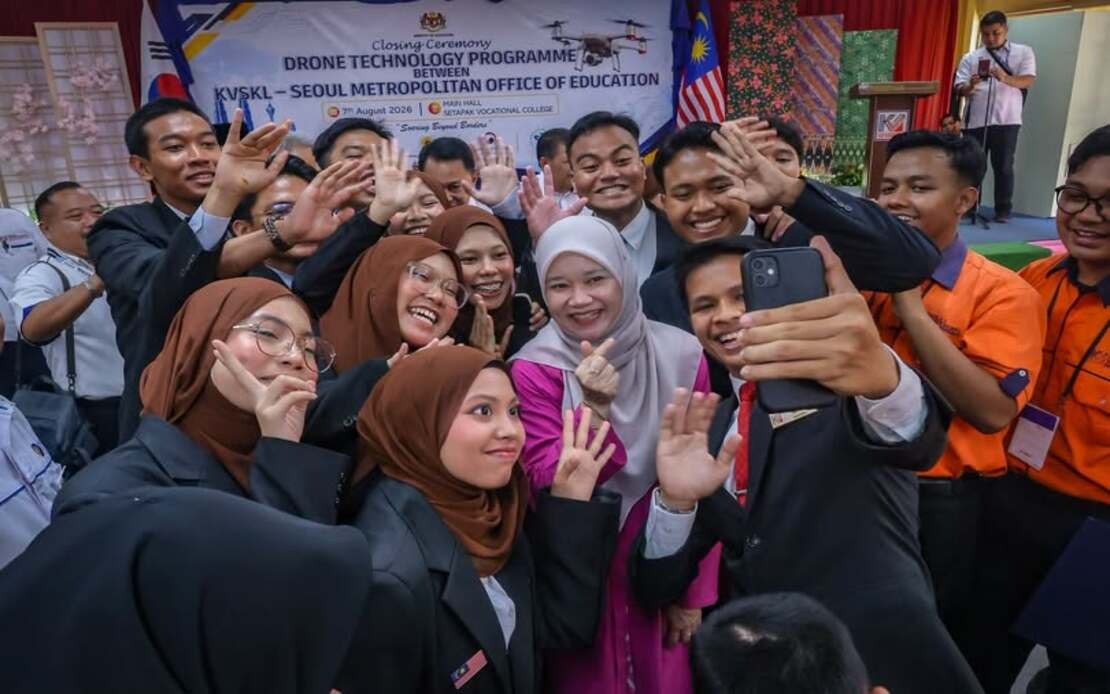
Education Minister Fadhlina Sidek has set an ambitious one-month deadline for students at Setapak Vocational College to devise practical applications of drone technology for enhancing campus security. The challenge, unveiled during a collaborative initiative with South Korea's Seoul Metropolitan Office of Education, reflects a broader push to transform vocational training from theoretical instruction into problem-solving innovation.
The initiative gained international dimensions with the presence of South Korean Ambassador to Malaysia Yeo Seung-bae, signalling how Malaysia is increasingly drawing on technological expertise from established East Asian innovation hubs. This partnership arrangement provides Setapak students with access to robotics and drone capabilities developed through Seoul's education programmes, creating a cross-border learning exchange that extends beyond traditional classroom boundaries.
Fadhlina's intervention highlights a critical gap in Southeast Asian vocational education: the distance between learning technical skills and applying them to solve tangible problems within local contexts. By explicitly tasking students with security applications rather than simply operating drones as an end in itself, the minister is attempting to reorient vocational training towards outcomes-based thinking. This approach aligns with global workforce trends where employers increasingly value problem-solving capacity alongside technical proficiency.
The one-month timeframe itself carries pedagogical significance. Rather than allowing indefinite project timelines, the compressed schedule forces students to prioritize efficiency, resource allocation, and decisive thinking—precisely the traits demanded in fast-moving technology sectors. For vocational institutions in Malaysia grappling with questions about curriculum relevance, such time-bound challenges offer a model for embedding real-world constraints into learning environments.
Fadhlina's reflection on student performance during the programme's demonstrations reveals an educational philosophy that valorizes persistence over perfection. Her observation that some students succeeded while others made mistakes, yet continued attempting tasks, underscores how modern skill development requires resilience in the face of technological failure. This framing is particularly important in Malaysia, where cultural education traditions sometimes emphasize avoiding mistakes rather than learning through them.
The broader context involves Malaysia's positioning within a rapidly evolving global economy where robotics, artificial intelligence, and autonomous systems are no longer futuristic concepts but immediate workplace realities. Vocational colleges that continue teaching yesterday's skills inevitably produce graduates mismatched to current labour market demands. By introducing students to drone technology and challenging them to innovate, Setapak Vocational College is attempting to compress the gap between education and employment relevance.
The security application focus holds particular resonance for Malaysian institutions. Campus safety remains a documented concern across educational facilities throughout Southeast Asia, making drone-based surveillance and monitoring genuinely relevant to the student experience. Unlike abstract technological exercises, the security challenge connects innovation directly to students' immediate environment, increasing motivation and ensuring they grasp practical constraints—power limitations, airspace regulations, integration with existing systems—rather than treating technology as divorced from operational reality.
Fadhlina's emphasis that education systems must keep pace with technological advancement touches on a fundamental challenge facing Malaysia's vocational sector. Training institutions across the country often operate with curricula updated on multi-year cycles, creating structural lag behind rapidly evolving industries. The challenge to Setapak students implicitly signals that institutions must develop more agile, responsive approaches to curriculum development, where student projects themselves become mechanisms for continuous technological updating.
The international dimension through the Seoul Metropolitan Office collaboration deserves closer examination. South Korea's transformation from a largely agricultural economy to a global technology leader within a single generation provides a compelling case study for Malaysian policymakers. The country's emphasis on integrating cutting-edge technology into vocational education from secondary level onwards has contributed to its competitive advantage. By facilitating such exchanges, Malaysia can access pedagogical innovations and technological access that might otherwise require substantially greater domestic investment.
For students at Setapak, the challenge carries significant implications beyond the immediate security project. Success could translate into portfolio credentials valuable for employment in emerging technology sectors, where demonstrated innovation experience often outweighs traditional qualifications. Additionally, the public nature of presenting proposals to the Education Minister elevates the project's stakes, potentially motivating deeper engagement than routine coursework typically generates.
The challenge also reflects evolving expectations about what vocational education should accomplish. Historically, such institutions focused on producing workers capable of executing defined tasks. Contemporary demands increasingly require graduates who can identify problems, propose technological solutions, and communicate complex ideas to non-technical stakeholders. The Setapak initiative, by requiring students to present proposals to a senior government figure, embeds communication and persuasion skills alongside technical capability.
Looking forward, the success or otherwise of this initiative could influence how other vocational institutions in Malaysia structure their programmes. If students generate genuinely implementable security solutions, it validates the approach and potentially creates momentum for similar challenge-based learning across the vocational sector. Conversely, if proposals prove impractical or lack feasibility, it will highlight the real constraints—budgetary, regulatory, technical—that separate interesting ideas from operational reality.
Ultimately, Fadhlina's challenge to Setapak students represents a small but symbolically significant effort to reorient Malaysian vocational education towards innovation-centred, outcomes-focused learning. In an era when technology changes faster than institutions can formally update curricula, such challenge-based approaches may prove essential for keeping educational institutions meaningfully connected to evolving workplace realities across the region.

