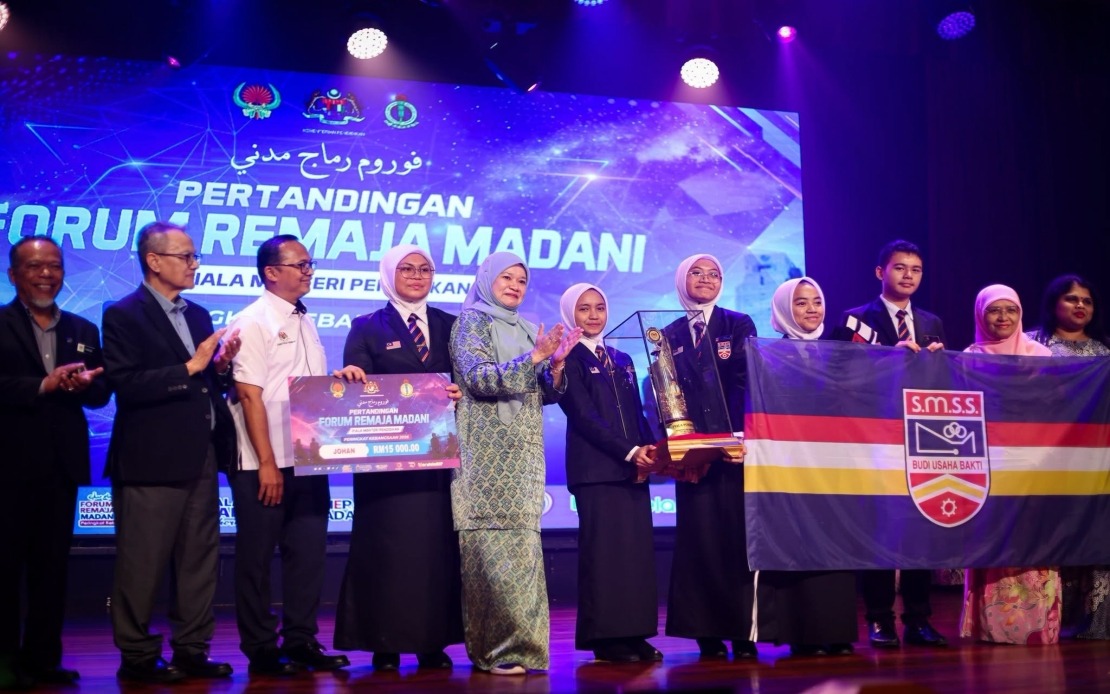
Education Minister Fadhlina Sidek has outlined a transformative vision for character education in Malaysia, arguing that developing confident and thoughtful citizens requires more than teaching children conventional notions of goodness. Speaking following observations at the National MADANI Youth Forum, Fadhlina stressed that the education system must create space for young people to express their perspectives openly while simultaneously developing the intellectual rigour and courtesy needed for meaningful civic discourse.
The minister's remarks reflect a broader rethinking of educational priorities in Malaysia. Rather than positioning character development as a mechanism for compliance or conformity, Fadhlina's approach suggests that genuine moral maturity involves cultivating the ability to articulate positions clearly, defend arguments with evidence, and maintain respect even when fundamental disagreements emerge. This framework acknowledges a reality that many Southeast Asian democracies are grappling with: that social cohesion depends not on universal agreement but on citizens' capacity to navigate disagreement constructively.
Fadhlina observed at the youth forum that participants demonstrated this emerging skillset, moving beyond passive acceptance of information to actively engaging with competing viewpoints. Young people were learning to consider alternative perspectives, challenge assumptions, and refine their own positions through dialogue—precisely the intellectual habits a functioning democracy requires. The minister characterised this development as central to the nation's future, suggesting that Malaysia's progress depends on nurturing a generation equipped to handle complexity and contestation.
Embedded within this vision is a significant pivot regarding the Malay language. Fadhlina emphasised that character education must be pursued alongside efforts to strengthen Malay as a medium of intellectual expression and public discourse. This dual commitment recognises that language capacity and critical thinking are intertwined: young Malaysians must not only think critically but possess the linguistic tools to articulate sophisticated arguments in their national language. The minister noted that Malay language usage strengthens when younger generations perceive it as capable of expressing their contemporary concerns and intellectual interests, rather than viewing it as merely ceremonial or historical.
The minister's comments implicitly acknowledge challenges within Malaysia's current educational landscape. Historically, Malaysian schools have sometimes prioritised obedience and standardised knowledge acquisition over inquiry and independent thought. By advocating for spaces where young people develop their own arguments and defend their positions, Fadhlina is signalling a departure from educational models that discourage questioning or position dissent as inherently problematic. This recalibration carries particular significance in a multicultural society where citizens must regularly engage across lines of ethnicity, religion, and ideology.
Fadhlina's distinction between a mature nation of universal agreement and one built by generations comfortable with disagreement deserves particular scrutiny. In plural societies like Malaysia, where citizens hold genuinely different values and interests, the ability to disagree without fracturing social bonds is not merely desirable but essential. The minister's formulation suggests that national resilience derives not from enforced consensus but from the quality of citizens' engagement across difference. This represents a significant statement about what Malaysia aspires to become.
The emphasis on courtesy alongside critical thinking addresses a practical concern facing many democracies. Online spaces and political discourse in Malaysia, as elsewhere in Southeast Asia, sometimes degenerate into personalised attacks and contempt rather than substantive engagement. Fadhlina's insistence that young people develop both intellectual rigour and the capacity to listen respectfully offers an antidote to this polarisation. It acknowledges that thinking critically does not require dismissing those who disagree or assuming bad faith in opposing views.
For educators and parents throughout Malaysia, Fadhlina's remarks suggest a reorientation of how character development should be approached in classrooms and homes. Rather than teaching children to conform to predetermined answers or accept established hierarchies without question, the approach she describes requires adults to facilitate young people's intellectual independence while modelling the respectful engagement that should accompany disagreement. This more demanding vision of character education requires teachers and leaders to tolerate greater uncertainty and ambiguity than traditional models.
The minister's comments also carry implications for how Malaysia positions itself regionally and globally. Southeast Asian nations are increasingly diverse, dynamic societies where young people encounter multiple worldviews and must navigate rapidly changing circumstances. An education system that produces citizens capable of critical analysis and respectful dialogue positions Malaysia competitively, equipping its youth with precisely the capabilities that knowledge economies and pluralistic societies demand. This represents an investment not just in individual development but in national capacity.
Implementing Fadhlina's vision will require sustained commitment and resources. Creating genuinely safe spaces for young people to express unpopular views, teaching educators to facilitate rather than control discourse, and developing assessment methods that value critical engagement rather than rote knowledge all represent significant shifts from established practices. The success of this initiative will ultimately depend on whether schools and communities embrace the risks and uncertainties inherent in allowing young people genuine intellectual agency.

