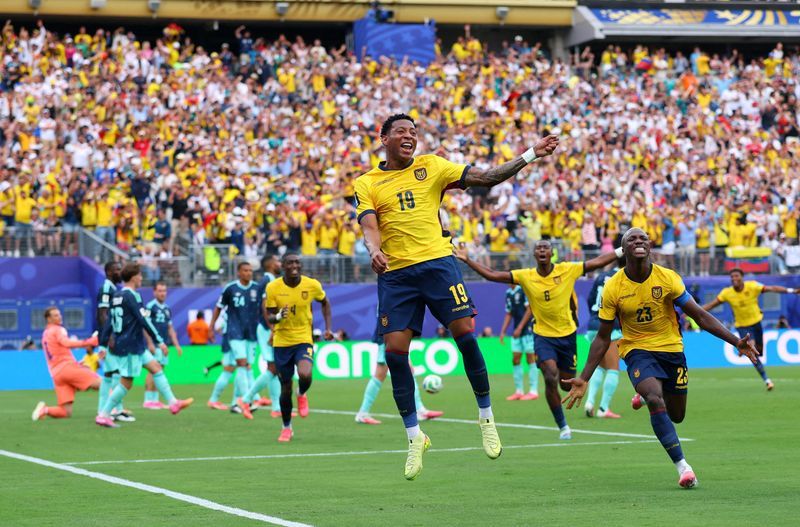
Ecuador engineered one of the tournament's most improbable comebacks on Thursday evening at the New York/New Jersey stadium, downing an already-qualified Germany 2-1 to dramatically salvage their World Cup campaign and claim a spot in the last 32. The South American side arrived at the match facing near-certain elimination after disappointing results against Ivory Coast and Curacao, yet turned their fortunes around with a resolute second-half performance that will be remembered as one of the competition's defining moments. The victory handed Ecuador qualification as one of the eight best third-placed teams, while Germany's defensive lapses meant they finished atop the group despite conceding in all three matches.
The match began disastrously for the underdog Ecuadorians when Leroy Sane capitalised within 120 seconds of kickoff, steering home a left-footed finish from the edge of the area after Florian Wirtz's incisive pass caught the South American defence flat-footed. For Sane, the goal represented a breakthrough at the major tournament level, arriving in his 15th appearance at such competitions. Ecuador's protests about a potential foul during the build-up—alleging that Aleksandar Pavlovic had struck Pedro Vite—proved futile as referee Tori Penso allowed the effort to stand, leaving the yellow-clad contingent in the stands facing the prospect of another scoreless tournament.
The early setback could have broken Ecuador's resolve, yet instead it sparked an immediate response that shifted the match's momentum. Nilson Angulo restored parity in the ninth minute when he collected possession at the edge of the penalty area and curled a beautifully-struck shot beyond goalkeeper Manuel Neuer, who appeared slow to react to the danger. This goal carried profound significance for Ecuador, ending a barren spell that had stretched across 39 previous attempts in the tournament without a goal. The breakthrough unleashed enormous celebrations among the Ecuador supporters who had travelled to New Jersey, providing the lift their team desperately required.
The second period brought fresh controversy when referee Penso awarded Germany a penalty after Felix Nmecha engineered possession for Kai Havertz, who tumbled under challenge from Joel Ordonez. However, the decision unravelled under VAR scrutiny, with officials determining that Germany had committed a foul during the build-up, thus overturning the spot-kick award. This sequence proved pivotal, denying the Germans an opportunity to extend their advantage when the match remained finely balanced and Ecuador's concentration was being tested.
With chances proving scarce thereafter, the decisive moment arrived in the 78th minute when Gonzalo Plata reacted quickest to a corner-kick situation. Substitute Kevin Rodriguez flicked the ball on at the near post, and Plata's instinctive finish past Neuer sent the stadium into pandemonium. The goal capped a remarkable turnaround for Ecuador, who had entered this final group encounter needing a victory—or conceivably a minor miracle—to remain alive in the competition. Instead, they achieved precisely what was required, silencing the German support and securing progression despite arriving as one of the tournament's lesser-fancied participants.
Germany's path through the group stage remained relatively straightforward in terms of mathematical qualification, as they had already secured top spot and were assured of knockout football before Thursday's encounter. Nevertheless, the defensive vulnerabilities that plagued their three group matches became uncomfortably apparent once more in this display. The four-time world champions had been chasing a 12th successive victory and a perfect record of three wins from three, yet their backline proved porous when Ecuador finally located their attacking rhythm. The concession of goals in all three group matches—despite the comfortable overall progress—raises questions about tactical discipline ahead of the knockout rounds.
Ecuador's qualification carries particular significance for South American football, demonstrating that even modest tournament entrants can manufacture remarkable performances when circumstance and desperation align. The team's earlier results suggested their World Cup adventure might end in disappointment, having registered a defeat to Ivory Coast and drawn with fellow minnows Curacao. However, their willingness to abandon caution against a superior opponent and press aggressively in open play proved rewarding, suggesting they possess qualities that might extend beyond the group stage if they avoid a prohibitively difficult knockout opponent.
Ivory Coast's 2-0 victory over Curacao confirmed their progression on goal difference alongside Germany, with the group ultimately shaped by these three nations' relative superiority over Ecuador. Yet the final standings somewhat obscure the South Americans' achievement in securing passage, having been written off by many observers before Thursday's match. Their subsequent knockout assignment will likely prove formidable, but the manner of their escape from elimination demonstrates resilience that could serve them well in the competition's later stages.
For Malaysia and Southeast Asian observers, Ecuador's revival offers a compelling narrative about tournament football's unpredictability and the margins separating success from failure at the highest level. The victory also underscores how tactical flexibility and desperation can sometimes overcome pre-match expectations and pedigree, lessons that resonate across world football. Germany's defensive frailties, meanwhile, suggest that even the tournament's established powerhouses remain vulnerable when concentration lapses, a reminder that knockout football remains wide open for any outfit capable of seizing opportunities when they arise.

