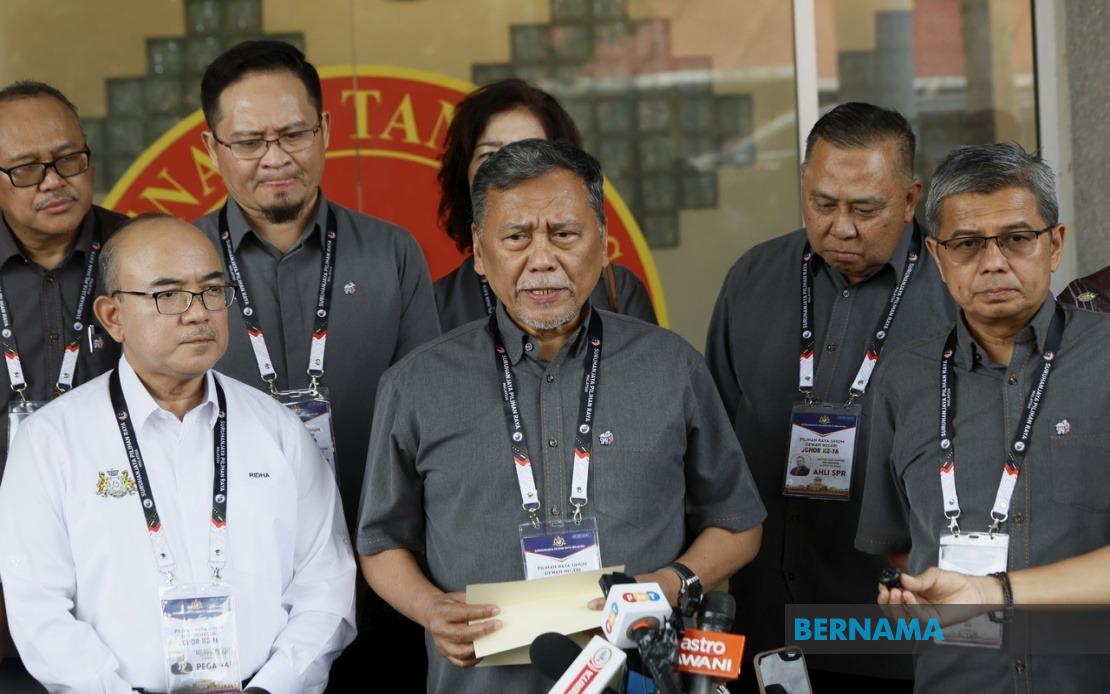
The Election Commission is banking on strong participation in early voting for the Johor state election, setting its sights on a 96 per cent turnout rate as the polling process unfolds across the state. Datuk Seri Ramlan Harun, the EC chairman, unveiled this ambitious target during a site visit to Kem Mahkota in Kluang, where he observed the mechanics of advance voting on July 7. The projection is grounded in the commission's track record with previous electoral contests, where early voting has consistently demonstrated such high engagement levels among eligible participants.
The infrastructure for early voting was substantial, reflecting the logistical complexity of conducting elections in Malaysia's southern state. Across Johor, 62 early voting centres were activated from 8 am, staggered to accommodate different schedules and operational requirements. The phased closure of these centres illustrated careful planning: 29 venues shut down at noon, five at 2 pm, and the remaining 28 at 5 pm. This approach acknowledged the varying needs of early voters, particularly the security forces and their families for whom these advance voting arrangements were primarily designed.
The voter pool for early voting revealed the deliberate structure of Malaysia's electoral system. A total of 20,607 electors participated in the advance voting process, drawn almost entirely from two categories integral to national security and governance. The Malaysian Armed Forces contingent, including spouses, comprised 8,544 voters, while personnel from the Royal Malaysian Police and their families accounted for 12,063 voters. This composition underscores how early voting mechanisms prioritise those with operational commitments that may prevent them from casting ballots on general polling day, ensuring that soldiers and police officers stationed across the state could still exercise their democratic rights.
Security and procedural integrity formed the backbone of the EC's planning. All early ballot boxes were to be transported to police stations immediately after voting concluded at each centre, where they would remain under guard until the official counting process commenced. This secure custody arrangement reflected the commission's commitment to protecting the sanctity of votes cast in advance, maintaining the chain of custody that underpins public confidence in electoral outcomes.
The schedule for revealing results demonstrated the EC's confidence in its operational capacity. Vote counting for early ballots would not begin until Saturday evening, commencing at 5 pm on general polling day itself. Despite this delayed start, the commission projected that complete results could be announced before midnight, with officials optimistically hoping to have provisional outcomes available by 10 pm. Such efficiency, if achieved, would provide Johor voters and the broader Malaysian public with timely clarity on the election outcome, minimising the period of uncertainty that typically follows state and federal polls.
Beyond the mechanics of early voting, the EC directed its messaging toward the broader electorate preparing for Saturday's main polling day. With 2.7 million ordinary voters eligible to cast ballots, Ramlan issued an appeal for robust participation across the state. His framing of voting as a civic responsibility and democratic opportunity reflected official rhetoric that emphasises the legitimacy conferred by high turnout, a concern particularly acute in Malaysian politics where participation rates carry symbolic weight.
The Johor state election represents a significant electoral event in Malaysia's political calendar, and the EC's logistical preparations underscore the commission's operational sophistication. By privileging early voting for security personnel, the electoral framework acknowledges practical realities while maintaining the principle of universal suffrage. However, the concentration of early voters among military and police contingents also raises questions about representational balance, as these voters constitute a distinct demographic with distinct interests and organisational structures that differ markedly from the civilian population at large.
The targeting of a 96 per cent turnout rate for early voters, while historically grounded, carries implicit assumptions about engagement levels that may warrant scrutiny. Whether such high participation truly reflects enthusiasm or whether it reflects the structured nature of voting within hierarchical organisations remains an open question. Nonetheless, the clear operational frameworks and security arrangements suggest that the EC has invested considerable effort in ensuring that those voting early can do so without impediment, setting conditions for the stated turnout projection to materialise.
As Johor voters approached Saturday's polling day, the early voting process served as a barometer of participation appetite and operational readiness. The results of early voting, once tallied alongside main polling day votes, would contribute to shaping Johor's political direction and potentially signal broader patterns in voter behaviour across Malaysian states. The EC's projections and procedures, while procedurally sound, would ultimately be validated only when actual participation data became available, transforming targets into measurable outcomes that either affirmed or challenged the commission's confidence in the electoral machinery.

