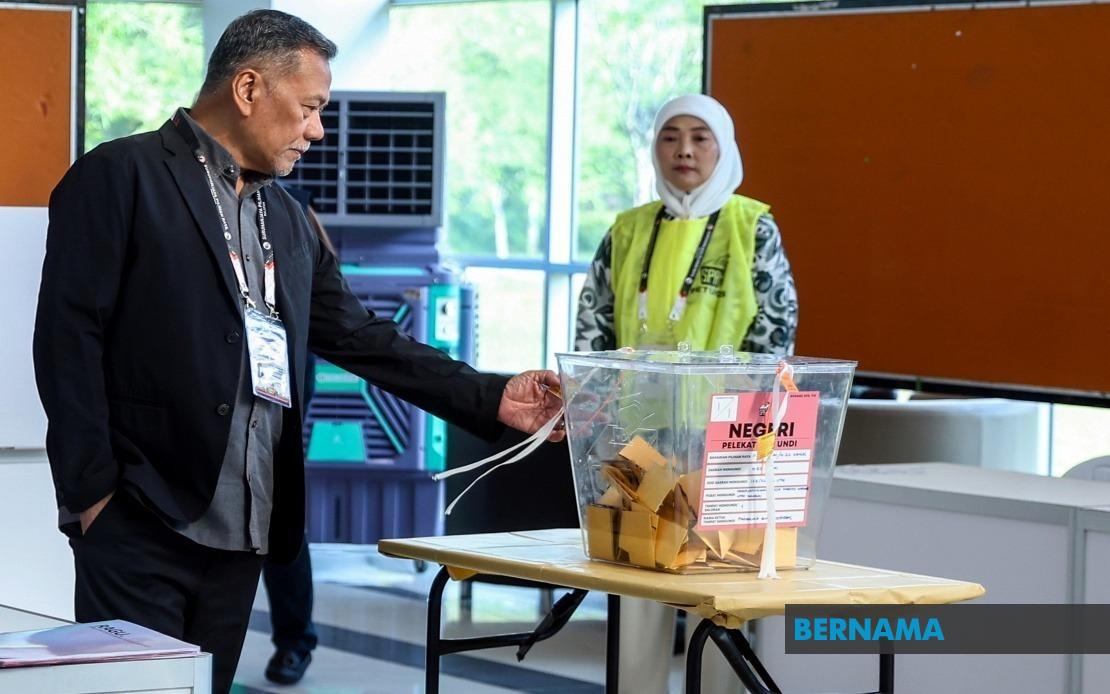
Datuk Seri Ramlan Harun, the Election Commission chairman, made a series of unannounced visits to polling centres across Johor Bahru on July 11, conducting a hands-on inspection of the voting process during the 16th Johor state election. The tour demonstrated the commission's commitment to maintaining electoral integrity by directly observing operations in real time across multiple constituencies, reflecting protocols designed to ensure transparency and accountability during crucial polling days.
Ramlan's inspection began at the Dewan Raya Taman Ungku Tun Aminah polling centre, which served voters in the Skudai constituency. The venue, equipped with seven polling streams, received the chairman's attention at approximately 8.50 am, allowing observation of the initial momentum of the voting day. This early-morning visit provided insight into how election officials managed the flow of voters and maintained procedural compliance during the critical opening hours when operational patterns are established for the entire day.
The inspection itinerary then proceeded to the Raja Zarith Sofiah Library located within Universiti Teknologi Malaysia's campus, which managed voting for the Senai constituency. With two polling streams, this venue presented a different operational scale compared to the first centre, offering the chairman an opportunity to assess how election officials adapted procedures to accommodate a university setting and managed logistics in an institutional environment where student and staff voters converged.
Subsequently, Ramlan visited Sekolah Agama Taman Bukit Mewah in the Kempas constituency, which operated six polling streams. This school-based polling centre represented the traditional approach to establishing voting venues, allowing inspection of how educational facilities were repurposed to serve electoral functions while maintaining security and voter confidentiality in a community-focused setting.
The final stop on the inspection circuit was Sekolah Menengah Kebangsaan Bandar Uda Utama, serving the Perling constituency with nine polling streams—the largest configuration among the visited centres. This venue's expanded capacity required more complex coordination of election personnel and voter management, presenting the most substantial operational challenge among the four locations examined during the tour.
During each visit, Ramlan received comprehensive briefings from election officials stationed at the centres. These discussions covered the mechanics of the voting process, including how registration procedures were executing, ballot distribution protocols were functioning, and voting booths were maintaining privacy standards. The chairman's direct engagement with ground-level staff provided firsthand understanding of operational challenges and successes rather than relying solely on administrative reports.
Beyond procedural elements, the inspection encompassed assessment of physical facilities available to both voters and election personnel. Ramlan examined whether polling venues provided adequate seating for elderly voters, accessible arrangements for persons with disabilities, comfortable working conditions for poll workers conducting long shifts, and sufficient sanitation facilities. These facility inspections reveal the commission's attention to voter experience and worker welfare, recognising that election quality extends beyond procedural correctness to encompass dignity and accessibility for all participants.
The multiple constituencies visited—Skudai, Senai, Kempas, and Perling—represented geographically dispersed areas across Johor Bahru, suggesting the chairman's intention to gain a representative sample of polling conditions rather than concentrate observations in a single region. This distribution allowed assessment of whether electoral standards remained consistent across different parts of the city and whether venue-specific challenges emerged in particular constituencies.
Such high-level inspections during active polling carry symbolic significance beyond their practical monitoring function. The presence of the Election Commission chairman on polling day reinforces public confidence that electoral processes receive sustained scrutiny from leadership, signalling institutional commitment to fair and orderly elections. For Malaysian voters and observers, these visible inspections contribute to perceptions of electoral credibility, particularly important in a democratic context where public trust in institutions directly influences civic participation.
The inspection also served operational purposes, enabling the chairman to identify any emerging problems requiring immediate intervention or future procedural refinement. Early detection of issues—whether related to voter management, staff training implementation, or facility adequacy—allows real-time correction and informs post-election assessments for continuous improvement in electoral administration.
Ramlan's visit to multiple polling streams across different constituency types and venue configurations demonstrated recognition that election quality depends on consistent application of standards across diverse operational contexts. Schools, university libraries, and community halls operate under different environmental constraints and management structures, yet each must deliver equivalent standards of security, privacy, and procedural integrity.
The scheduled press conference following the inspection tour indicated the Election Commission's intention to communicate findings to media and public, maintaining transparency about election day operations. Such briefings allow the commission to address concerns, highlight positive developments, and provide authoritative information about the conduct of voting, helping shape public narrative around electoral legitimacy during a critical moment when results remain pending.

