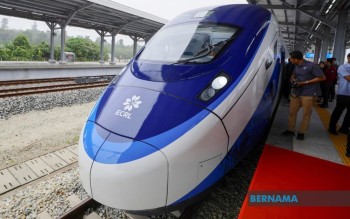
The East Coast Rail Link (ECRL) represents far more than a transportation infrastructure project for Malaysia's eastern states—it is shaping up to be a transformative economic catalyst that could fundamentally reshape how businesses operate and compete across the region. Deputy Minister of Economy Datuk Mohd Shahar Abdullah articulated this broader vision, emphasizing that the ECRL's true value lies not merely in connecting cities through modern rail networks, but in constructing an integrated economic ecosystem that will support businesses at every stage of their operations, from supply chain management to final delivery.
The project's impact will extend well beyond the immediate logistics sector. The development framework anticipates the emergence of a comprehensive business landscape encompassing construction services, operational support, and ongoing maintenance activities that will generate sustained employment and contractual opportunities for years to come. This layered approach to infrastructure development represents a departure from traditional transport-focused projects, instead embedding economic development directly into the infrastructure's DNA. As Mohd Shahar explained, the ECRL will catalyze the creation of specialized commercial zones, including modern warehouse facilities and designated industrial parks that will serve as nodes of economic activity along the entire corridor.
The geographical scope of this opportunity is substantial. The rail line will traverse four states—Pahang, Terengganu, Kelantan, and Selangor—each with distinct economic characteristics and business sectors. This multi-state connectivity opens unprecedented possibilities for regional trade. Entrepreneurs currently constrained by geographic limitations or prohibitively expensive logistics costs will suddenly gain access to consumer bases and commercial partners previously beyond their reach. The impact on small and medium enterprises could be particularly pronounced, as these businesses typically operate with tighter margins where transportation costs represent a significant operational burden.
Reduced logistics expenses and accelerated delivery timeframes will fundamentally alter the competitive dynamics within the region. Smaller manufacturers and traders will be able to serve larger geographic markets without the cost disadvantages that have historically limited their expansion. As Mohd Shahar illustrated, the difference between a business producing 10,000 units and one producing 20,000 units is not merely quantitative—it fundamentally changes unit costs and pricing competitiveness. With access to expanded markets via the ECRL, companies will achieve production volumes that generate economies of scale, enabling them to offer more competitive pricing while maintaining healthier profit margins. This virtuous cycle of growth and efficiency gains could catalyze rapid business expansion across the East Coast.
The tourism sector stands to benefit substantially from improved transport connectivity. Enhanced rail access will make East Coast destinations more attractive to domestic and international visitors, driving traffic increases that will create ripple effects throughout local economies. Food vendors, handicraft producers, and artisanal manufacturers—particularly those creating distinctive regional products like batik—will find their customer base expanding dramatically. Tourism-dependent economies thrive on visitor volumes, and the ECRL's ability to facilitate easier travel to these states should generate measurable boosts in tourist arrivals and spending patterns.
However, Mohd Shahar's cautionary remarks warrant serious consideration from the business community. Simply having access to new markets and improved transport infrastructure does not guarantee commercial success. Entrepreneurs must fundamentally rethink their operational strategies, moving beyond traditional business models that may prove inadequate in a more competitive, digitalized environment. The businesses that thrive in the post-ECRL landscape will be those that embrace technological innovation—from supply chain management systems to digital marketing and e-commerce platforms. Those that cling exclusively to conventional approaches risk finding themselves outpaced by more adaptable competitors.
The current project timeline suggests these opportunities are not distant aspirations. The Pahang section of the ECRL has reached 97.33 per cent completion as of the reporting period, while the overall megaproject had achieved 93.66 per cent progress by April, with a targeted completion date in December. This advanced stage indicates that the practical benefits outlined by government officials are transitioning from theoretical projections to imminent reality. Communities and business operators along the route should be actively preparing to capitalize on these incoming opportunities.
For Malaysia's broader economic strategy, the ECRL represents a critical investment in regional rebalancing. The East Coast has historically lagged more developed western states in terms of economic diversification and business dynamism. By creating a modern transport backbone and enabling the emergence of logistics hubs and industrial clusters, the ECRL addresses a fundamental infrastructure constraint that has limited regional development. The project demonstrates how strategic infrastructure investment can unlock latent economic potential that exists but remains constrained by geographic and logistical barriers.
The implications extend beyond the immediate ECRL corridor. Improved East Coast connectivity will influence supply chain decisions across Malaysia and the broader region. Manufacturers will reconsider their operational bases and distribution strategies. Warehousing operators will identify new sites along the rail route. Service providers will establish branches in secondary cities that suddenly become economically viable locations. This cascading effect of infrastructure development creating new business geography is a hallmark of transformative transport projects.
For entrepreneurs contemplating how to position themselves for this transition, the message is clear: preparation is essential. Those who begin now to modernize their operations, digitize their business processes, and develop strategies to access expanded markets will be well-positioned when the ECRL opens. Conversely, businesses that delay adaptation risk discovering that infrastructure improvements alone cannot overcome organizational inertia or operational inefficiency. The ECRL creates the conditions for growth, but businesses must create the capabilities to seize it.

