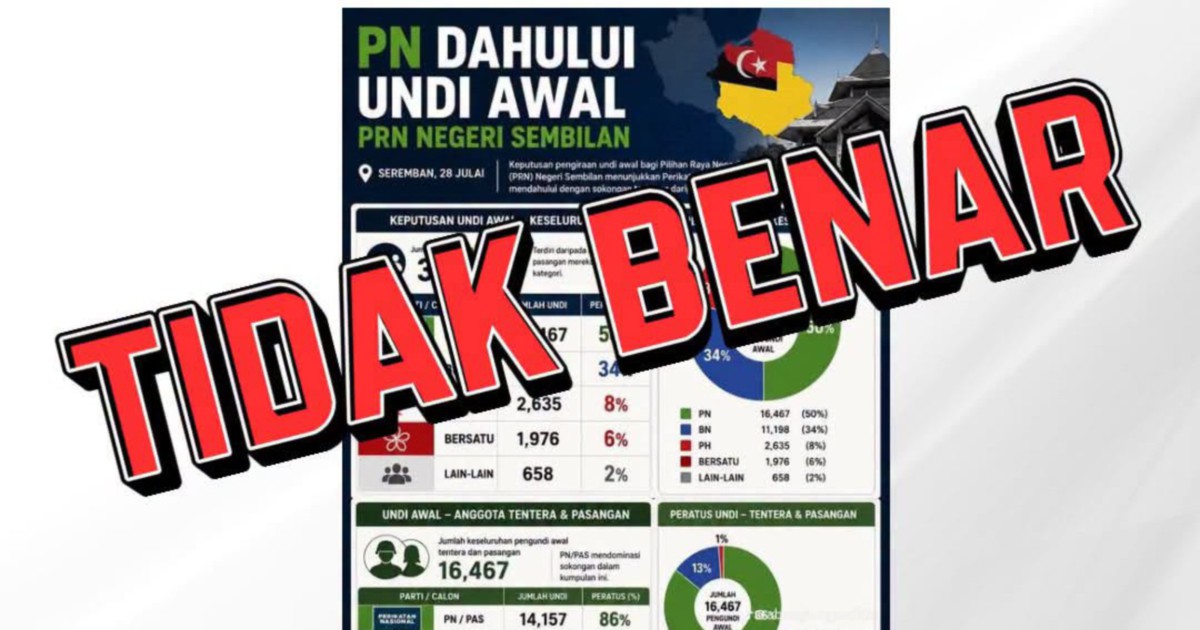
The Election Commission has formally announced that early votes cast for the 16th Negeri Sembilan state election will be counted beginning at 5pm on Saturday, establishing a clear timeline for the initial phase of the tallying process. The announcement, made in Seremban on Wednesday, comes as the election machinery prepares for the crucial vote-counting phase that will give voters and political parties their first insight into electoral momentum following the completion of polling.
This timeline is significant for several reasons. Early voting procedures, which allow certain categories of voters including election officials, security personnel, and those unable to vote on election day to cast their ballots in advance, represent an important barometer of voter sentiment. The concentrated counting schedule also allows election observers and party representatives to monitor the process closely, lending credibility to the overall electoral procedure.
The decision to set 5pm as the counting start time reflects administrative scheduling considerations, as it allows the Election Commission to conduct final preparations and verification of early voting materials throughout Saturday morning and afternoon. This methodical approach ensures that all procedural requirements are met before the tallying commences, minimising the risk of administrative errors that could undermine the integrity of the count.
The Election Commission's announcement also served to address misleading information circulating on social media platforms. False claims had emerged suggesting that Perikatan Nasional was already leading in preliminary results, allegations that the commission swiftly and categorically denied. Such misinformation poses genuine risks to public confidence in electoral processes, potentially influencing voter behaviour and creating unnecessary anxiety among political participants.
This type of disinformation is not uncommon in Malaysian electoral cycles, as various political actors seek to influence narrative and momentum in the lead-up to and during voting periods. The deliberate spread of fabricated electoral results, even as preliminary claims, represents a coordinated effort to shape perception of contest outcomes before legitimate tallying can occur. The Election Commission's proactive response underscores its commitment to ensuring that only verified, official information emanates from authorised counting centres.
The early vote counting process serves multiple constituencies beyond simple result announcement. Party observers positioned at counting centres gain real-time understanding of demographic voting patterns and regional performance, information that becomes strategically valuable for understanding the broader electorate. Media organisations depend on accurate, timely reporting of these counts to provide Malaysian voters with informed analysis of what results might indicate about the election's trajectory.
For Negeri Sembilan voters and observers, the Saturday afternoon count offers the first concrete data point about electoral sentiment in a state election that carries implications beyond Seremban. Results in this 16th state election may signal broader trends in Malaysian politics and voter preferences, particularly regarding the strength of various coalitions and the effectiveness of campaign messaging across different voter demographics.
The Election Commission's firm stance on timing and its explicit rejection of false claims demonstrate institutional mechanisms designed to protect electoral integrity. In an era of rapid information dissemination through digital channels, authoritative bodies must actively counter misinformation with verified facts and transparent procedures. By clearly communicating when official results will be available and categorically denying false claims, the commission provides voters with reliable reference points.
The Negeri Sembilan state election represents one in a series of electoral contests that have characterised Malaysian politics in recent years, each contributing to evolving patterns of coalition politics, voter alignment, and regional preferences. The early vote count on Saturday will provide election analysts and political observers with preliminary indicators that may prove instructive for understanding the state's electoral dynamics and how voters in this crucial peninsular state are responding to current political circumstances and party offerings.
As polling day approaches, maintaining public trust in electoral processes becomes increasingly paramount. The Election Commission's clear communication about counting procedures and its rapid response to false information serve this essential function, reassuring stakeholders that Malaysia's electoral framework operates with proper oversight and transparency. These institutional practices, while sometimes overshadowed by campaign drama and political rhetoric, form the quiet backbone of democratic legitimacy.

