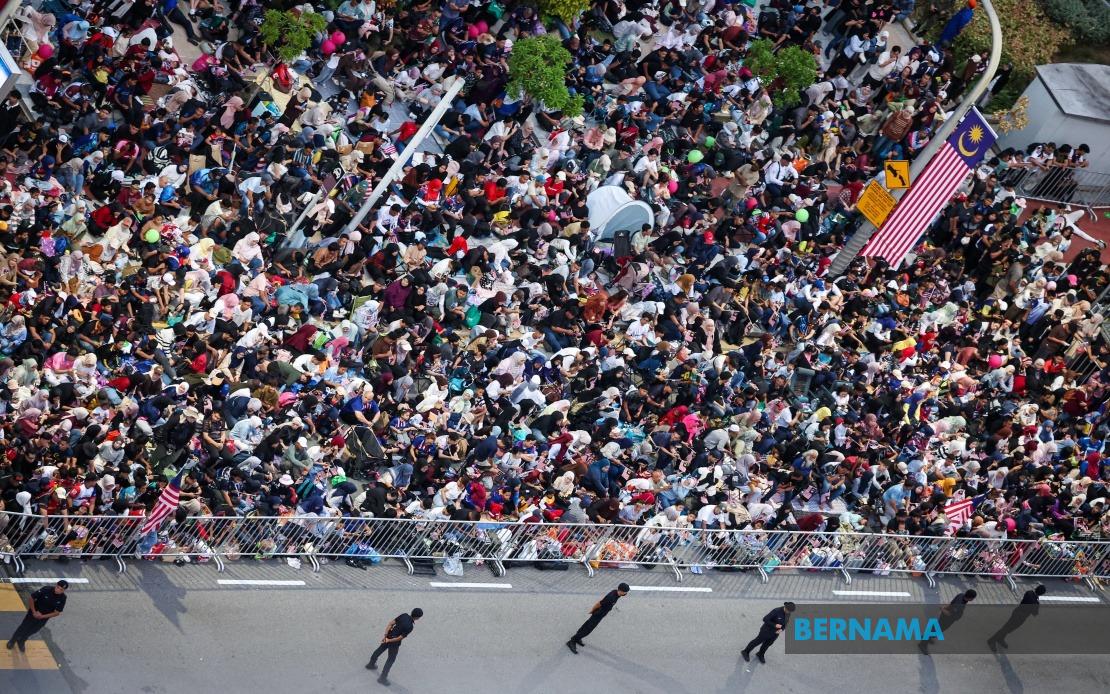
Anticipation for Malaysia's 69th National Day drew crowds to Dataran Putrajaya well before dawn, as members of the public staked out premium vantage points along the parade route. Beginning their vigils from late evening the previous day, many visitors chose to spend the night at the venue rather than risk missing out on ideal positions to witness the festivities scheduled to commence at 8 am. The theme for this year's celebration, "Malaysia MADANI: Kesejahteraan Dinikmati," had captured public imagination sufficiently to motivate these advance arrivals, underscoring the enduring appeal of National Day as a unifying national occasion.
The gathering included visitors of diverse motivations and backgrounds. Among the early arrivals were young creatives leveraging the significant national event as an opportunity to hone their craft. Mock Wei Qi, a 23-year-old freelance photographer, and his circle of friends positioned themselves at the venue from 11 pm the previous evening, driven by professional ambition and a desire to produce distinctive visual content. Rather than viewing the National Day parade merely as a spectacle to enjoy, Mock and his colleagues approached it as a canvas for demonstrating Malaysia's distinctive character through their lenses, hoping to share compelling imagery of the nation with a global audience.
For Mock Wei Qi, the National Day celebration represented more than just another event to document. He articulated a deliberate intention to capture footage that would authentically reflect Malaysia's exceptional qualities, seeing the occasion as an ideal testing ground for his cinematography and photography capabilities. This perspective mirrors a broader trend among younger Malaysians who increasingly view national occasions as opportunities for creative expression and professional development, rather than solely as ceremonial observances.
Families similarly prioritised early arrival to maximise their viewing experience. A couple identifying themselves as As and Adib made the decision to arrive by 5 pm the previous day, bringing their children along with determination born from previous disappointment. Their experience the prior year—arriving too late and consequently watching proceedings from a considerable distance—had prompted them to restructure their approach. This time around, they were resolved to position themselves considerably closer to the main parade area, transforming a practical objective into a family outing that promised substantially enhanced enjoyment for all participants.
The family-oriented dimension of early arrivals extended to Ahmad Azri Onn, a 55-year-old visitor who attended alongside his wife and three offspring aged between 10 and 15. Rather than conceptualising the overnight wait as merely an inconvenience to endure, Ahmad Azri reframed the extended stay into an informal camping adventure for his family unit. Having arrived at approximately 5.30 pm the previous evening, his family secured a favorable viewing position while simultaneously creating what he characterised as a recreational experience, particularly valuable during the school holiday period when such activities take on heightened significance.
Weather considerations, often a potential deterrent for outdoor overnight stays, presented minimal obstacles for these determined attendees. Ahmad Azri noted that meteorological conditions actually proved advantageous for his family's comfort. Light drizzle that occurred the previous evening, rather than creating discomfort, actually provided welcome relief from the tropical heat characteristic of Putrajaya, enabling his children to remain comfortable throughout their extended vigil. This observation reflects the pragmatic resilience of Malaysian event-goers who have grown accustomed to managing tropical weather patterns as routine aspects of public gatherings.
The gradual accumulation of visitors throughout the morning transformed Dataran Putrajaya into an increasingly populated venue as the celebration's scheduled commencement drew nearer. The steady flow of arrivals created a building sense of anticipation and collective purpose, as thousands of Malaysians converged on the nation's administrative capital to participate in this quintessential national observance. The diversity of attendees—ranging from professional content creators to multigenerational families—underscored the broad appeal of National Day celebrations across different demographic segments.
The phenomenon of early arrivals and overnight camping at Dataran Putrajaya reflects deeper patterns within Malaysian civic participation. National Day continues to function as a significant moment for identity affirmation and national solidarity, drawing individuals across age groups and professional backgrounds. The willingness of families to sacrifice sleep and comfort, coupled with young creatives' investment of their time and skills, demonstrates the occasion's continued resonance as a marker of national belonging and pride.
From a practical perspective, the overnight gatherings also reflect the high premium placed on optimal viewing experiences at major national events. With limited premium positions available along the parade route, the early-arrival strategy represents a rational response to competition for these scarce vantage points. This competitive dynamic has effectively become institutionalised, with experienced attendees recognising that substantial advance positioning is necessary to secure desirable spots, thereby encouraging the increasingly early departure of visitors from their homes.
The scale of public engagement demonstrated by these overnight encampments carries implications for event management and crowd coordination. The concentration of large numbers of people in defined areas, sustained over extended periods, requires comprehensive planning regarding sanitation facilities, safety measures, and crowd flow management. Authorities managing Dataran Putrajaya must balance facilitating public participation and access to prime viewing areas whilst maintaining orderly conditions and public safety throughout the extended gathering period preceding the formal ceremony.

