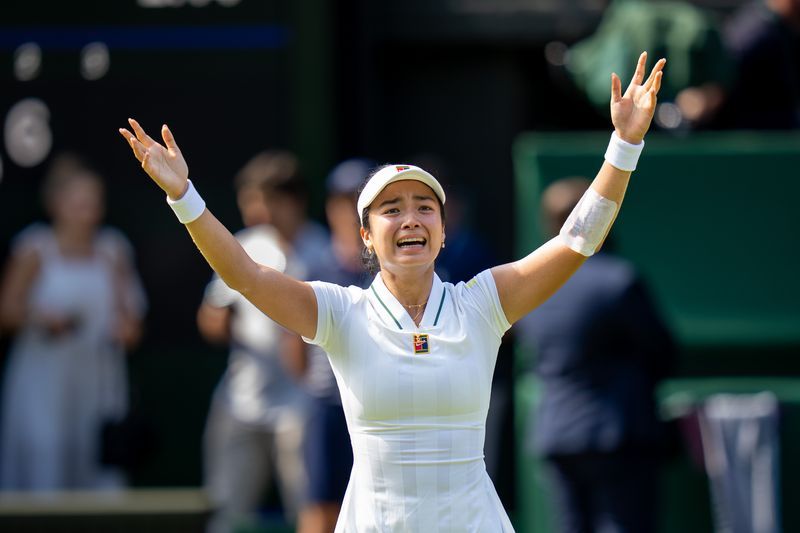
Philippine tennis has reached a watershed moment. Alexandra Eala, seeded 29th at Wimbledon, conquered defending champion Iga Swiatek on Saturday with a composed 7-6(9) 6-2 victory that will resonate far beyond the All England Club. The 26th-ranked Filipino became the first player from her nation to advance to the fourth round of a Grand Slam tournament, a barrier-breaking achievement for Southeast Asian tennis on the sport's most prestigious stage.
Eala's triumph was built on a foundation of composure and tactical acumen that belied her relative inexperience at this level. The first set alone lasted nearly 90 minutes, a grinding battle of serves and strategic groundstrokes that saw her save a set point in the opening-set tiebreak when Swiatek netted a forehand. Rather than wilting after that reprieve, the Filipino accelerated through the second set, breaking clear decisively to seal a famous victory. Her post-match emotion was genuine but measured—speaking to the Centre Court crowd in English and Tagalog, she explained that growing up in the Philippines, training daily with her brother and grandfather in childhood, this moment represented everything to her. Yet she tempered the sentiment by declaring herself unsatisfied and focused entirely on her next opponent, 13th seed Jasmine Paolini, the 2024 runner-up.
Swiatek's defeat represented far more than a single tournament upset. The Polish three-time Grand Slam champion has struggled visibly this season, and her loss to Eala compounds mounting frustration. After the match, Swiatek revealed the psychological toll of chasing results, telling reporters that her obsession with outcomes had become counterproductive. She departed the grounds with visible dejection, a stark contrast to Eala's radiant energy. For Malaysian and Southeast Asian fans, Eala's breakthrough carries symbolic weight—tennis remains dominated by European and North American players, making regional representation at this level exceptionally rare and meaningful.
The women's draw experienced seismic disruption beyond Swiatek's elimination. Elena Rybakina, the 2022 Wimbledon champion and second seed, crashed out to Belgian Elise Mertens in straight sets, 7-6(4) 6-1. Rybakina had arrived at Wimbledon having won the Australian Open earlier this year, doubling her Grand Slam tally and positioning herself for a potential world number one ranking if she had reached the quarter-finals. Instead, she collapsed after a competitive first set, losing the second set in just 23 minutes. The defending champion's disappointing performance demonstrated that even the sport's elite can suffer sudden, inexplicable lapses, particularly on grass where consistency matters enormously. Mertens advanced to the last 16 for the fourth time in her career, her baseline aggression proving too demanding for Rybakina's typically assured game.
The American presence at Wimbledon remained formidable despite Serena Williams' withdrawal from doubles on her nation's Independence Day. Williams, returning to competitive tennis after a four-year absence, had already exited the singles draw following a loss to Maya Joint. Her withdrawal from the eagerly-anticipated doubles partnership with sister Venus due to injury was disappointing for spectators but strategically prudent given her comeback status. However, the American contingent compensated with strong performances elsewhere. Madison Keys, the 26th seed, delivered the day's marquee upset by defeating sixth seed and last year's runner-up Amanda Anisimova 3-6 6-2 6-3. Keys, riding momentum from winning the Eastbourne title the previous week, dominated the American confrontation on Centre Court with sustained aggression and serve reliability. Qualifier Ashlyn Krueger cruised past Ukraine's Daria Snigur 6-3 6-2, though 23rd seed Emma Navarro fell to Ukraine's Marta Kostyuk in three sets.
By contrast, the men's draw remained largely predictable. Second seed Alexander Zverev, fresh from his French Open triumph, overcame American Marcos Giron 6-2 7-6(4) 6-4, maintaining his impressive Wimbledon trajectory without surrendering a set. The German's consistent performance stands as a cautionary reminder that even seeded players, having just won a Grand Slam, frequently sustain their excellence at subsequent tournaments when grass-court preparation has been thorough and mental freshness remains intact.
Italy harbored extraordinary aspirations entering Saturday's matches. With defending champion Jannik Sinner already advanced, the Italians sought to place four men in the last 16 for the first time since 1947. That ambition faced immediate pressure when ninth seed Flavio Cobolli, the French Open runner-up, fell into a 0-6 hole against Russia's Karen Khachanov. Rather than surrendering, Cobolli displayed remarkable resilience, storming back in five sets 0-6 7-6(4) 6-7(5) 6-2 6-2 to keep Italian hopes alive. He will next face Australian Alex de Minaur, who dispatched American Zachary Svajda 6-2 5-7 6-2 6-4. However, sixth seed Lorenzo Sonego's defeat to American Taylor Fritz 4-6 6-3 6-4 7-6(5) complicated Italy's bid to achieve that historical benchmark, leaving Matteo Berrettini's late-evening clash against Grigor Dimitrov on Centre Court as potentially decisive for the Italian contingent's fourth-round representation.
Beyond the principal matches, Arthur Fery delivered one of Saturday's most emotionally stirring performances. The British player's comeback victory against Belgium's Zizou Bergs on a raucous Court 18 produced the longest match of the tournament, concluded via deciding-set tiebreak. Fery trailed by two sets to one and faced double-break deficit at 1-4 in the fifth set yet refused capitulation, scrambling back with characteristic British resolve despite suffering three nosebleeds during the exhausting encounter. His gutsy performance exemplified the unpredictability that makes Wimbledon compelling—raw determination occasionally overcomes technical disadvantage when willpower remains uncompromised.
For Malaysian sports enthusiasts, Eala's ascension offers inspiration precisely because she succeeds in an environment where Southeast Asian representation remains sparse. Her Tagalog motto—etched on her cap and translating as "once it grows, it cannot be stopped"—encapsulates both her personal philosophy and a broader regional aspiration. Tennis development across Southeast Asia historically lagged far behind established European and North American programs, yet Eala's progression through Wimbledon's rounds demonstrates that sustained training, family support, and unwavering commitment can overcome geographic and infrastructural disadvantages. Her fourth-round matchup against Paolini will prove significantly more challenging, yet Eala's breakthrough has already altered regional perceptions of what Southeast Asian players might achieve at tennis's highest level.
The tournament's narrative arc remains fluid. With Swiatek and Rybakina eliminated and unexpected challengers like Eala and Keys advancing, the women's bracket has lost its predictability. Established players must suddenly navigate opponents who possess nothing to lose and everything to prove—a dynamic that often produces tennis of startling quality and emotional resonance. For Malaysian readers following international women's tennis, the competition has genuinely opened, creating narrative tension that extends far beyond grass-court technicalities into questions of mental resilience, national pride, and sporting breakthrough.

