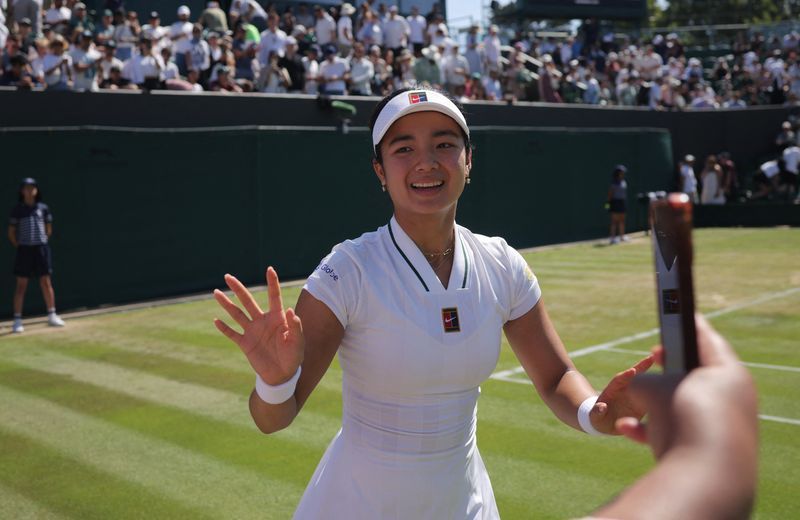
Alexandra Eala etched her name into Philippine sports history on Thursday when she became the first player from the Philippines to advance to the third round of Wimbledon. The 21-year-old from Quezon City delivered a commanding comeback performance against Australia's Maya Joint, winning 3-6 6-2 6-0 at the All England Club in London. The dramatic turnaround—from losing the opening set to dominating the final two frames—showcased both her technical prowess and mental resilience on the grass courts where she has flourished in recent months.
The milestone represents a watershed moment for Philippine tennis on the world's grandest stage. In an era when Southeast Asian representation at major Grand Slams remains limited, Eala's progression carries particular significance for a nation with a passionate but underrepresented tennis community. Her presence in the third round signals that Philippine athletes can compete at elite levels when given the right support structures and opportunities, a message that resonates beyond sport.
Eala's victory came with layered personal meaning. Inscribed on the back of her sun visor at Wimbledon was a Tagalog phrase translating to "once it grows, it cannot be stopped"—words that proved prophetic as she methodically dismantled Joint after a tentative start. The slogan, part of a collaboration with her sponsor Nike, reads "Kapag lumago, hindi na hihinto." It reflects a deliberate strategy to carry cultural identity onto the court, something Eala has spoken about with genuine emotion throughout her career.
For her Wimbledon debut the previous year, Nike had provided her with a custom hair tie adorned with a single sampaguita bloom, the Philippines' national flower. These touches may appear minor in the context of professional sport, but they underscore Eala's commitment to representing her heritage authentically rather than adopting a generic international persona. She has emphasized repeatedly that maintaining this connection to her roots forms a cornerstone of her identity both as an athlete and as a person.
The 29th seed now faces a formidable test on Saturday against Poland's Iga Swiatek, the defending Wimbledon champion who enters as the overwhelming favourite. Swiatek is a six-time Grand Slam titlist with a pedigree that would intimidate most opponents. However, Eala's recent trajectory on grass surfaces suggests she arrives at this matchup with considerably more confidence than her seeding position might indicate. She won the Birmingham title last month and reached the semi-finals in Berlin, demonstrating a comfort level on this particular surface that could prove decisive.
When informed of the historical significance of her achievement, Eala acknowledged the weight of the moment while maintaining focus on the personal dimensions of her success. She described the milestone as simultaneously amazing and emotional, noting that breaking new ground for her country aligned with her individual aspirations. Rather than viewing herself purely as a standard-bearer, she articulated a more nuanced understanding where national representation and personal ambition coexist and reinforce each other.
Eala's trajectory to this point reflects steady professional development rather than meteoric ascent. She broke into the top 50 rankings last year and has maintained upward momentum throughout the current season. This is only her sixth Grand Slam tournament appearance, meaning she remains in the early stages of her major championship career. The fact that she has already achieved this milestone at such a young age, while still developing her game and adapting to the demands of tour tennis, suggests considerable untapped potential.
The 21-year-old trains at the Rafa Nadal Academy in Mallorca, a facility renowned for its rigorous development programmes and world-class coaching infrastructure. This institutional support has clearly contributed to her rapid improvement, though her success also reflects individual talent and determination. Her willingness to articulate her values and refuse to compromise her authenticity for commercial or strategic advantage demonstrates a maturity that often takes years to develop.
Eala's presence as the sole Philippine player in the Wimbledon main draw adds another layer to her achievement. She carries the expectation of an entire nation, a responsibility that could easily overwhelm a younger athlete. Instead, she has channelled it into motivation, embracing the role of ambassador while maintaining clarity about her personal goals. Her poise in handling these dual pressures suggests she possesses the psychological toolkit necessary to succeed at sport's highest levels.
Looking ahead, the encounter with Swiatek will provide valuable insights into Eala's readiness for the very top tier of women's tennis. Regardless of the outcome, her third-round appearance has already opened doors for Philippine tennis at major championships. Young players back home now have a reference point, a contemporary example of what is achievable with dedication and opportunity. In a sport where representation matters profoundly for participation and development, Eala's breakthrough carries implications that extend well beyond the grass courts of SW19.

