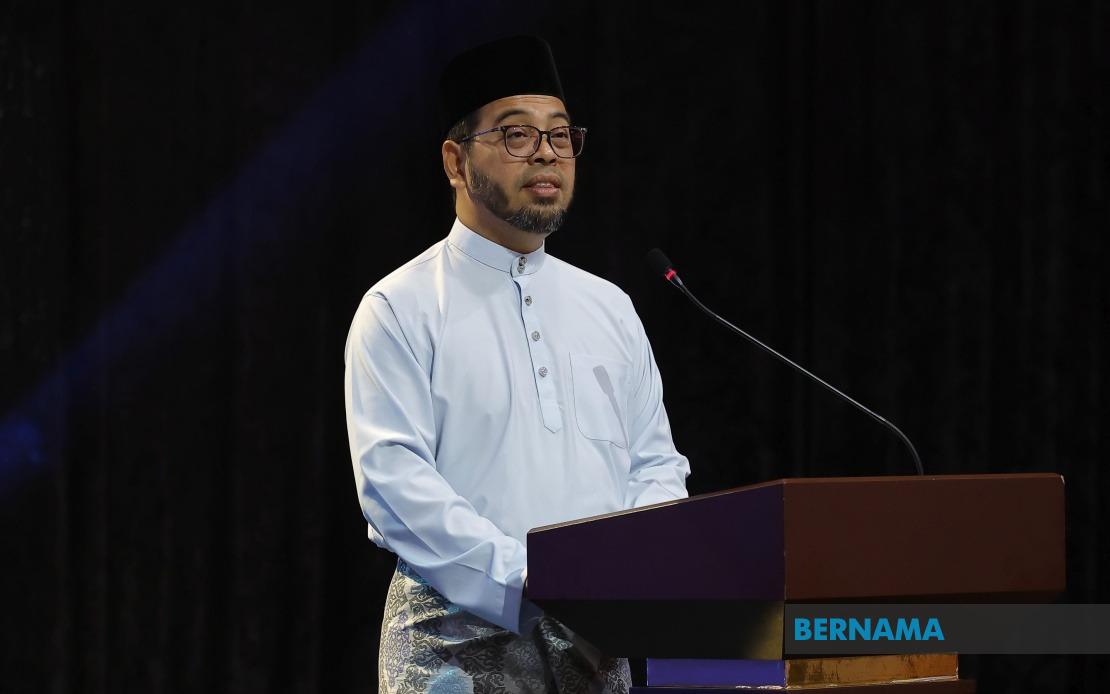
Dr Zulkifli Hasan, the Minister in the Prime Minister's Department (Religious Affairs), has made an impassioned call for Malaysian Muslims to transcend longstanding disputes and overcome residual tensions that threaten to undermine collective strength. Speaking at the national-level Maal Hijrah 1448H/2026M celebration held at Putra Mosque in Putrajaya on June 17, he emphasised that putting aside differences is essential for navigating an increasingly uncertain global landscape. The ceremony, themed "MADANI Dihayati, Ummah Diberkati", was attended by Sultan Nazrin Shah of Perak and Deputy Prime Minister Datuk Seri Fadillah Yusof, underscoring the significance of the occasion.
Dr Zulkifli articulated a vision of social transformation that begins with internal change at the individual level, encompassing intellectual, spiritual, and moral development. He contended that meaningful progress cannot be achieved through superficial gestures or institutional reforms alone, but requires a fundamental shift in how citizens approach their responsibilities to one another. This perspective reflects a growing recognition among Malaysian policymakers that social cohesion depends less on top-down mandates and more on citizens internalising shared values and commitments. The minister framed this internal transformation as a prerequisite for the external manifestation of unity that the nation urgently requires.
Central to Dr Zulkifli's message was the warning that division brings only hardship and national weakness, whilst a cohesive community generates blessings and prosperity for all members. This framing positions communal unity not merely as a religious or cultural ideal but as a practical necessity for national wellbeing. In the context of Malaysia's multicultural framework and the challenges facing MADANI initiatives, the emphasis on collective strength serves as a reminder that religious and moral values must underpin governance and public policy. The minister's rhetoric suggests an attempt to move beyond factional disputes within the Muslim community that have occasionally surfaced in recent years, channelling instead toward constructive engagement with shared national objectives.
Malaysia's vulnerability to global shocks formed another key plank of Dr Zulkifli's argument. He highlighted how disruptions to international supply chains and mounting economic uncertainty across the world are already affecting Malaysian households and businesses, creating conditions that demand unified responses rather than fragmented ones. This acknowledgment of external pressures reflects the reality facing Southeast Asian economies, where geopolitical tensions, trade wars, and energy market volatility have created significant planning challenges for governments and citizens alike. By linking communal unity to economic resilience, Dr Zulkifli implicitly framed social cohesion as an economic asset that protects Malaysia from external shocks.
The minister called on Malaysians to sustain their support for government initiatives aimed at elevating Muslim dignity and ensuring that Islamic principles continue to shape public life in Malaysia. This appeal came amid broader efforts by the current administration to demonstrate commitment to Islam whilst maintaining the country's constitutional secular framework and multicultural character. The balance between these objectives remains delicate, particularly as Malaysia navigates regional competition with other Muslim-majority nations seeking to position themselves as Islamic leaders. Dr Zulkifli's framing suggests an effort to reinterpret government support as a shared endeavour rather than an imposition, encouraging voluntary participation in a collective project.
A significant reinterpretation of the Maal Hijrah concept emerged in Dr Zulkifli's address, where he characterised it as an ongoing journey rather than a historical event frozen in the Islamic calendar. Under this understanding, hijrah becomes applicable to contemporary life, representing the continuous abandonment of harmful behaviours and the cultivation of qualities that strengthen social bonds. This modernised interpretation serves multiple purposes: it renders historical Islamic concepts relevant to present-day challenges, it positions spiritual development as compatible with national development goals, and it creates space for secular and religious citizens to find common cause in building a more cohesive society. The emphasis on character development as the true substance of hijrah shifts focus from ritual observance to practical ethical conduct.
Dr Zulkifli stressed that strengthened communal unity creates the conditions necessary for elevating and upholding Islamic values more effectively across Malaysian society. This suggests a recognition that religious principles cannot be imposed through legislation or bureaucratic mechanisms alone, but require organic social acceptance rooted in genuine solidarity. The statement reflects sophisticated thinking about how religious values are transmitted and embedded in communities—through lived experience, mutual respect, and shared commitment rather than through top-down religious authority. For Malaysia, where diverse faith communities coexist within a constitutionally Islamic framework, this approach offers a potential pathway to deepening religious observance whilst respecting pluralism.
Acknowledging the reality of Malaysia's diversity, Dr Zulkifli affirmed that all citizens, irrespective of religious belief or cultural background, bear collective responsibility for preserving peace, stability, and prosperity. This inclusionary statement serves as a crucial counterbalance to rhetoric that could be perceived as exclusionary or sectarian. By extending responsibility for national wellbeing to all Malaysians regardless of faith, he reinforced the constitutional consensus that undergirds the nation's stability. The remark also addressed potential concerns among non-Muslim communities that initiatives framed in religious language might marginalise their contributions to national development or their stake in shared outcomes.
The ceremony recognised outstanding contributions to Islamic learning and practice through prestigious awards. Prof Emeritus Datuk Dr Osman Bakar, Rector of International Islamic University Malaysia (IIUM), received the National Tokoh Maal Hijrah award, acknowledging his decades of scholarship and institutional leadership in Islamic higher education. Moroccan Islamic scholar Dr Ahmad Al-Raysuni received the International Tokoh Maal Hijrah award, reflecting Malaysia's engagement with global Islamic intellectual traditions and its aspiration to participate in shaping contemporary Islamic discourse. These recognitions signal that Malaysia values both local Islamic scholarship and international Islamic engagement, positioning the nation as a bridge between regional and global Muslim communities.
The gathering at Putra Mosque represented an occasion for senior government figures to articulate a vision of Malaysian Islam rooted in unity, character development, and pragmatic engagement with contemporary challenges. The presence of Sultan Nazrin Shah and Deputy Prime Minister Fadillah Yusof underscored the political and constitutional significance attached to these themes. For Malaysians observing these proceedings, the message conveyed was that religious devotion and national development are complementary rather than contradictory objectives, and that the path forward requires both spiritual commitment and social responsibility. As Malaysia continues to balance religious identity with multicultural coexistence, messages emphasising organic unity and shared responsibility offer an important counterweight to more divisive framings of national life.