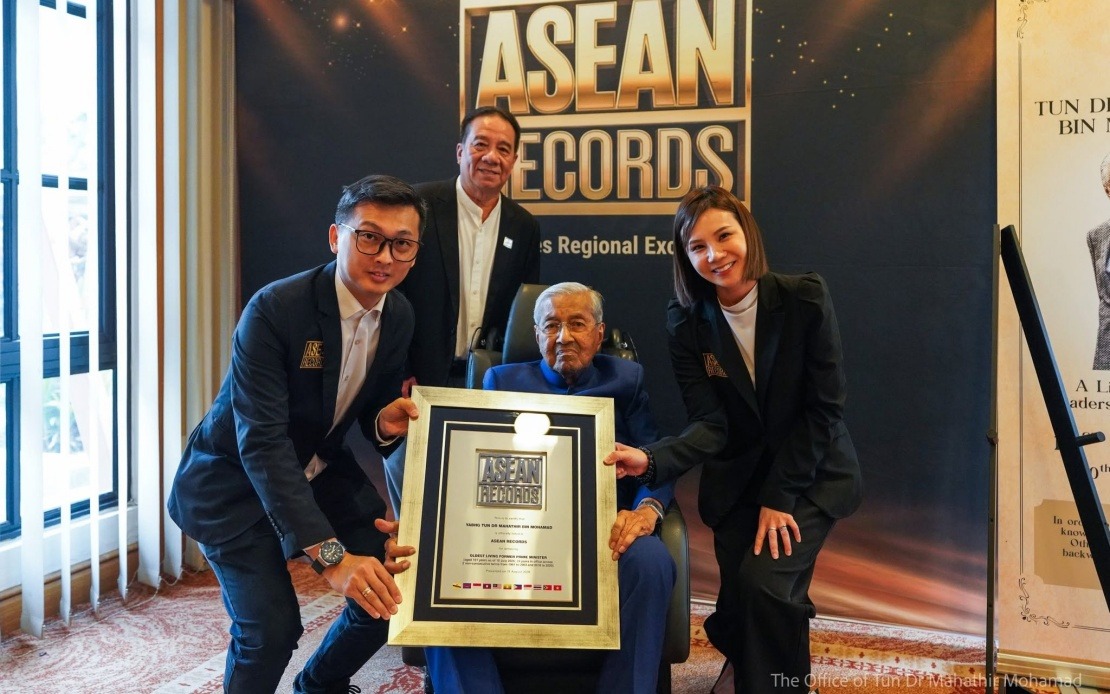
Tun Dr Mahathir Mohamad and Tun Dr Siti Hasmah Mohd Ali have entered the history books as recipients of three record certifications that underscore the remarkable longevity of Malaysia's longest-serving former prime minister and his spouse. The 101-year-old Dr Mahathir was formally recognised by ASEAN Records as the Oldest Living Former Prime Minister in the region, while his wife, who turned 100 in July, received the distinction of Oldest Living Spouse of a Former Prime Minister. The pair jointly earned a third accolade—acknowledged by ASIA Records as the First Former Head of Government and Spouse to Both Become Living Centenarians—a milestone that speaks to their exceptional health and vitality well into triple digits.
The presentation ceremony took place at the Perdana Leadership Foundation in Kuala Lumpur, where officials from ASEAN and ASIA Records presented the official certificates. Tan Sri Danny Ooi, chairman of the ASEAN Records Advisory Board, oversaw the proceedings alongside chief adjudicators Gillian Ooi and Eldrick Koh, both of whom serve as directors for the record-keeping organisations. The ceremonial recognition arrived during an especially significant month for the couple, who have experienced a cascade of personal milestones within weeks of each other.
The timing of these celebrations underscores the exceptional nature of their achievements. Dr Mahathir marked his 101st birthday on July 10, setting the stage for his wife's centennial celebration just two days later on July 12. The couple then commemorated their 70th wedding anniversary on August 5, demonstrating not only individual longevity but also decades of sustained companionship. Together, these three occasions within a single month have crystallised the couple's place in regional history, capturing public attention and prompting official recognition from international record-keeping bodies.
The verification process undertaken by the adjudication teams carries particular weight given the thoroughness required to authenticate such claims across the ASEAN region and major Asian markets. Officials confirmed that no comparable achievement—whereby both the former head of government and their spouse achieved centenarian status simultaneously—has been publicly documented in neighbouring countries or across the broader Asian continent. This determination positions Dr Mahathir and Dr Siti Hasmah not merely as national figures but as exceptional individuals whose life span and partnership represent a singular phenomenon at the regional level.
For Malaysia, the recognition carries symbolic significance beyond the statistical achievements it represents. Dr Mahathir's tenure as Prime Minister from 1981 to 2003, followed by his controversial return to office from 2018 to 2020, shaped decades of the nation's political and economic trajectory. His longevity and continued public engagement have made him a towering figure in Malaysian political discourse, and his entry into his second century of life reflects broader improvements in healthcare, living standards, and quality of life that have benefited the nation as a whole. The fact that his wife has joined him as a centenarian adds another dimension to this narrative.
Dr Siti Hasmah, a trained physician, has long been recognised for her intellectual contributions and her role as a stabilising presence throughout her husband's political career. Her achievement as the oldest living spouse of a former head of government acknowledges not only her personal resilience but also the important roles played by spouses of political leaders, whose influence often extends beyond formal recognition. Her medical background and continued engagement in public life have made her a respected figure in her own right, independent of her relationship to Dr Mahathir.
The couple's health and vitality at their advanced ages raise broader questions about ageing, longevity, and the factors that contribute to extended lifespans. Malaysia, like many Southeast Asian nations, is experiencing demographic shifts with an increasingly ageing population. The longevity demonstrated by Dr Mahathir and Dr Siti Hasmah provides a compelling case study in how lifestyle, access to healthcare, and mental engagement may contribute to extended and active lives. Their continued public visibility and involvement in national discourse suggests that age need not diminish intellectual capacity or social relevance.
The regional recognition from ASEAN and ASIA Records also highlights Malaysia's standing within broader Asian contexts. As a nation that has produced a former leader capable of achieving such longevity, Malaysia can take pride in the health infrastructure and social systems that have enabled this outcome. The records serve as unofficial testimonials to the development achieved over the past several decades, even as they prompt reflection on the challenges that remain in extending such life expectancy and quality of life across broader segments of the population.
Looking forward, the records established by Dr Mahathir and Dr Siti Hasmah are likely to remain benchmarks within the ASEAN region for some time, given the exceptional nature of the achievement. Their dual centenarian status represents a rare convergence of individual longevity and sustained partnership, unlikely to be replicated easily elsewhere in the region. The certifications from international record-keeping bodies ensure that this achievement will be formally acknowledged and preserved for future reference, cementing their place not just in Malaysian national memory but in the broader historical record of Southeast Asia.

