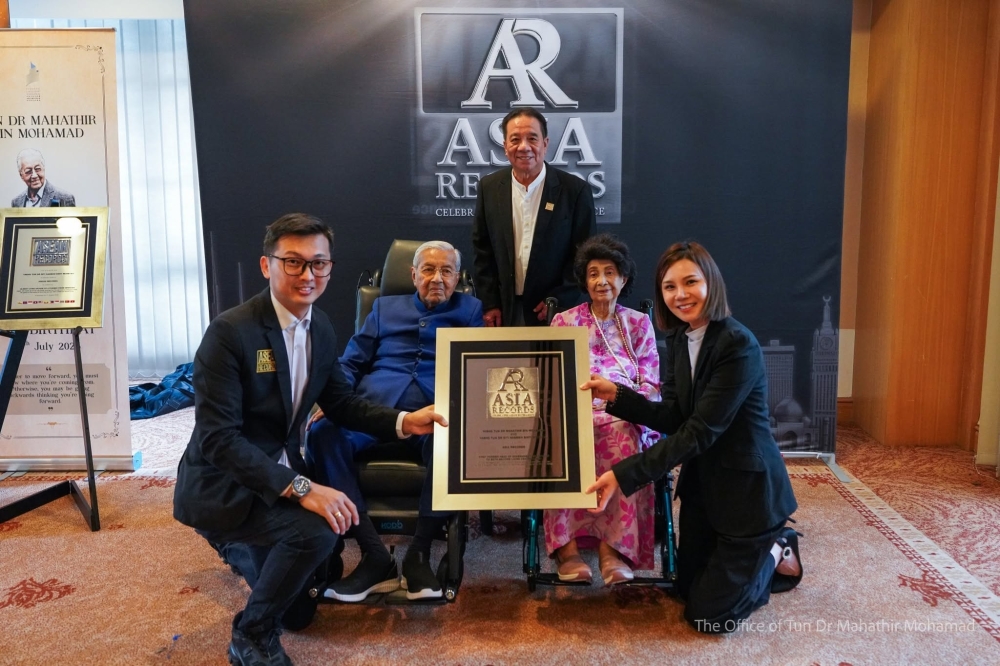
Malaysia's former prime minister Tun Dr Mahathir Mohamad and his wife Tun Dr Siti Hasmah Mohd Ali have been formally recognised by Guinness World Records for achieving three distinct records upon both reaching the age of 100, cementing their place in global history books and adding another chapter to their remarkable personal and political legacy.
The centenarian couple's recognition reflects not merely the statistical rarity of both spouses living to such an advanced age, but also the profound impact their lives have had on Malaysian society and governance. Dr Mahathir's 22-year tenure as Prime Minister fundamentally shaped the nation's political landscape, economic development, and regional standing, while Dr Siti Hasmah carved her own distinguished path as a medical professional and advocate for social welfare throughout her lifetime.
The three Guinness records represent different dimensions of their achievement. These distinctions underscore the couple's significance within the broader context of global longevity records and serve as a testament to their health, resilience, and the quality of life they have maintained well into their second century. For Malaysia, these records carry symbolic weight, reflecting the nation's growing prominence in diverse international spheres and the esteem in which its elder statesmen are held globally.
Dr Mahathir's journey to this milestone has been marked by his continued public engagement despite his advanced age. Even after stepping down from high office, he remained an influential voice in Malaysian politics and governance, demonstrating the vigour and intellectual capacity that has defined his entire career. His willingness to comment on contemporary issues and his occasional returns to the political arena underscore his enduring relevance and the persistent respect accorded to him within the country's political establishment.
Dr Siti Hasmah's century-long life represents a different but equally significant narrative within Malaysian history. As a woman who pursued higher education and professional achievement during an era when such paths were far less accessible to women, she exemplified a pioneering spirit that contributed to broadening opportunities for subsequent generations of Malaysian women. Her work in the medical field and her commitment to humanitarian causes demonstrated that leadership and impact extend far beyond formal political office.
The couple's longevity raises important questions about aging, healthcare, and quality of life in Malaysia and the wider region. As Southeast Asian nations grapple with rapidly aging populations and the associated challenges of healthcare provision and social support systems, the Mahathir household serves as an example of successful aging, maintaining both physical health and mental acuity into the second century of life. This has implications for policymakers considering how to support their own aging populations.
The recognition from Guinness World Records also highlights Malaysia's place within global conversations about longevity and human achievement. While centenarians are no longer extraordinarily rare globally, the combination of both spouses reaching this milestone simultaneously remains remarkable. Their records place Malaysia alongside other nations celebrated for their elderly populations and longevity research, elevating the country's profile within international health and demographic circles.
For Malaysian society more broadly, the celebration of Dr Mahathir and Dr Siti Hasmah's achievements serves as a moment of national reflection on legacy and continuity. Dr Mahathir's influence on Malaysia's development trajectory remains contested in some quarters, yet his centrality to the country's modern history is undeniable. The couple's longevity and continued presence in the public consciousness ensure that their roles in shaping the nation remain subjects of ongoing discussion and interpretation.
The recognition also underscores the evolving relationship between Malaysia and international record-keeping bodies. Guinness World Records' acknowledgment of the couple demonstrates how Malaysian achievements are increasingly documented and celebrated within global frameworks, contributing to the nation's international visibility and soft power. This has practical implications for Malaysia's standing in world rankings across various fields and contributes to national pride.
As Dr Mahathir and Dr Siti Hasmah enter their second century, their story continues to unfold. Their sustained health and engagement with life offer lessons for gerontological research and for individuals and families concerned with aging well. The couple's ability to maintain their mental sharpness and social presence serves as an inspiration within a region where respect for elders remains culturally paramount, yet where practical support for the aging remains an evolving challenge.
The Guinness World Records recognition is ultimately a formal acknowledgment of an extraordinary human achievement. For Malaysia, it represents a moment to celebrate not just the personal triumph of two remarkable individuals, but also to reflect on the nation's development, the legacies of its leaders, and the ongoing evolution of Malaysian society. As the nation observes these milestones, questions about how to honour such achievements while also learning from them—in terms of healthcare, governance, and social policy—become increasingly relevant for policymakers and citizens alike.

