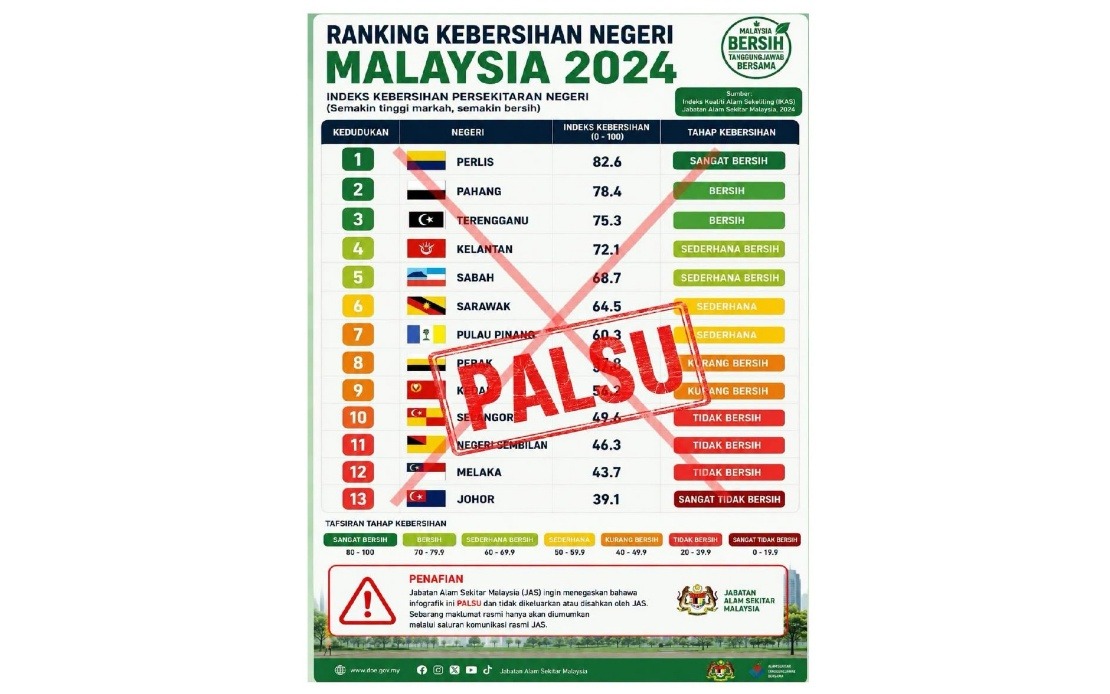
The Department of Environment in Putrajaya has issued a strong denial regarding an infographic purporting to rank Malaysian states by cleanliness that has circulated extensively across social media and messaging platforms. In a formal statement, the DOE clarified that it had neither authored, published nor validated the graphic titled "Ranking Kebersihan Negeri Malaysia 2024", which has achieved significant viral reach among Malaysian internet users seeking information about environmental standards across the country's states.
The department emphasised that no official communication, whether as a media release, technical report or departmental response, had been issued to support or verify the claims made in the circulating infographic. This categorical denial reflects growing concern among Malaysian government agencies about the proliferation of misleading content that falsely associates itself with official sources, thereby lending unearned credibility to potentially inaccurate information.
Public officials stressed the importance of citizens exercising discernment when encountering environmental data or rankings, particularly those shared through informal digital channels without traceable provenance. The DOE cautioned that relying on unverified material as though it represented official government assessment could lead to fundamental misunderstandings about environmental conditions and management priorities across Malaysia's states.
The broader implications of such misinformation extend beyond simple confusion. When false information circulates with institutional branding, it can systematically undermine public trust in genuine government communications about environmental protection and management. The DOE recognised this risk explicitly, noting that the dissemination of unverified claims posed a threat to public confidence in authentic official guidance regarding environmental conservation efforts.
To combat ongoing confusion and prevent similar incidents, the department outlined its official communication protocols. All legitimate statements, statistical reports, graphics, announcements and information from the DOE are exclusively distributed through its designated institutional channels, primarily its official portal. This centralised approach aims to create a single, verifiable source that Malaysian citizens and organisations can consult with confidence when seeking authoritative environmental data.
The department also indicated a firm stance on protecting its institutional identity and reputation. Officials noted that the misappropriation of the DOE's name, official logo and corporate branding—whether for the viral infographic or any other misleading material—constitutes a serious violation of protocol that the agency takes with considerable gravity. This concern reflects a pattern across Malaysian government bodies of increasing concern about impersonation and unauthorised use of official imagery.
Legal accountability figures prominently in the DOE's response. The department declared its readiness to pursue legal remedies against any individuals or entities identified as responsible for creating or deliberately spreading false information that exploits the department's identity or authority. This escalation signals that Malaysian government agencies are moving beyond passive denial toward active enforcement mechanisms to protect institutional credibility.
The statement reaffirmed the DOE's fundamental commitment to ensuring that all public communications meet rigorous standards of accuracy, authenticity, transparency and credibility. Officials characterised this commitment as inseparable from the department's core mandate to manage and safeguard Malaysia's natural environment on behalf of the nation.
For Malaysian citizens and organisations engaged with environmental issues, the episode underscores the critical importance of verification practices when consuming policy-relevant information online. With environmental governance increasingly subject to public scrutiny and participation, distinguishing between authoritative sources and unauthorised claims has become essential for informed civic engagement. The DOE's clarification serves as a reminder that official environmental rankings, assessments or comparative analyses should always be traced directly to government sources rather than accepted on the basis of social media circulation or visual polish.
The incident also reflects broader regional challenges as Southeast Asian democracies grapple with information verification in rapidly evolving digital environments. Malaysia's experience mirrors patterns in neighbouring countries where institutional identities are exploited to lend false authority to dubious claims. As digital literacy remains unevenly distributed across the population, government agencies face mounting pressure to both educate the public about verification practices and protect their own institutional boundaries from misuse.
Moving forward, the DOE's clarification establishes a clear demarcation between verified official information and the vast ecosystem of unvetted digital content. Citizens and organisations seeking authoritative data on state-level environmental performance or cleanliness standards should consistently direct their inquiries toward the department's official portal and designated communication channels. This approach ensures not only accuracy but also maintains the integrity of environmental governance conversations that increasingly shape policy outcomes across Malaysia's states.

