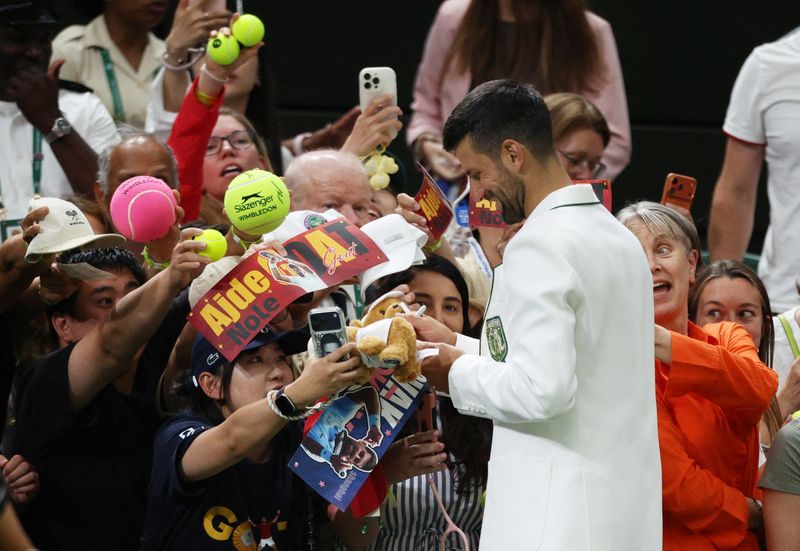
Novak Djokovic's commanding performance at Wimbledon on Wednesday transcended the typical tennis script, transforming his demolition of Stefanos Tsitsipas into a theatrical display of controlled dominance punctuated by genuine moments of levity. The 24-time Grand Slam champion's 6-3 6-4 6-2 victory was never in doubt, and with that certainty came the freedom to entertain both the crowd and himself in ways rarely seen from a player protecting a crucial match.
The most memorable moment of Djokovic's afternoon came when he enlisted a ball girl to assist with removing some black tape from his right shoulder. Instructing her to use scissors, he suddenly cried out in exaggerated pain, convincing the unsuspecting attendant that she had caused him genuine injury in front of millions of global viewers. The shock registered visibly on her face as she recoiled, hand pressed to her chest, momentarily consumed by the horror of having accidentally wounded one of tennis's greatest players during what should have been a routine task.
But the alarm lasted only seconds before Djokovic's laughter dissolved the tension completely. His genuine amusement at successfully executing the prank proved contagious, and the ball girl quickly recognised the humour in the situation, her own giggles confirming that no harm had befallen her reputation or Djokovic's shoulder. The exchange encapsulated something often overlooked in professional sports: the capacity for elite athletes to maintain their humanity and sense of humour even while performing at the highest level.
Djokovic himself reflected on the moment during his post-match interview, acknowledging that such levity only becomes possible when the match outcome has already been determined in decisive fashion. "These kinds of things surface when you are two sets to love up rather than two sets to love down," he explained, adding that the playfulness had actually contributed to his relaxed state on court. The prank, rather than being a distraction or a breach of tennis etiquette, appeared instead to be a pressure valve that allowed him to maintain the loose, fluid tennis that characterised his overpowering display against Tsitsipas.
The significance of Djokovic's performance extends beyond the individual match result. At a stage of his career when questions persist about his ability to remain competitive against younger challengers, this emphatic demolition of one of the ATP's promising talents served as a reminder of his enduring quality. Tsitsipas, despite his considerable ability and recent improvements on grass, offered precious little resistance as Djokovic dictated from the baseline with precision and power.
With the match safely in hand and the crowd thoroughly entertained, Djokovic's attention turned toward the Royal Box, where he spotted Rory McIlroy, the twice Masters champion, watching proceedings while wearing his prestigious Green Jacket. The observation sparked another moment of theatrical engagement that captured the growing cross-pollination between tennis and golf in the world of elite sport, and Djokovic's genuine admiration for the garment was unmistakable.
Djokovic, dressed in his own personalised cream blazer that he has favoured throughout this year's championships, complimented McIlroy on the jacket's appearance before confirming with the Northern Irishman whether it was indeed the famous Masters prize. When McIlroy nodded in affirmation, Djokovic seized the opportunity to propose an entirely tongue-in-cheek wager: a tennis match in which the loser would forfeit their jacket to the winner.
The proposal carried both genuine jest and underlying respect. Djokovic's challenge acknowledged McIlroy's standing in world sport while simultaneously asserting tennis's claim to equal prestige. His insistence that they play tennis rather than golf—"no golf"—drew widespread amusement from the Centre Court crowd, who clearly appreciated the playful turf war being conducted with grins and good humour rather than competitive hostility.
For Malaysian and Southeast Asian sports enthusiasts, the moment underscored how personality and entertainment value have become increasingly important dimensions of elite sport globally. The blending of competitive intensity with genuine human connection, the capacity to entertain while maintaining excellence, represents a quality that transcends any single sport. Djokovic's Wimbledon performance demonstrated that dominance need not be grim or purely results-focused; instead, it can encompass a broader appreciation for the spectacle and shared experience that makes live sport compelling.
The interaction with McIlroy also highlighted the growing convergence of tennis and golf at the highest levels, with athletes from both disciplines increasingly attending each other's events and engaging with their communities. For a region like Southeast Asia, where both sports enjoy growing followings among affluent and aspirational audiences, such moments of cross-sport camaraderie help elevate the cultural standing of both disciplines within the regional sports ecosystem.
Looking forward, Djokovic's performance raises important questions about his trajectory through the remainder of Wimbledon and into the remainder of the season. His ability to combine the mechanical perfection required to dismantle a quality opponent with the psychological flexibility to remain engaged and entertaining suggests a competitor still capable of major tournament success. The ball girl prank and McIlroy jacket exchange, rather than distracting from his purpose, appeared instead to be evidence of a player completely in control of his environment and his emotions.
Ultimately, Djokovic's Wimbledon afternoon represented something increasingly rare in professional sport: a demonstration of complete mastery delivered with genuine joie de vivre. The demolished scoreline against Tsitsipas will feature in record books and statistics, but it may well be the laughter of a relieved ball girl and the appreciative roars of Centre Court that best capture what made Wednesday's performance memorable. In an era where sports narratives often centre on dramatic narratives of triumph and struggle, sometimes the most telling moments are those when excellence simply feels easy.

