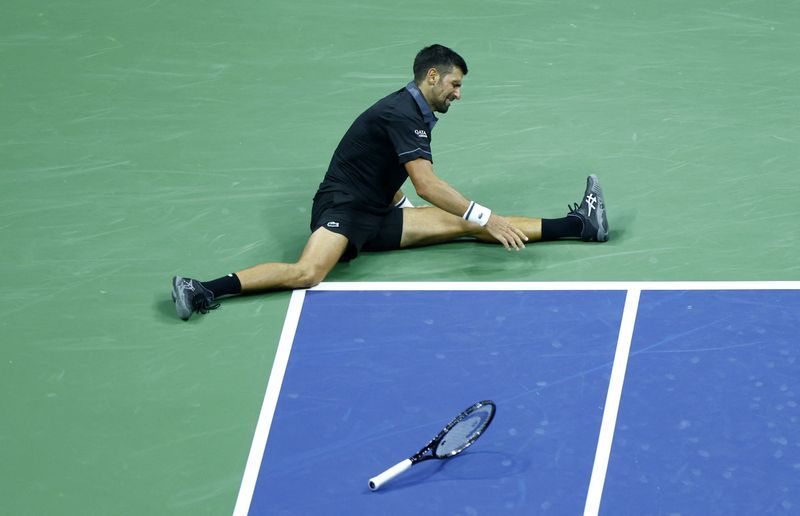
Novak Djokovic's latest pursuit of Grand Slam history ended in disappointment on Sunday when the legendary Serbian suffered his earliest exit from the US Open in nearly two decades, tumbling to unseeded Argentine Mariano Navone in a gruelling first-round encounter that lasted four hours and 36 minutes. The fourth seed's shock 7-6(5), 5-7, 4-6, 6-2, 6-1 defeat marked a watershed moment in his career trajectory, representing not merely another loss but rather the first time since the 2006 Australian Open that Djokovic has bowed out in a Grand Slam's opening round. At 39 years old, the Serb appeared visibly distraught as tears streamed down his face at match's conclusion, a raw emotional display that underscored the gravity of this unexpected reversal.
Djokovic's physical struggles manifested starkly throughout the contest as his body seemed unable to withstand the demands of competing at tennis's highest level. The champion vomited into a courtside bin during the third set, a symptom of broader physiological issues that had plagued him throughout the year. Speaking candidly after the match, he disclosed that gastrointestinal distress had become a recurring nightmare, one that cascaded into comprehensive bodily deterioration—cramping, acute pain, and muscular failure that robbed him of the physical resilience required to overcome a determined opponent. His back and shoulder progressively deteriorated as the match advanced, particularly affecting his serving motion during the crucial fourth and fifth sets, forcing him to rely increasingly on groundstrokes while his opponent dictated play from the baseline.
The circumstances surrounding Djokovic's arrival in New York carried concerning undertones. His preparation proved inadequate after he suffered defeat to Thiago Agustin Tirante in his Cincinnati warm-up tournament just fourteen days earlier, suggesting that confidence and conditioning had both eroded during the summer months. Pre-tournament speculation regarding his fitness levels proved prescient, as the early warning signs manifested immediately once meaningful competition commenced. The humid New York conditions at Flushing Meadows, combined with his declining physical resilience, created an environment where maintaining competitive edge became progressively more challenging as the match extended.
Navone's stunning upset triumph represented the defining moment of his professional career trajectory, a victory that fundamentally altered his status within the sport. The 25-year-old Argentine, ranked 49th globally and unseeded in the draw, had accomplished something that eluded far more celebrated contemporaries—defeating the player widely regarded as the greatest of all time. The emotional weight of this achievement visibly overwhelmed Navone immediately following the final point, as he struggled to comprehend the magnitude of what he had just accomplished. During his on-court interview, he expressed profound disbelief, acknowledging that such victories against Djokovic represent extraordinarily rare occurrences in professional tennis. His remarks underscored the psychological burden that even top-ranked players carry when facing the Serb's formidable legacy.
Navone's post-match commentary revealed the surreal quality of his accomplishment as he grappled with the immediate aftermath of his breakthrough. The Argentine disclosed that adrenaline surges prevented him from settling emotionally, keeping his nervous system in overdrive hours after the final point. His mobile telephone had become inundated with incoming communications, a tangible manifestation of how dramatically his professional standing had shifted within mere hours. He anticipated that his achievement would generate substantial reverberations in Argentine sporting circles, understanding intuitively that national tennis establishments would celebrate this unexpected triumph by one of their promising representatives.
The match's opening phases provided early indication that Djokovic would face unexpected resistance. Despite establishing a commanding 3-0 advantage early in the first set under humid atmospheric conditions, Navone demonstrated remarkable composure and tactical sophistication as he clawed back to parity at 4-4. A roof closure at the Arthur Ashe Stadium following rainfall interruptions seemed to reset the match's psychological equilibrium, allowing the Argentine to gain confidence and forcing Djokovic into an unexpected tiebreak. Navone's successful navigation of this tiebreaker, claiming it 7-5, provided the emotional impetus that sustained his performance throughout the subsequently gruelling five sets.
Djokovic's fightback in the second set suggested he might overcome this unexpected challenge, and for extended periods during the third set, he appeared to have stabilized his condition. A break of serve at 5-4 in the third set seemed to position him favourably, and he ultimately claimed that set despite evident discomfort with his serving mechanics. However, Navone's resilience proved equally substantial as the fourth set commenced. The Argentine's progressive improvement in his serving accuracy, coupled with Djokovic's mounting physical deterioration as his back mechanics finally capitulated under cumulative strain, shifted the match's momentum decisively in Navone's favour. The fifth set became a procession, with Navone claiming six games decisively while Djokovic struggled to mount meaningful resistance.
Djokovic's post-match reflections demonstrated mature acceptance of his circumstances despite the crushing disappointment. When questioned whether thoughts of retirement had surfaced during the match's later stages, he firmly rejected such suggestions, insisting that his competitive instincts demanded completion of the contest regardless of its trajectory. This sentiment, while admirable in principle, also highlighted the disconnect between his ambitions and his body's current capabilities—a gap that appears to be widening as the tennis calendar advances. His magnanimous acknowledgement of Navone's qualities and his explicit recognition that the Argentine deserved credit for a determined performance suggested that Djokovic retained sufficient perspective to recognize when superior tennis had been executed by his opponent.
The significance of this defeat extends beyond mere statistical interest in the record books. For the Malaysian and Southeast Asian tennis community, Djokovic's unexpected vulnerability raises important questions about the twilight phases of even the greatest athletic careers. The sport's increasingly demanding physical requirements mean that advancing age, compounded by accumulated injuries and chronic health challenges, can precipitate surprisingly rapid declines. Navone's victory demonstrates that the sport remains fundamentally unpredictable, that reputations and world rankings provide imperfect predictors of match outcomes, and that dedicated competitors operating outside the traditional elite establishment can nonetheless achieve remarkable breakthroughs through determination and tactical acumen.
Looking forward, Djokovic faces a critical juncture regarding his professional future. The 25th Grand Slam title that has motivated his continued participation now appears more distant than ever, with his physical capacity to sustain elite-level tennis remaining genuinely uncertain. His performance against Navone suggests that the cumulative toll of professional tennis at its highest echelon may be finally superseding even his extraordinary mental fortitude and technical mastery. Whether he will continue pursuing Grand Slam records or reconsider his competitive trajectory remains to be determined, but this US Open defeat has crystallized questions about the sustainability of his career that can no longer be dismissed as temporary setbacks.

