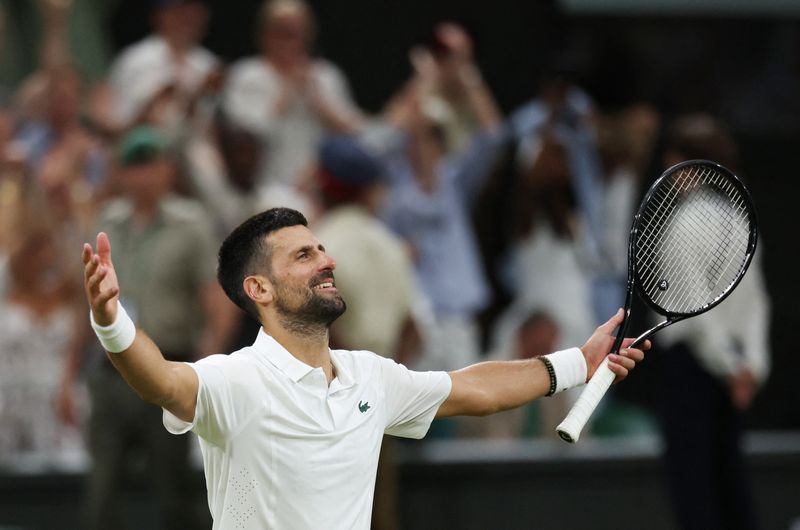
Novak Djokovic extended his extraordinary Wimbledon reign on Tuesday, dismantling the spirited resistance of Canadian Felix Auger-Aliassime 7-6(10) 3-6 6-3 6-7(4) 7-6(10-4) in the longest quarter-final the tournament has ever witnessed. The marathon encounter lasted five hours and 15 minutes and propelled the 39-year-old Serbian champion into his eighth consecutive semi-final at the grass court showpiece, a feat no male competitor has previously accomplished.
The achievement represents another milestone in Djokovic's storied association with the All England Club. By reaching the semi-finals again, he became the first man in the tournament's modern history to accomplish this feat eight times consecutively. Earlier in the tournament, he also surpassed Roger Federer's record for most match victories at Wimbledon when he claimed his 106th win in the preceding round, further cementing his legacy as one of the greatest grass court performers in tennis history.
Djokovic's path to the semi-finals proved far from straightforward. Auger-Aliassime, the Canadian 21-year-old competing at one of his highest levels, presented a formidable obstacle from the opening service game. The first set descended into a tension-laden tiebreak that stretched to 10-10 before Djokovic's opponent capitulated, blasting a volley long to gift the set to the seventh seed. It was a moment that encapsulated the wafer-thin margins separating victory from defeat in matches of such magnitude and duration.
Auger-Aliassime appeared destined to seize control of proceedings when he manufactured a decisive break in the second set, establishing a comfortable 5-3 advantage and forcing Djokovic to defend his serve in the following game. The Canadian's composure and clinical execution suggested momentum was swinging his way, but Djokovic's resolve and experience proved insurmountable. However, environmental factors began influencing the match when the Centre Court roof was closed at approximately 7.40 p.m. local time, a decision that visibly irked the Serbian champion and prompted audible expressions of displeasure.
The closure of the roof appeared to reset the contest's psychological trajectory. Djokovic regrouped and channelled his frustrations constructively, executing more precise strokes and demonstrating the court intelligence that has defined his career. He broke Auger-Aliassime in the sixth game of the third set and subsequently tightened his stranglehold on the match, accumulating a two-sets-to-one lead through a combination of defensive resilience and attacking opportunities.
Auger-Aliassime, however, refused to surrender despite the mounting pressure. He lost his opening service game in the fourth set, and his frustration briefly boiled over when he struck his chair with his racket in an expression of disappointment. Yet the Canadian demonstrated remarkable mental fortitude by recovering to force a tiebreak, which he won to level the overall contest and mandate a fifth-set decider. The theatre of the occasion was palpable, with a thoroughly engaged crowd at Centre Court witnessing one of the tournament's defining matches unfold across five sets.
The final set proved an exercise in attrition and experience. For 12 games, neither contestant could establish a decisive advantage, and no breaks materialised. The inevitable match tiebreak commenced at 6-6, and this is where Djokovic's vast repository of knowledge proved decisive. Drawing upon decades of competing in the sport's most demanding situations, he navigated the mini-tiebreak with characteristic composure and precision, ultimately prevailing 10-4 to secure passage to the semi-finals.
Following his victory, Djokovic exhibited the philosophical outlook of a champion who understands the importance of perspective. He described his triumph as achieved through the combined application of his racket and profound emotional commitment, before elaborating on the psychological demands inherent in matches of such intensity and duration. The management of nerves and the ability to process extreme tension emerged as recurring themes in his post-match reflections, acknowledging that such contests are won through mental fortitude as much as technical excellence.
Djokovic's next challenge pitches him against the tournament's reigning champion and current world number one, Jannik Sinner, in what promises to be another heavyweight semi-final encounter. This matchup represents a fascinating chapter in the emerging rivalry between the Serbian veteran and Italian prodigy, with Djokovic hunting an eighth Wimbledon title to match Federer's haul and a 25th major championship overall to surpass Australian icon Margaret Court's record. For Malaysian and Southeast Asian tennis enthusiasts, the semi-final will showcase not merely a generational clash but a compelling narrative of sporting longevity and determination.
The victory carries particular significance given Djokovic's age and the physical toll of such extended matches. His candid admission that he instructed his children to retire to bed after the fourth set, only for them to insist on witnessing the conclusion, underscores the match's dramatic arc. Ultimately, his satisfaction with the victory extended beyond the scoreline itself; he ranked it amongst the finest performances of his illustrious Wimbledon career, a testament to both his own excellence and Auger-Aliassime's valiant efforts on one of tennis's most hallowed stages.

