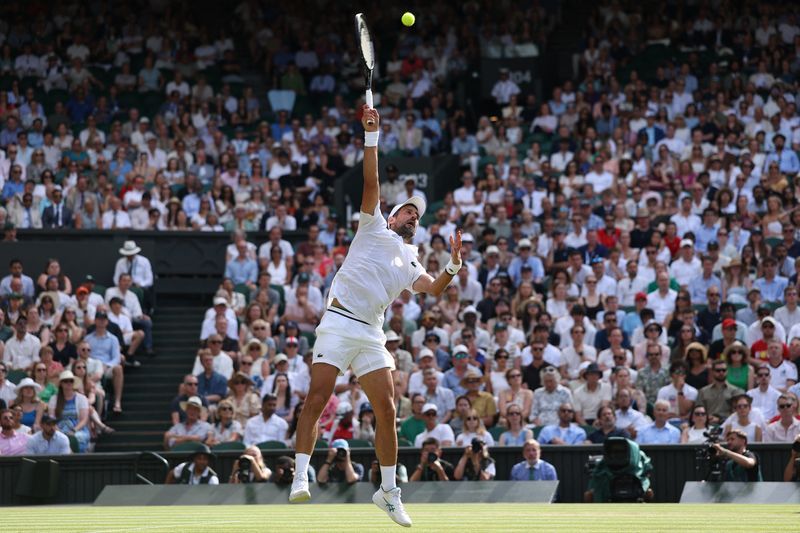
Novak Djokovic etched another significant milestone into his illustrious Wimbledon history on Sunday when he outlasted Russian qualifier Roman Safiullin across four sets to claim his 106th victory at the All England Club, a figure that now surpasses the legendary Roger Federer's long-standing record for match wins on the grass court Grand Slam. The seventh-seeded Serb's 7-6(6) 6-3 3-6 6-3 triumph propelled him into the quarter-finals while simultaneously advancing his pursuit of an eighth title at the venue, which would equal Federer's benchmark achievement.
At 39 years old, Djokovic continues to demonstrate remarkable longevity and competitive hunger, with the championship now providing him another opportunity to etch his name into sporting immortality. His steady progression through the opening week has been marked by a willingness to absorb punishment and adapt his game when conditions or opponents demand adjustment. The world's seventh-ranked player currently sits in pursuit of a record 25th Grand Slam trophy, and a Wimbledon triumph would substantially enhance his claims to be regarded among tennis's greatest champions.
Yet the victory over Safiullin was anything but straightforward, revealing vulnerabilities that Djokovic acknowledged openly in his post-match reflections. The Serbian champion dropped serve twice in a performance that lacked the clinical precision typically associated with his game, forcing himself into circumstances where conventional baseline rallies worked against him. Playing on Centre Court beneath intense summer heat, Djokovic found himself particularly uncomfortable from the back of the court, a tactical disadvantage he would normally dominate.
Safiullin, ranked 132nd in the world and returning from an extended absence due to hip complications, proved an unexpectedly resilient challenger who tested Djokovic's concentration throughout. The Russian qualifier's aggressive baseline game, combined with challenging wind conditions that affected play substantially, created a hostile environment for the seven-time champion. In the opening set, Djokovic found himself facing two set points whilst trailing 2-5 before mounting a remarkable recovery to capture the tiebreak through sheer determination and mental fortitude.
The second set witnessed Djokovic's characteristic ability to capitalize on brief advantages, with Safiullin's unforced error at 2-4 providing the opening the Serbian required. Djokovic then elevated his intensity, implementing serve-and-volley tactics that immediately doubled his advantage in the match and appeared to have broken his opponent's resistance. However, Safiullin refused to acquiesce entirely, breaking Djokovic's serve and claiming the third set to extend what had become a genuinely competitive encounter.
Djokovic's post-match commentary reflected his struggles with the particular demands of the day, noting that maintaining extended baseline exchanges had proven counterproductive against Safiullin's direct aggression. Instead, the veteran strategist emphasized the importance of varying his attacking patterns, particularly through net approaches, though he conceded that such adjustments produced inconsistent results throughout the match. His breakthrough came through refinement of his first-serve execution, which ultimately proved decisive in the fourth set when greater accuracy allowed him to consolidate his advantage.
The final set demonstrated the championship mentality that has sustained Djokovic's dominance across two decades of professional tennis. After holding serve at the start, he systematically elevated his performance level, securing the remaining breaks required to complete the victory and advance toward his quarter-final assignment. His opponent would emerge from the third-round matchup between Felix Auger-Aliassime and Spain's Alejandro Davidovich Fokina, both players representing considerably different stylistic challenges that Djokovic will need to assess and counter.
Djokovic's philosophical reflection on the encounter—characterizing his approach as "survive to thrive"—encapsulates his broader Wimbledon narrative. Having surrendered sets in three of his first four matches, the seventh seed has demonstrated that advancement through the early rounds demands resilience and adaptability rather than consistent brilliance. This measured progression suggests a veteran calibrating his physical output across the fortnight whilst maintaining sufficient intensity to overcome quality opposition.
The broader context of Djokovic's Wimbledon pursuit must be understood within the competitive landscape of contemporary men's tennis. The absence of several elite challengers through injury and other circumstances has created a pathway for the Serbian champion, yet opponents like Safiullin remind observers that talent remains distributed throughout the professional circuit. The significance of breaking Federer's match-win record transcends mere statistical accumulation; it reflects Djokovic's sustained excellence and ability to generate positive results across multiple decades of competition.
From a Southeast Asian perspective, Djokovic's continued dominance at Wimbledon and pursuit of Grand Slam records underscores the concentration of major titles among a small number of elite players, a dynamic that shapes tournament narratives and media attention globally. The region's tennis community observes closely as Djokovic approaches the pinnacle of statistical achievement in professional tennis, with potential implications for how sporting legacies are evaluated internationally. His advancement to the quarter-finals positions him favorably for a deep run that could see him challenging once again for championship honors at the world's most prestigious grass court venue.

