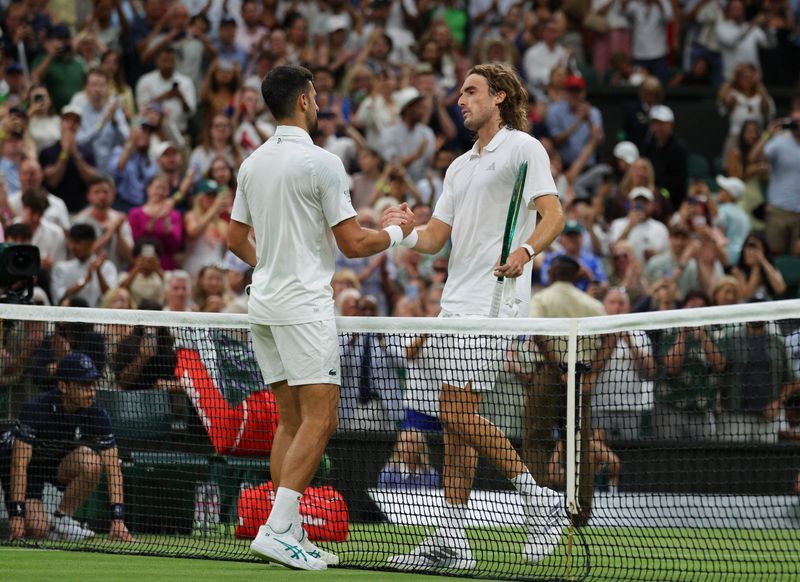
Novak Djokovic's mastery over Stefanos Tsitsipas on Centre Court on Wednesday provided a textbook lesson in capitalising on opponents' mistakes. When a competitor finds himself converting points that should have been finished off decisively, it signals an overwhelming class differential. The 39-year-old Serbian champion proved once again why he remains a formidable force on grass, advancing to the third round with a straightforward 6-3 6-4 6-2 triumph that left no room for drama or doubt.
What organisers billed as a heavyweight Centre Court showdown quickly devolved into a one-sided affair, with Djokovic controlling proceedings from the opening serves. Tsitsipas, once heralded as a potential Grand Slam champion-in-waiting, found himself unable to impose any meaningful pressure on the match. The disparity became especially evident during the second set when, at 4-4, the Greek player squandered two overhead smashes that should have brought him to a break-point advantage. Both attempts drifted beyond the baseline, and Djokovic immediately seized the momentum to claim the break himself. That single exchange effectively ended any realistic hope Tsitsipas harboured of pulling off an unlikely upset.
The trajectory of the contest became inevitable after that moment. Djokovic captured eight of the final ten games played, extending an already impressive head-to-head record to twelve consecutive victories over Tsitsipas. This lopsided rivalry demonstrates the gulf that separates elite competitors from those merely aspiring to their level. For a player ranked seventh in the tournament seeding, facing someone at 87th in the world rankings, the outcome seemed almost predetermined from the moment both players walked onto the iconic grass court.
Looking ahead, Djokovic will confront 25th-seeded Frenchman Arthur Rinderknech in the next round as he pursues an eighth Wimbledon championship and a record-extending 25th Grand Slam title. His rapid dismissal of Tsitsipas leaves him well-positioned to mount another deep run at the ancient tournament, one where his name has already been inscribed multiple times in the record books.
Speaking to the crowd after his victory, Djokovic reflected on the satisfaction of performing at such a high level. He described feeling grateful and content when executing his game plan effectively, and emphasised his appreciation for the privilege of competing on Wimbledon's Centre Court at his stage of career. The Serb addressed the inevitable questions about his age, noting that while advancing age often serves as an excuse, he genuinely believes chronological figures hold less significance than many assume. His sartorial choice—a cream-coloured blazer that could have belonged to a much younger competitor—seemed to underscore his point about transcending conventional age expectations.
Tsitsipas arrived at this year's tournament carrying considerable emotional and professional baggage. The 27-year-old had withdrawn from his first-round match the previous year due to chronic back pain that threatened to derail his entire career trajectory. Having spent months managing that physical challenge, he came to Wimbledon seeking vindication and a fresh start. Instead, his comeback narrative faced immediate complications when he parted ways with his coach—his father, Apostolos—just days before the tournament commenced, as he attempted to reverse a dramatic decline in world rankings.
The personal turmoil surrounding Tsitsipas's participation cannot be overlooked when assessing his performance against Djokovic. A player who had reached two Grand Slam finals, losing at Roland Garros in 2021 and the 2023 Australian Open, would understandably carry significant psychological weight from those defeats. Returning to competitive tennis after serious injury concerns, restructuring his coaching situation, and facing a player who had defeated him repeatedly created a confluence of challenges that proved overwhelming.
Djokovic required just under two hours to deliver yet another demonstration of his superiority, a pace that underscores his continued ability to dominate matches without excessive exertion. The victory brings him tantalizingly close to matching Roger Federer's men's record of 105 match-wins at Wimbledon, a milestone that would cap an already extraordinary legacy at a tournament that has defined much of his career.
For Malaysian and Southeast Asian tennis enthusiasts, Djokovic's continued excellence at Wimbledon represents a reminder of the sustained performance levels required to compete at sport's highest echelon. His ability to remain competitive at 39, while younger rivals struggle with injuries and mental pressures, suggests that longevity in professional tennis depends on more than talent alone. As regional players develop their games, the lesson from Djokovic's dominance extends beyond technique—it encompasses consistency, psychological resilience, and an unwavering commitment to excellence across decades of competition.

