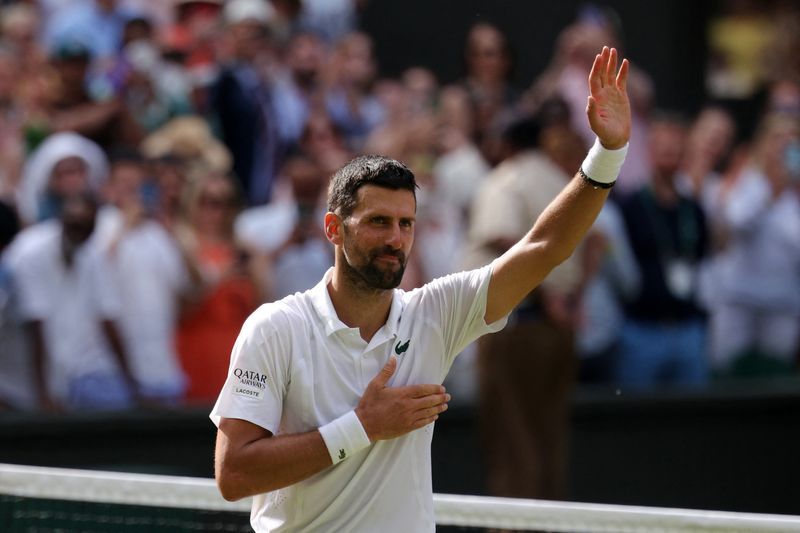
The All England Club enters its most compelling phase on Tuesday when eight competitors battle for spots in the semi-finals, headlined by two storylines that capture different arcs of professional tennis. Novak Djokovic, the 39-year-old Serbian champion, pursues what would be a record 25th Grand Slam victory, while Naomi Osaka, the Japanese comeback story, has suddenly emerged as a genuine title threat after eliminating world number one Aryna Sabalenka in dominant fashion.
Djokovic has already etched his name deeper into Wimbledon's record books by surpassing 106 victories at the All England Club, but the path to another major remains arduous. His march through the tournament has been characterised by grinding, multi-set affairs that have tested both his physical reserves and mental fortitude. Against qualifier Roman Safiullin in the previous round, the 39-year-old needed three and a half hours to prevail, a victory he readily acknowledged came through sheer will rather than sparkling tennis.
The Serbian champion's philosophy reflects the reality of competing at an age when most peers have retired. He has embraced the necessity of suffering through difficult matches, viewing the ability to find ways to win even when playing poorly as a defining characteristic of his legendary career. Yet this approach inevitably raises questions about whether his body can sustain the demands of best-of-five-set tennis against a young, hungry challenger in Felix Auger-Aliassime.
The 25-year-old Canadian third seed represents a different generation entirely, one that has grown up watching Djokovic's dominance from outside the elite circle. Auger-Aliassime's previous encounters with Djokovic yielded a split record in 2022, suggesting he possesses the weapons to trouble the veteran. The Canadian has spoken with genuine reverence about the magnitude of competing against someone whose body of work seems incomprehensible when examined closely. For Auger-Aliassime, reaching a quarter-final against tennis royalty carries significance beyond the match result, representing validation of his trajectory as a player.
On the women's side, Osaka's reinvention appears to be gathering momentum at precisely the right moment. The Japanese player, seeded 14th and competing in her first Wimbledon quarter-final, delivered a masterclass against Sabalenka by dominating the serve exchanges and deploying withering forehands that neutralised the world number one's aggressive game. Sabalenka had defeated Osaka three times already this year, making the comprehensive nature of this victory particularly striking.
Osaka's narrative carries particular resonance across Asia, where her mental health struggles and gradual return to tennis competition have been closely followed. The 28-year-old has not claimed a Grand Slam title since 2021, and her presence in the latter stages of a major tournament reminds observers that her career trajectory remains unfinished business. Beyond the on-court results, her fashion choices at Wimbledon have generated their own conversation, adding another dimension to her story.
Her quarter-final opponent, Karolina Muchova of Czech Republic, brings her own credentials to the matchup. The 10th seed has reached this stage at the All England Club on three previous occasions without advancing further, suggesting she possesses the skill set to trouble seeded opponents but has struggled to break through to the semi-finals. Muchova and Osaka have split their recent meetings, with the Czech player's victory coming on grass at Bad Homburg Open last month. Muchova's deliberate preparation, having contested two tournaments before Wimbledon to accumulate grass-court matches, reflects a strategic approach designed to peak during the fortnight.
The men's draw also features a remarkable subplot involving defending champion and world number one Jannik Sinner facing German first-timer Jan-Lennard Struff. The 36-year-old Struff has become the oldest man in the Open Era to reach a Grand Slam quarter-final for the first time, achieving this feat when Hubert Hurkacz's hip injury forced his retirement during their round-of-16 encounter. For Struff, this represents a validation of perseverance and longevity in a sport that typically favours youth.
The Italian four-time major winner Sinner, by contrast, embodies the younger generation ascendant in men's tennis. However, his three previous victories over Struff provide no guarantee of advancement, as quarter-final matches carry different pressures and dynamics. Sinner has acknowledged the heightened tension accompanying semi-final berth opportunities at major tournaments, even as he expresses contentment with his current positioning.
The quarter-final stage at a Grand Slam represents a fundamental threshold where consistency alone no longer suffices. The remaining eight competitors have demonstrated the capacity to perform under pressure, navigate challenging draws, and maintain physical and mental resilience across multiple rounds. The matches unfolding on Tuesday will determine which competitors possess the additional reserves required to reach the semi-finals.
For Malaysian and Southeast Asian tennis enthusiasts, these matches hold particular interest given the region's growing engagement with professional tennis and the inspirational narratives embedded within each storyline. Osaka's comeback resonates particularly strongly given her Japanese heritage and her visibility across Asian markets. Djokovic's pursuit of longevity at the sport's highest level also carries philosophical weight in cultures that value respect for experience and sustained excellence.
The quarter-finals represent a compression of championship-level tennis into four matches, each carrying maximum consequences. These encounters will likely be remembered not simply for their results, but for what they reveal about the current state of professional tennis and the evolving competition between different generations of athletes. The grass courts at the All England Club will determine whether established champions maintain their grip on the sport's most prestigious tournaments, or whether emerging talents have accumulated sufficient preparation to advance their own legacies.

