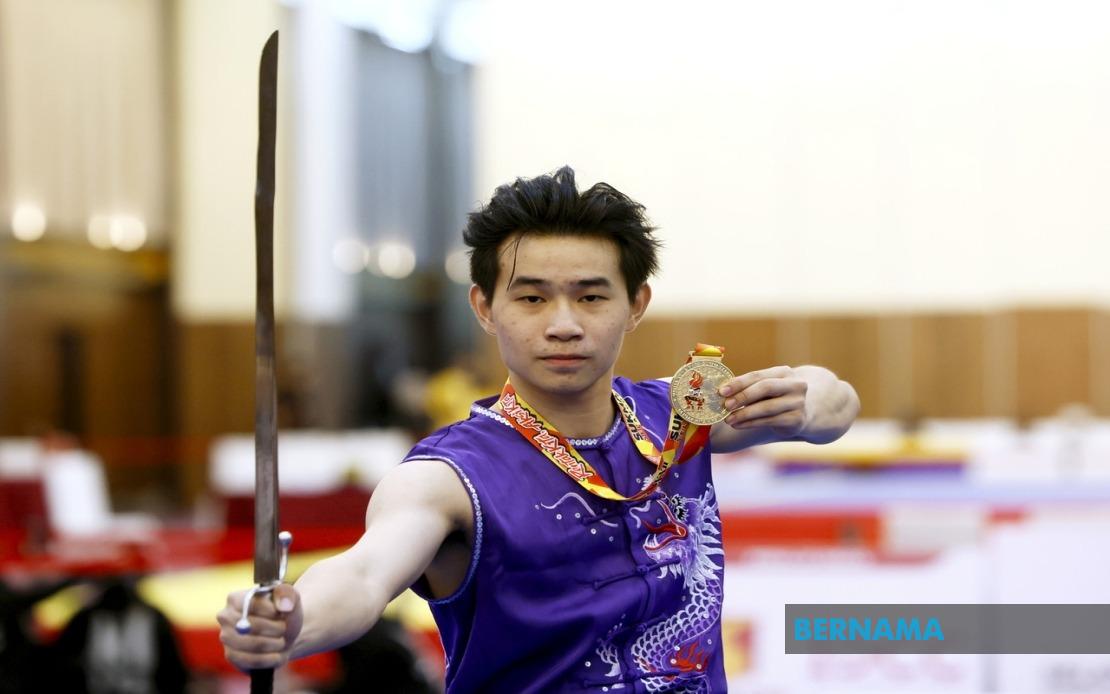
Wee Din Jun's journey to the podium at the 2026 Malaysia Games in Shah Alam represents far more than a single athletic achievement—it embodies the resilience required to overcome both physical setbacks and mental barriers in competitive sport. The 21-year-old Penang wushu specialist claimed gold in the men's nandao nangun competition on August 21, scoring 9.600 points at the Ideal Convention Centre, narrowly surpassing Sarawak's John Phang, who secured silver with 9.563 points. Selangor's Tan Yu Zhe rounded out the podium with bronze, posting 9.550 points. Yet what makes this victory particularly significant is that Din Jun achieved it while nursing a hip injury incurred merely four weeks before the Games commenced, a timing that could have derailed the careers of lesser-determined athletes.
The injury represented only the latest chapter in a challenging narrative that has defined Din Jun's SUKMA career thus far. At the 2022 edition held in Kuala Lumpur, the Bayan Lepas-born athlete managed only a bronze medal performance, a result that fell short of his ambitions. That disappointment paled, however, when compared to his experience at SUKMA 2024 in Sarawak, where a cascade of technical errors across three separate events resulted in him returning empty-handed. The psychological toll of that failure cannot be understated; for an athlete competing on the national stage, failing to medal represents not merely a sporting setback but a personal reckoning with one's capabilities and preparation.
What distinguishes Din Jun's response to adversity is his willingness to absorb coaching wisdom during moments of peak vulnerability. Speaking after his triumph, he revealed that his coach's counsel proved instrumental in shifting his mental approach to competition. Rather than allowing the weight of previous failures to compound his anxiety, Din Jun's coaching staff redirected his focus toward the immediate task at hand—executing a clean, disciplined performance. This philosophical reorientation, emphasising enjoyment and presence over outcome fixation, reflects emerging best practices in sports psychology that increasingly permeate elite athletic training globally. By divorcing himself from external pressure and the ghosts of past competitions, Din Jun created psychological space for technical excellence to flourish.
The nandao nangun event represents one of wushu's most technically demanding disciplines, requiring athletes to demonstrate precise weapon manipulation, controlled footwork, and explosive power whilst maintaining absolute balance and fluidity of movement. The scoring differential between Din Jun's gold and Phang's silver—just 0.037 points—illustrates the extraordinarily narrow margins that separate medals at the elite level. Such margins are often determined not by dramatic failures but by minute deviations in execution, making mental composure an equally decisive factor as physical preparation. Din Jun's ability to deliver near-perfect technical execution while managing pain from his recent hip injury speaks to both his conditioning and his psychological fortitude under competitive pressure.
For Malaysian wushu, the medal carries additional significance as it demonstrates the technical quality being developed within the national programme. Wushu remains a discipline where Asian athletes generally command competitive advantages, yet Malaysian representation at the elite level requires consistent investment in coaching infrastructure, training facilities, and athlete development pipelines. Din Jun's success, achieved despite injury and previous disappointments, illustrates the potential that exists within the local talent pool when proper support structures are in place. His performance also contributes to Malaysia's overall medal tally at SUKMA 2026, with implications for institutional prestige and funding allocation decisions that typically follow Games cycles.
Din Jun's decision to dedicate his gold medal to his former coach, who has since relocated to China, reveals another dimension to his sporting journey. The absence of this mentor at previous medal ceremonies represented a recurring source of regret, underscoring how coaching relationships extend beyond technical instruction to encompass emotional mentorship and personal investment in athlete development. This gesture of remembrance and gratitude, made public in his post-competition interview, reflects the broader reality that athletic achievement rarely emerges from individual effort alone but rather from collaborative relationships built on trust, knowledge transfer, and mutual commitment to excellence.
Looking forward, Din Jun's schedule at SUKMA 2026 extends beyond his nandao nangun success. The nanquan event scheduled for the following day represents his final competitive opportunity at the Games, as this marks his last SUKMA appearance as an eligible athlete. The nanquan discipline, which emphasises hand techniques and rapid combinations, will test whether Din Jun can sustain his performance momentum and potentially accumulate additional medals to conclude his SUKMA career on an even more triumphant note. A strong showing in this event would transform his overall Games record from a narrative of inconsistency into one of genuine resurgence and mature athletic development.
For Malaysian sports enthusiasts, Din Jun's story carries universal resonance that transcends wushu's particular technical lexicon. His journey from bronze to nothing to gold encapsulates the unpredictability of sport, where marginal improvements in preparation, psychology, and physical condition can generate transformative results. The hip injury that threatened to undermine his final Games appearance instead became an unexpected backdrop that enriched the narrative arc of his triumph. In an era when Malaysian athletes increasingly compete on regional and international stages, Din Jun's demonstration of resilience under adversity contributes important examples of the mental attributes required to sustain elite athletic performance. His gold medal, earned through adversity managed rather than prevented, represents not merely a sporting outcome but a testament to the power of perseverance.

