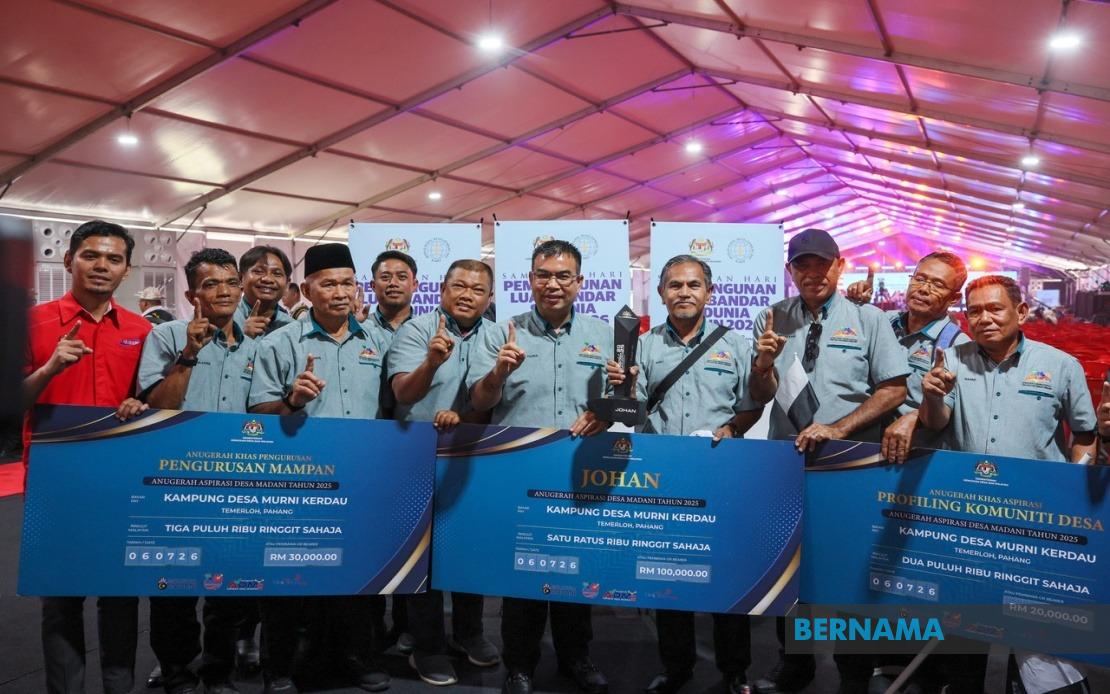
Desa Murni Kerdau, a traditional settlement located in Temerloh, Pahang, has secured three major awards at the World Rural Development Day 2026 celebration held at Tun Abdul Razak Stadium in Jengka Sentral. The recognition encompasses the 2025 MADANI Rural Aspiration Award Champion title alongside two additional honours: the Rural Community Profiling Aspiration Special Award and the Sustainable Management Special Award. The accolades were presented during a ceremony that underscored the government's commitment to acknowledging grassroots development efforts across Malaysia's rural landscape.
Deputy Prime Minister Datuk Seri Dr Ahmad Zahid Hamidi personally delivered the main MADANI Rural Aspiration Award, while Deputy Minister of Rural and Regional Development Datuk Rubiah Wang handed over the two special recognitions. The involvement of senior government figures reflects the significance placed on rural development initiatives that demonstrate tangible community transformation and sustainable practices. Such high-level endorsement signals the administration's prioritization of rural Malaysia as a critical pillar of national development strategy.
According to Mohamad Fazrul Ahmad, who chairs the Village Development and Security Committee for Desa Murni Kerdau, the awards represent validation of the village's approach to governance, institutional leadership, and community-centred development. He emphasized that the recognition acknowledged the village's deliberate efforts to foster excellence across multiple dimensions of rural life, from administrative efficiency to grassroots participation. The committee chairman expressed gratitude to the Ministry of Rural and Regional Development for establishing an award framework that specifically celebrates rural community achievements, recognizing that such initiatives often operate with limited resources yet deliver meaningful results.
The village's success extends beyond governance structures into economic diversification and entrepreneurship. Desa Murni Kerdau has cultivated approximately 20 entrepreneurs operating across diverse sectors, including small and medium industries, agricultural production, and the automotive trade. This entrepreneurial ecosystem demonstrates how rural communities can create sustainable livelihoods without depending exclusively on traditional agricultural pursuits. The emergence of multiple business ventures reflects successful capacity-building and the creation of enabling conditions for local residents to establish income-generating activities.
Tourism has emerged as another significant economic driver for the village through its "Kampung Stay" product, which positions Desa Murni Kerdau among Malaysia's recognized rural tourism destinations. This initiative capitalizes on growing domestic and international interest in authentic rural experiences, allowing visitors to engage with village life while generating revenue for local families. The tourism model exemplifies how traditional settlements can monetize their cultural and environmental assets whilst preserving community character, a balance that many rural areas struggle to achieve.
The physical composition of Desa Murni Kerdau—comprising approximately 200 houses serving a population exceeding 600 residents—reflects a settlement of modest but viable scale. This size allows for cohesive community management and collective decision-making whilst maintaining sufficient population base to sustain local services and economic activities. The structural characteristics suggest a well-planned community organization rather than haphazard rural sprawl, indicating deliberate land-use management and infrastructure development.
The financial rewards associated with the three awards will be channelled directly to residents and allocated toward village improvement and community development initiatives. This approach ensures that recognition translates into tangible benefits for the population, funding projects that address infrastructure gaps, enhance public amenities, or support community services. By distributing prize money among residents rather than absorbing it into government accounts, the village leadership demonstrates commitment to shared prosperity and transparent resource management.
For the broader Southeast Asian context, Desa Murni Kerdau's achievements offer instructive lessons about sustainable rural development. The village illustrates how traditional communities can integrate modern governance practices, entrepreneurial activity, and tourism economics without abandoning cultural identity. The multi-award recognition from Malaysia's rural development ministry suggests growing policy acknowledgment that rural success depends on holistic approaches addressing governance quality, economic opportunity, and quality-of-life improvements simultaneously.
The World Rural Development Day celebration itself functions as a platform for sharing best practices and incentivizing excellence across Malaysia's extensive rural sector. By creating competitive award categories and providing high-profile recognition, the government encourages other villages to adopt similar comprehensive development strategies. Such recognition mechanisms can catalyze wider adoption of effective rural governance models and demonstrate viability of balanced economic diversification in non-urban settings.
For Malaysian policymakers and development practitioners, the Desa Murni Kerdau example underscores that rural prosperity remains achievable through strategic leadership, community engagement, and diversified economic activity. The village's emergence as an award-winning model demonstrates that excellence in rural administration and development is neither aspirational nor dependent on exceptional resource endowment, but rather reflects deliberate management, institutional commitment, and resident participation in charting community futures.

