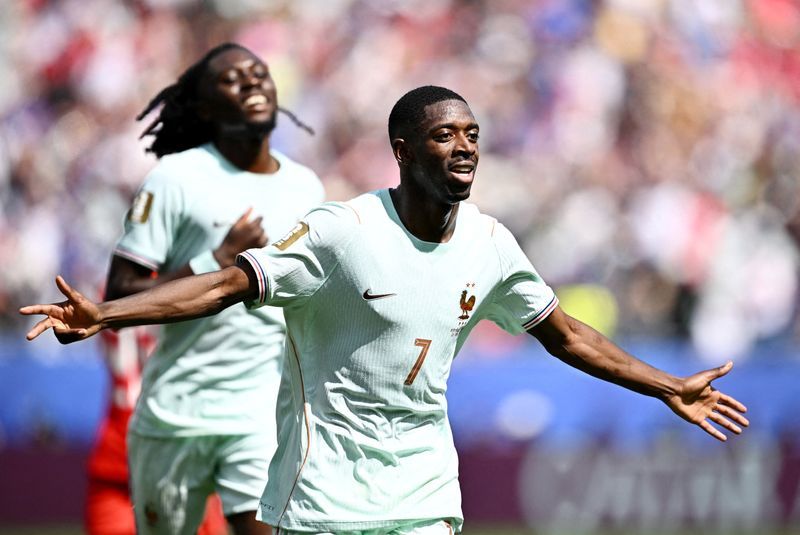
France's hopes of securing a favourable path through the knockout stages were realised on Friday in Foxborough, Massachusetts, with a ruthless 4-1 demolition of a weakened Norway side that underscored the competitive advantage of resting key personnel. Ousmane Dembele emerged as the architect of Les Bleus' dominant performance, completing a spectacular hat-trick in under 30 minutes to propel the defending runners-up and 2018 champions into the Round of 32 with genuine momentum. The efficiency with which the French dismantled their opponents served notice that Didier Deschamps' squad remains among the tournament's most dangerous teams, despite the unusual circumstances surrounding the fixture.
Both teams had already guaranteed their passage to the knockout rounds before Friday's encounter, stripping the match of genuine drama and creating space for strategic calculation to take precedence. France's primary objective was clear: secure first place in the group standings to capitalise on a more forgiving travel schedule through the tournament's sprawling North American geography. The French squad had publicly committed to delivering a victory as a tribute to Deschamps, whose mother's funeral he attended following his departure from the United States earlier in the week. This combination of personal motivation and tournament pragmatism proved devastating for Norway.
The Scandinavian side's tactical approach played directly into France's hands. Coach Stale Solbakken implemented wholesale changes to his starting lineup, rotating out virtually all players from the previous match against Senegal save for one. This decision left critical attacking weapons sidelined, most notably Erling Haaland and skipper Martin Odegaard, a strategic choice designed to preserve fitness for the knockout phase but one that robbed Norway of genuine defensive coherence and creative threat. Against an opponent of France's quality and intensity, such wholesale resting carried substantial risks that quickly materialised.
From the opening moments, France's intentions were unmistakable. Kylian Mbappé, the teenage sensation competing fiercely with Haaland for the tournament's Golden Boot, almost opened the scoring within 20 seconds with a precision angled strike that cannoned off the crossbar. This early warning signal proved prescient. In the sixth minute, Mbappé orchestrated the opening goal with a sensational cross-field pass that released Dembele into space down the left flank. The Paris Saint-Germain winger demonstrated composure beyond his years, cutting inside his marker before executing a clinical angled finish past goalkeeper Egil Selvik.
Dembele's second arrived with remarkable speed fourteen minutes later when Mbappé again proved the architect, feeding his teammate into space where he produced a dipping shot of exquisite technique to extend France's advantage. By this point, Norway appeared overmatched and disorganised, their tactical setup offering insufficient resistance to the French attacking onslaught. Yet remarkably, the Scandinavians managed a fleeting moment of respite when Thelo Aasgaard converted to pull one back, briefly interrupting France's relentless momentum and suggesting the possibility of an improbable comeback.
This interruption proved temporary. Dembele silenced any Norwegian optimism by claiming his hat-trick in the 32nd minute with a precisely curled shot into the bottom corner, becoming only the third French player to achieve the feat at World Cup level after Just Fontaine and Mbappé himself. This treble, accomplished in the space of 25 minutes, ranks among the fastest hat-tricks in World Cup history, surpassed only by Austria's Erich Probst, who scored three goals in 24 minutes against Czechoslovakia in 1954. The statistical rarity of Dembele's achievement underscored the exceptional quality of his finishing and the comprehensive collapse of Norway's defensive structure.
Norway offered limited resistance thereafter, though not through lack of endeavour. Jørgen Strand Larsen squandered an opportunity to narrow the gap early in the second half when he struck a weak penalty that France goalkeeper Mike Maignan comfortably saved. Oscar Bobb continued to press the French backline and forced another save from Maignan, momentarily exposing vulnerabilities in Deschamps' defensive arrangements and suggesting that tactical rigidity might become an issue as the tournament progressed. However, these brief glimpses of vulnerability never translated into concrete scoring opportunities or sustained pressure.
Desire Doué provided the emphatic full stop to the contest in the match's final moments, heading home a cross delivered by substitute Bradley Barcola to establish France's commanding four-goal advantage. This conclusion represented more than simple scoreline inflation; it reflected France's complete control of both tactical and temporal dimensions of the encounter. The victory mechanism functioned with mechanical efficiency, each phase of play reinforcing French superiority while exposing the risks inherent in Solbakken's rotation strategy.
Group I's final standings have created distinct knockout trajectories for the two sides. France's top-place finish positions them to face Sweden in the Round of 32, a matchup that presents manageable challenges given their current form and squad depth. Conversely, Norway's runners-up berth consigns them to a meeting with Ivory Coast, a fixture that presents considerably greater difficulty and limited margin for error. The mathematics of tournament structure thus reward France's group-stage excellence with what appears a more negotiable path forward, though the nature of knockout football ensures no fixture offers genuine guarantees.

