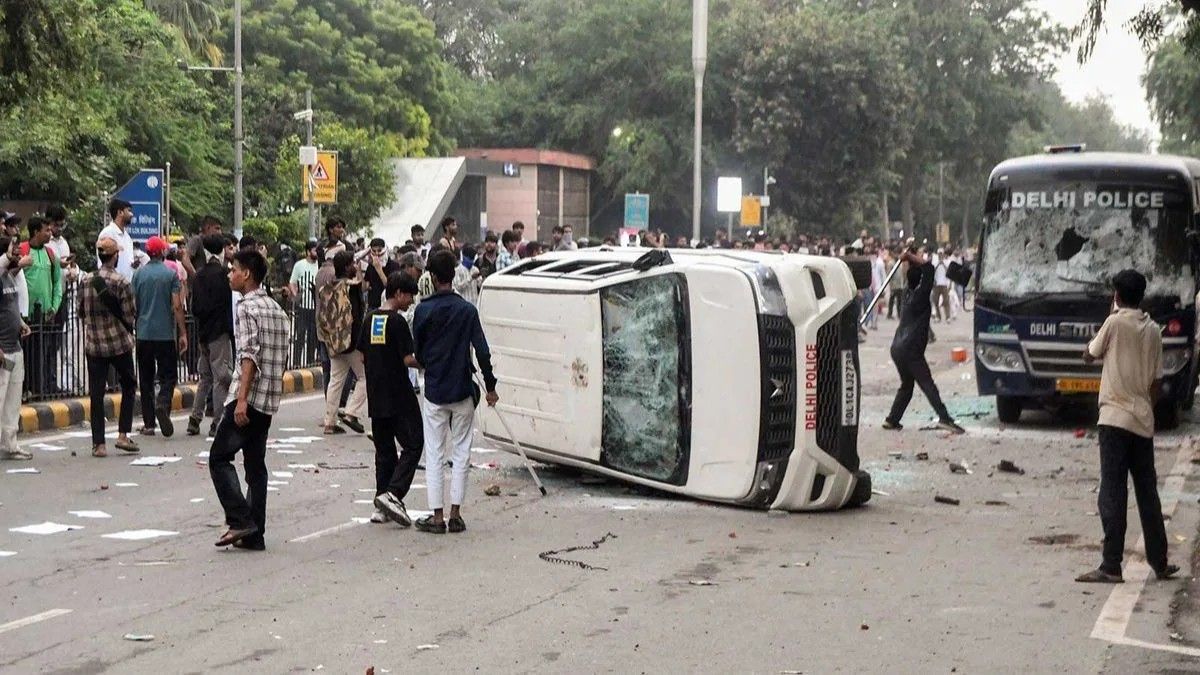
Delhi Police have formally registered 10 cases in connection with disturbances that erupted during the Cockroach Janta Party's (CJP) "Sansad Chalo" march to Parliament, marking a significant escalation in law enforcement response to the demonstration. The filings span multiple police stations across New Delhi district, with four cases lodged at Parliament Street, three at Connaught Place, and individual cases at Mandir Marg, Barakhamba Road and Kartavya Path stations. The charges encompass conspiracy, obstruction of government functions, assault on police, and destruction of public infrastructure, with authorities invoking provisions of the Bharatiya Nyaya Sanhita, the Arms Act, and the Prevention of Damage to Public Property Act.
Even as investigations proceed, Delhi Police have moved swiftly to counter narrative claims circulating on social media, with the Deputy Commissioner of Police for New Delhi issuing an explicit statement dismissing allegations of fresh violence on Tuesday. The police assertion comes as viral videos purporting to show stone-pelting incidents and police action at Jantar Mantar continue circulating online, creating a contest over the protest's actual trajectory. Officials characterised the circulating footage as "false and misleading," appealing to citizens to rely exclusively on official channels rather than unverified social media content. This tension between ground-level narratives and official denials underscores the role of information warfare in contemporary protest dynamics, particularly relevant for regional observers tracking how demonstrations are mediated through digital platforms.
The underlying catalyst for the CJP's mobilisation centres on demands for Union Education Minister Dharmendra Pradhan's resignation, following allegations of examination irregularities within India's higher education system. The Monday march, which precipitated the violence, reflects broader public concern about institutional accountability and governance failures affecting students and families across South Asia. For Malaysian readers accustomed to similar education governance debates, the intensity of Delhi's street politics offers a comparative lens on how regional democracies navigate crises of institutional credibility. The examination irregularities issue strikes at foundational educational equity concerns that resonate across Southeast Asia's rapidly expanding student populations.
Monday's clashes appear to have been particularly intense, prompting Delhi Police to document what they characterise as "unruly, aggressive and violent behaviour" despite pre-existing prohibitory orders and repeated law enforcement warnings. One FIR specifically concerns an alleged life-threatening assault on a Rapid Action Force personnel, suggesting physical confrontation escalated beyond typical protest dynamics. Additionally, authorities have registered a separate case regarding the unauthorised flying of a drone across New Delhi during Parliament's session, indicating the incident involved sophisticated tactical elements beyond conventional demonstration logistics. This detail suggests potential coordination or technological capabilities within protest movements that warrant closer scrutiny.
The forensic investigation effort underway represents the scale of police resource deployment, with authorities examining more than 250 videos to construct accountability chains and establish whether violence followed predetermined coordination rather than spontaneous outbreak. This investigative approach carries implications for protest organisers across the region, as it demonstrates authorities' capacity to reconstruct events through digital evidence and establish individual liability. For Malaysian civil society actors, this precedent illustrates how modern protest contexts increasingly involve digital forensics and retroactive identification of participants, fundamentally altering the risk calculus for demonstration participation.
CJP spokesperson Ashutosh Ranka has signalled that the agitation will persist until the party's core demands are satisfied, indicating that Monday's disruption represents a starting point rather than culmination of the mobilisation. Ranka additionally alleged that numerous demonstrators, particularly students and volunteers, sustained injuries during the confrontation, while asserting that female protesters—including Geetanjali J. Angmo, spouse of activist Sonam Wangchuk—experienced mistreatment. These allegations, if substantiated, would suggest disproportionate police response affecting vulnerable protest demographics. The invocation of Sonam Wangchuk's family name carries particular weight in Indian activism circles, as the Ladakh-based education reformer commands significant credibility within civil society networks.
Following the removal of protest infrastructure by security personnel, demonstrators reconvened at Jantar Mantar on Tuesday, establishing what appears to be an extended occupation of the space. The sustained police and Rapid Action Force presence at the venue maintains pressure on protest continuity, though the absence of confirmed fresh violence suggests either stabilisation or tactical adjustment by authorities intent on preventing escalation. For regional observers, this cat-and-mouse dynamic mirrors protest management strategies deployed across Southeast Asia, where authorities employ graduated responses calibrated to avoid international attention while maintaining control.
The information warfare dimension deserves particular emphasis for Malaysian audiences navigating increasingly fragmented media landscapes. The police denial of Tuesday incidents, issued through social media precisely where misinformation circulates, represents institutional actors attempting to reclaim narrative authority in spaces traditionally dominated by unmediated citizen reporting. The explicit appeal to "rely only on official sources" reflects establishment concern about institutional credibility erosion, particularly acute in contexts where prior police action has generated public scepticism. This dynamic mirrors tensions in Malaysian civil society around protest coverage and police accountability.
The case registrations across multiple jurisdictions carry strategic significance, as dispersed filings complicate bail proceedings and legal coordination for defendants, potentially fragmenting protest movement cohesion. Authorities effectively employ administrative procedure as a pressure mechanism, a tactic relevant across the region where legal systems offer mechanisms for state leverage against organised dissent. The specific inclusion of Arms Act provisions suggests police may be pursuing allegations involving weaponry or explosive devices, elevating charges beyond simple public order breaches into security-related territory that carries heavier sentencing implications.
Looking forward, this protest cycle will likely influence how Indian civil society calibrates future mobilisation strategies, particularly regarding tactical approaches to police engagement and digital documentation practices. For Malaysia and Southeast Asia more broadly, the Delhi episode offers instructive lessons regarding protest management, law enforcement response calibration, and the persistent contestation over narrative control in spaces where government authority and citizen agency collide. The examination of 250 videos and pursuit of pre-planned conspiracy allegations signal authorities' determination to establish movement coordination, potentially deterring future sustained agitation even as immediate mobilisation momentum persists.

