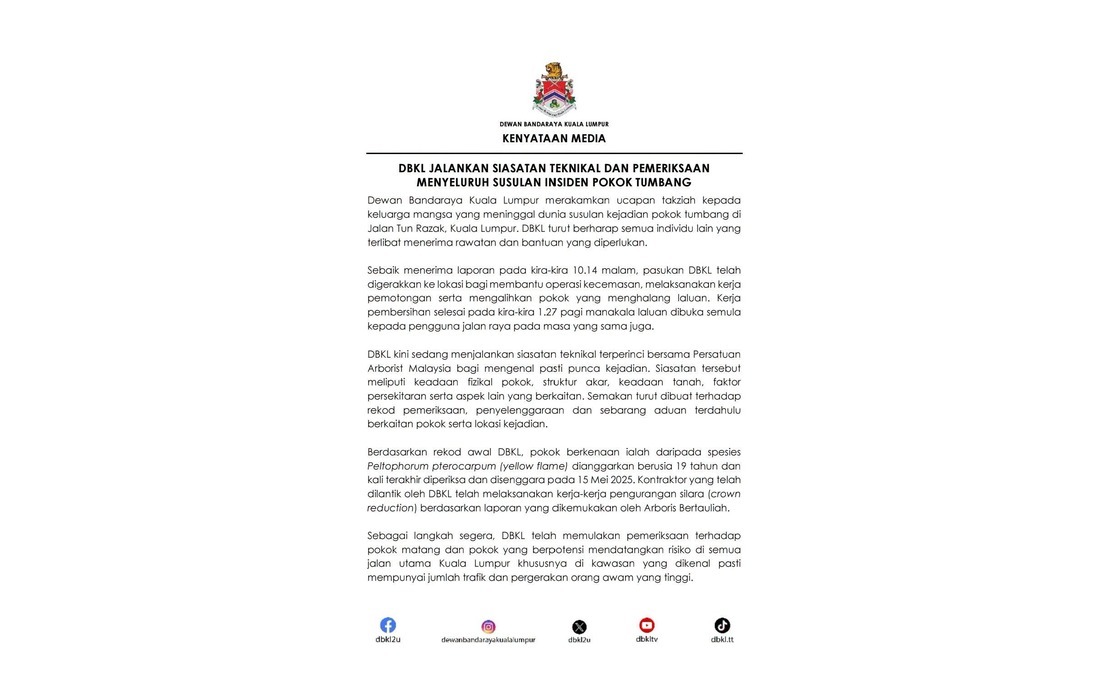
A collaborative investigation between Kuala Lumpur City Hall (DBKL) and the Malaysian Society of Arborist has commenced following a fatal tree collapse on Jalan Tun Razak that claimed a life on the night of July 19. The probe represents a comprehensive technical examination designed to pinpoint the precise factors that led to the structural failure of the tree, with authorities pledging full transparency and cooperation with law enforcement agencies.
The technical assessment will encompass multiple dimensions of the fallen tree's condition and history. Investigators will evaluate the physical structure of the tree itself, examine its root system for signs of disease or deterioration, analyse the surrounding soil composition and stability, and assess broader environmental variables that may have contributed to its collapse. Additionally, the inquiry will scrutinise all available records documenting previous inspections, maintenance activities, and any complaints or concerns raised by members of the public regarding the tree or its immediate vicinity.
DBKL extended formal condolences to the victim's family and indicated that it will ensure those affected receive appropriate medical treatment and financial or logistical assistance as needed. The statement signified the council's intention to cooperate fully with police investigations and any other relevant government agencies involved in establishing accountability and understanding the circumstances of the incident.
Emergency response procedures were activated swiftly, with a dedicated team arriving at the scene immediately after receiving notification at 10:14 pm. The response crew undertook urgent tree-cutting operations and cleared obstruction from the roadway, allowing Jalan Tun Razak to reopen to vehicular traffic by 1:27 am. This rapid clearance minimised disruption to transportation networks in what is one of Kuala Lumpur's key arterial routes.
Records indicate that the fallen specimen was a Peltophorum pterocarpum, commonly known as the Yellow Flame tree, estimated to be approximately 19 years old. The tree had undergone its most recent inspection and maintenance procedures on May 15, when a certified arborist's report prompted the appointed contractor to execute crown reduction works—a technique intended to reduce overall biomass and lower the centre of gravity to improve stability. That these preventive measures had been undertaken shortly before the fatal collapse has raised questions about whether the assessment was adequate or whether unforeseen factors altered the tree's condition in the intervening weeks.
In response to the incident, DBKL has implemented an urgent systematic inspection programme targeting mature trees and those exhibiting elevated risk across all major thoroughfares throughout Kuala Lumpur. The immediate phase concentrates on high-traffic corridors including Jalan Ampang, Jalan Sultan Ismail, Jalan Raja Laut, Jalan Datuk Keramat, and sections of Jalan Tun Razak itself. The city council has mobilised eight inspection teams, including five certified arborists, with projections indicating completion of initial assessments within ten weeks—a timeline suggesting the scale of the undertaking and the number of trees requiring evaluation.
Looking beyond immediate emergency measures, DBKL is pursuing a medium-term technological solution to prevent similar incidents. The council is currently awaiting approval from SIRIM, the Standards and Industrial Research Institute of Malaysia, to deploy approximately 400 advanced tree sensors throughout high-risk locations across the city. These devices will function as an early-warning system, continuously monitoring multiple parameters that indicate tree health and structural integrity. The sensors will track soil moisture dynamics, detect shifts in wood structure that signal internal decay or stress, and measure response to environmental stressors such as heavy rainfall and flood conditions—factors particularly relevant in Malaysia's tropical climate where monsoon seasons bring intense precipitation.
The initial deployment phase will focus on four strategically significant locations: Jalan Bangsar, Dataran Merdeka, Jalan Ampang, and Jalan Raja Chulan. These sites have been selected based on their combination of mature tree populations, high pedestrian and vehicular traffic volumes, and proximity to commercial or civic infrastructure where tree failure poses heightened risk to public safety. Once installed and operational, the sensor network will generate real-time data allowing DBKL's arboricultural teams to prioritise maintenance activities and removal decisions on an evidence-based foundation rather than relying solely on periodic manual inspections.
The incident underscores vulnerabilities in urban forestry management that extend well beyond Kuala Lumpur, resonating across Southeast Asia's rapidly urbanising cities. As regional capitals expand and mature tree canopies age, municipal authorities face escalating pressure to balance environmental and aesthetic benefits of urban greenery against public safety imperatives. The adoption of sensor technology represents a sophisticated response aligned with global best practices in arboricultural management, though implementation costs and technical expertise requirements may challenge resource-constrained municipalities throughout the region.
For Malaysian residents and businesses, particularly those in Kuala Lumpur, the investigation outcome and subsequent policy adjustments carry direct implications. Enhanced tree monitoring and accelerated removal of compromised specimens may alter the visual character of certain streetscapes, yet promise improved safety margins. The incident has catalysed a broader reckoning with tree management practices, forcing acknowledgment that historical inspection frequencies and maintenance protocols may be insufficient given climate variability and the inherent degradation of biological materials. This calibration of urban forestry approaches reflects a maturation in how cities conceptualise infrastructure stewardship, recognising that trees constitute essential but potentially hazardous components of the public realm requiring proactive rather than reactive governance frameworks.

