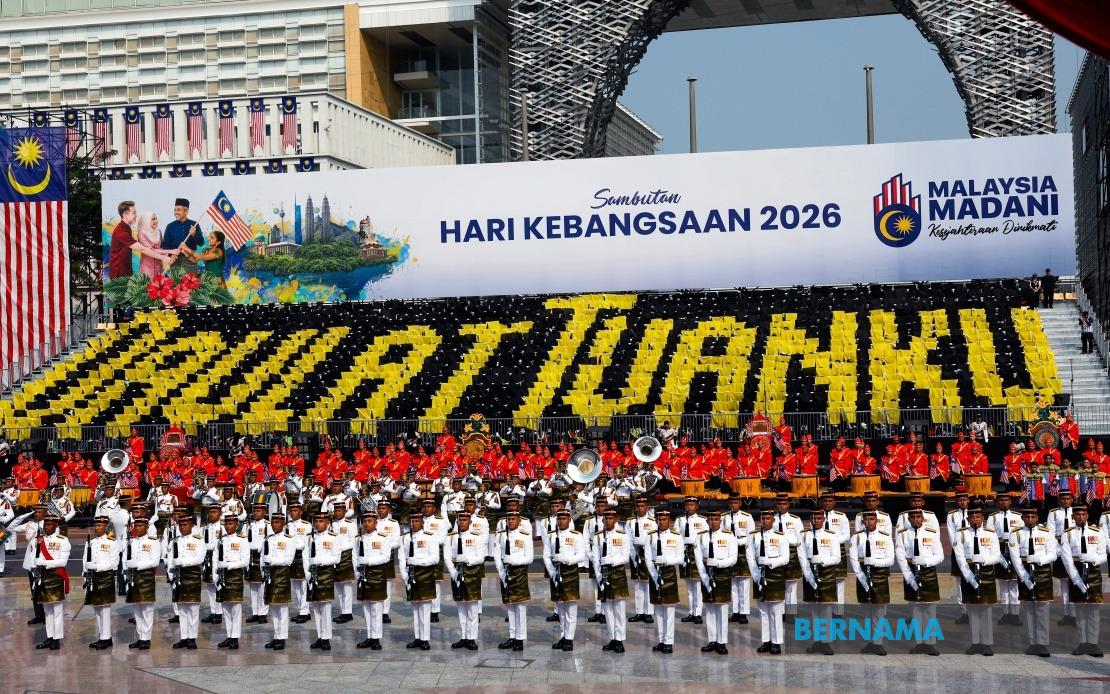
Malaysia's administrative heart will host a sweeping display of national pride tomorrow as Dataran Putrajaya transforms into a stage for the country's 69th National Day celebration. The event, anchored by the theme "Malaysia MADANI: Kesejahteraan Dinikmati", represents far more than ceremonial pomp—it encapsulates how the government seeks to frame contemporary Malaysian identity through a blend of traditional values, modern innovation, and inclusive prosperity messaging that resonates with the MADANI governance agenda.
Royal participation underscores the constitutional significance of the occasion. His Majesty Sultan Ibrahim, King of Malaysia, and Her Majesty Raja Zarith Sofiah, Queen of Malaysia, will grace the proceedings, joined by Prime Minister Datuk Seri Anwar Ibrahim and Cabinet members. This convergence of constitutional, executive, and ceremonial authority signals the unified national purpose that Independence Day ceremonies aim to reinforce across Malaysian society.
The logistical scale of tomorrow's gathering demonstrates the complexity involved in orchestrating such public spectacles. Beginning at 8:00 am, the parade will mobilise 10,819 participants across 76 distinct contingents, accompanied by 22 marching bands and 11 float vehicles. Perhaps most striking is the military component: 328 land, naval, and air assets will be deployed, alongside 112 working animals and 22 electric vehicle platforms. This arsenal of hardware serves dual purposes—projecting national defence capacity while simultaneously showcasing Malaysia's technological modernisation and environmental consciousness through EV integration.
The opening performance, titled "Gema Inovasi MADANI", represents a deliberate attempt to synthesise cultural continuity with contemporary relevance. Coordinated by the National Department for Culture and Arts under the Ministry of Tourism, Arts and Culture, this segment will feature 150 musical instruments and 700 traditional kompang frame drums. By recruiting predominantly traditional percussion ensembles to represent Malaysia's ethnic diversity—framed as symbols of harmony and well-being—organisers craft a cultural narrative that positions heritage not as museum artefact but as living expression of national cohesion. This approach carries particular weight for Southeast Asian readers who recognise the political sensitivity surrounding cultural representation and ethnic balance in multicultural societies.
Successive parade components build thematic coherence around the MADANI framework. The statehood segment includes uniformed services and cadet officers from the National Resilience Leadership Academy and National Defence University of Malaysia (UPNM), alongside National Service Training Programme (PLKN) contingents. This emphasis on institutional discipline and structured national development reflects administrative priorities emphasising youth mobilisation and institutional robustness. The inclusion of Glasgow 2026 Commonwealth Games medalists within a sports well-being component further connects individual achievement to collective national standing—a particularly potent messaging strategy in Southeast Asia, where sporting excellence often carries disproportionate soft-power significance.
Private sector integration throughout the parade reveals contemporary Malaysian celebration's commercial dimensions. Corporations including Munchy's Malaysia, ZUS Coffee, MR. D.I.Y Group (M) Berhad, Carsome Sdn Bhd, and Malaysia Airlines occupy designated parade positions, blurring boundaries between patriotic spectacle and commercial branding. This private-public partnership model reflects broader governance trends where business participation in state-sanctioned events becomes normalised, offering companies visibility while allowing organisers to distribute logistical costs. For Malaysian businesses, parade participation represents legitimacy signalling and community brand positioning.
Public order and security agencies feature prominently, with the Malaysia Civil Defence Force, Road Transport Department, and Malaysian Fire and Rescue Department all participating. This institutional visibility serves reassurance functions particularly relevant in the Southeast Asian context, where security concerns regularly intersect with public event planning. The Johor Military Force's participation, positioned as Malaysia's oldest military unit defending royal sovereignty, adds historical depth while reinforcing federalist principles and state-level institutional pride.
Tourism promotion through parade floats showcasing state icons, traditional attire, and flora and fauna signals how National Day celebrations function as year-round destination marketing tools. The Visit Malaysia Year 2026-2027 campaign floats transform the independence commemoration into promotional opportunity, merging patriotic observance with economic objectives—a pragmatic approach that reflects Malaysia's tourism-dependent regional economy.
Younger demographic engagement receives explicit attention through animated content partnerships. Les' Copaque's deployment of Upin and Ipin characters targets family audiences and younger Malaysians, recognising that contemporary national identity formation increasingly occurs through media franchises and entertainment rather than through traditional institutional channels. The human graphics performance mobilising 1,500 students from 36 Selangor schools adds participatory element, transforming observers into choreographed components of the spectacle itself.
The air show climax, featuring Royal Malaysian Air Force fighter jets performing aerial manoeuvres above the administrative centre, crystallises the event's security-centred narrative arc. Military hardware displays throughout the region function as deterrent signalling and capability projection, particularly pertinent given ongoing regional security dynamics in the South China Sea and surrounding waters. For Malaysian audiences, such demonstrations reinforce confidence in institutional defence capabilities.
Faizal Tahir's commissioned theme song "Aku Berjanji" provides emotional and musical framing, translating abstract governmental policy themes into accessible popular culture formats. Professional musical composition lends ceremonial gravitas while contemporary performance styles ensure broader generational resonance than traditional patriotic march arrangements might achieve.
Practical public health considerations reflect current environmental challenges facing the region. Communications Minister Datuk Seri Fahmi Fadzil's recommendation that attendees wear N95 masks responds to ongoing haze conditions affecting Malaysia and broader Southeast Asia. The organisers' distribution of over 10,000 masks to parade participants demonstrates acknowledgment that contemporary public events must address air quality alongside ceremonial concerns—a reality increasingly shaping how Southeast Asian nations conduct outdoor gatherings.
Transport coordination and infrastructure closure represent necessary accompaniments to large-scale public events. The Ministry of Home Affairs' notification of full closure to Putrajaya's Core Island beginning August 30 at 5:00 am through August 31 at 6:00 pm, affecting five major bridges and surrounding routes, reflects the geographical scale of participation anticipated. Malaysian and visiting audiences must plan alternative transport via public systems, itself a logistical exercise reflecting Klang Valley's transport infrastructure capacity and limitations.

