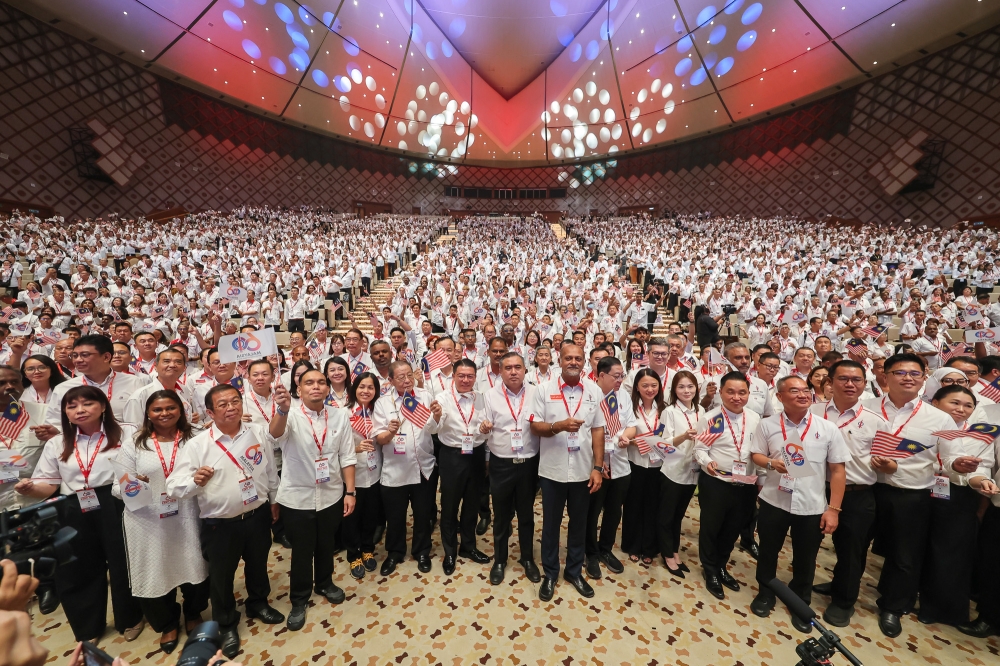
At its national congress in Putrajaya, the Democratic Action Party heard a pointed challenge to its governing strategy when Sangeet Kaur Deo, chief of the party's legal bureau, questioned the sustainability of DAP's partnership with Prime Minister Anwar Ibrahim. Speaking to delegates, she argued that the coalition structure under Anwar's administration has created divisions rather than cohesion, a concern that reflects growing tensions within the broader Pakatan Harapan alliance and raises questions about the viability of Malaysia's ruling arrangements heading into 2025.
Sangeet's intervention at the party congress represents a significant moment of internal dissent within DAP's leadership ranks. Rather than framing her critique as merely tactical disagreement, she positioned her concerns as foundational issues about whether the current coalition model serves the party's electoral and policy interests. Her assertion that the Prime Minister has inadvertently empowered Umno—traditionally viewed as DAP's chief political antagonist—strikes at the heart of coalition logic, suggesting that participation in government may be weakening rather than strengthening the multiethnic opposition to Malay-Muslim majority politics.
The timing of these remarks during a formal party congress carries particular weight in Malaysian politics. Such gatherings serve as arenas where party leaders test emerging positions and gauge grassroots sentiment before potential policy shifts. That Sangeet felt emboldened to voice these doubts suggests underlying frustration within DAP that extends beyond individual personalities to structural questions about how the coalition functions and allocates influence. For Malaysian observers, this signals that the post-2022 governing arrangement, once hailed as a return to democratic normalcy, faces legitimacy challenges even among its architects.
DAP's historical role as the primary representative of urban Chinese and Indian Malaysian interests, combined with its positioning as a secular, multiethnic alternative to race-based politics, means that its relationship with Anwar Ibrahim carries symbolic weight beyond mere coalition arithmetic. Anwar, himself a former Umno member turned reformist icon, has sought to position his administration as transcending the old ethnic-centric political divisions. However, Sangeet's critique suggests that this vision may be seen by some within DAP as a hollow concession that leaves the party vulnerable while failing to fundamentally reshape Malaysia's political culture.
The allegation that Anwar's government has inadvertently strengthened Umno warrants closer examination within the Malaysian political context. Umno, despite its corruption scandal and the imprisonment of former premier Najib Razak, has maintained significant organisational capacity and remains the largest single party in parliament. If DAP perceives that government participation has weakened its ability to challenge Umno's dominance—whether through compromised policy autonomy or diluted oppositional messaging—then the party faces a genuine strategic dilemma about whether continued coalition participation serves its long-term interests or those of rival Chinese-based parties like Gerakan or DAP's own electoral challenges from the Islamist PAS.
Sangeet's call for a rethink of ties with Anwar does not necessarily presage DAP's departure from government or the collapse of Pakatan Harapan. Rather, it articulates a dissatisfaction that likely resonates among party activists concerned that DAP has become a minority voice within a larger structure dominated by Anwar's presence and Bumiputera-oriented politics. For DAP's urban, educated voter base, particularly in states like Penang and Selangor where the party exercises stronger influence, concerns that coalition participation has blunted their policy objectives—especially on matters of meritocracy, secular governance, and institutional reform—carry real consequences for electoral motivation.
From a Southeast Asian perspective, DAP's internal reckoning reflects broader challenges facing multiethnic, progressive coalitions across the region as they navigate majority-centric politics and competing visions of national identity. Thailand, Indonesia, and the Philippines have all witnessed similar tensions where secular, reform-minded parties struggle to maintain distinctiveness and leverage within broader coalitions increasingly shaped by populist or religious-nationalist dynamics. Malaysia's Pakatan Harapan, despite its 2018 victory promise, has not fundamentally altered the underlying primacy of Malay-Muslim political interests in national policymaking.
The immediate question for DAP's leadership is whether Sangeet's comments represent a genuine shift toward repositioning within or outside the coalition, or whether they function as a pressure valve allowing controlled dissent that ultimately reinforces the status quo. Party veteran Lim Kit Siang and secretary-general Anthony Lim will need to respond substantively to demonstrate that DAP retains strategic agency rather than serving as junior partners acquiescing to Anwar's leadership. The party congress itself becomes an indicator of whether DAP membership has reached a tipping point on coalition confidence or whether traditional party discipline will prevail.
Looking forward, Sangeet's intervention suggests that the next general election cycle, whenever called, will feature significant internal coalition negotiations even before competition with opposition parties fully materialises. Should economic conditions deteriorate or if specific policy failures erode the government's performance credentials, DAP may indeed contemplate recalibrating its political posture. Conversely, if the government stabilises and delivers tangible results in areas like cost of living and institutional reform, DAP can better justify continued participation despite internal reservations.
Ultimately, the congress remarks illuminate a fundamental question about whether Malaysia's 2022 political realignment represents genuine transformation or merely a redistribution of power among established elites. For DAP and other component parties within Pakatan Harapan, the answer will shape not only coalition dynamics but also the broader trajectory of Malaysian democracy and the viability of alternatives to race-based political organisation.

