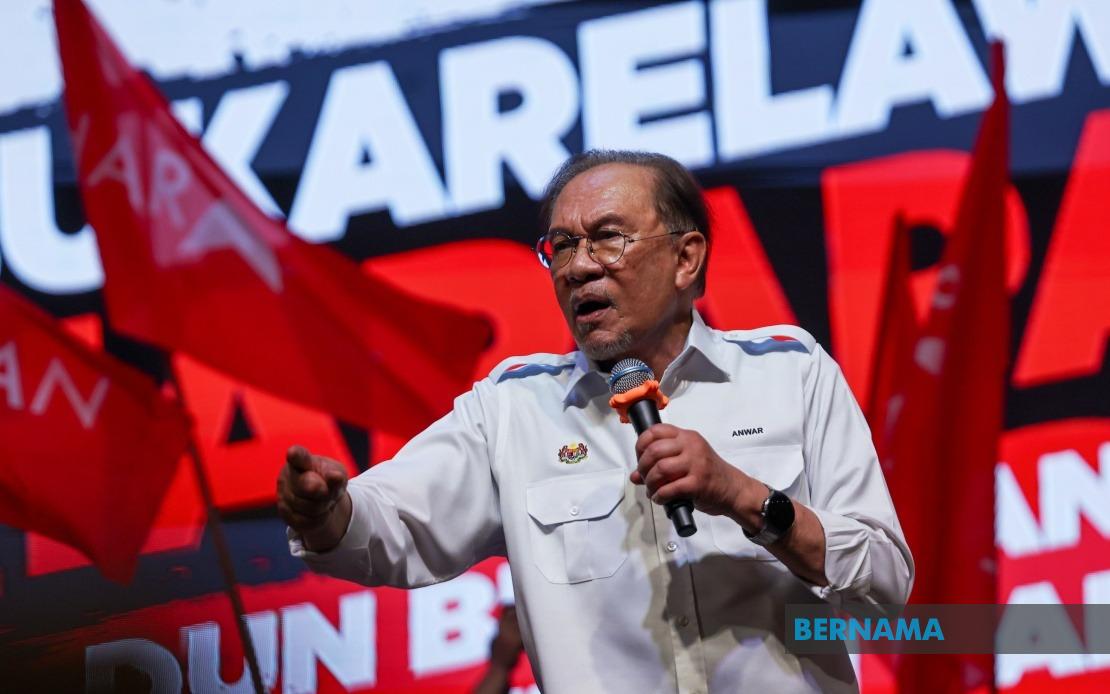
Prime Minister Datuk Seri Anwar Ibrahim moved to counter a damaging political narrative on Saturday, defending the Democratic Action Party (DAP) against suggestions that it harbours anti-Malay sentiments. Speaking at a campaign event in Muar ahead of Johor's state elections, the Pakatan Harapan chairman rejected characterisations of the Chinese-majority party as harbouring racist intentions, pointing instead to concrete evidence of its willingness to accommodate constitutional protections for the Malay community.
The timing of Anwar's remarks reflects ongoing tensions within Malaysia's fragile political coalition, where opposition parties have frequently sought to drive wedges between DAP and its Malay-Muslim coalition partners by portraying the party as fundamentally hostile to Bumiputera interests. Such attacks have proven particularly potent in Malay-majority electoral contests, where perceptions of threats to constitutional safeguards carry considerable political weight. By raising the issue proactively during a state election campaign, Anwar appears determined to neutralise this line of attack before it gains further traction.
As evidence of DAP's commitment to Malay rights, Anwar highlighted the party's lack of opposition to the government's gazettal of 20.23 hectares in Bandar Malaysia as Malay Reserve Land. The significance of this example extends beyond mere symbolism. The designation of reserve land carries constitutional weight under Article 153 of the Federal Constitution and represents a visible acknowledgment of special Bumiputera entitlements. DAP's acceptance of this designation—rather than mounting legal or parliamentary challenges—demonstrates pragmatic recognition that Malaysia's constitutional settlement around indigenous protections is foundational to national stability.
However, Anwar's broader message articulated a vision of inclusive governance that goes well beyond protecting any single community's interests. In remarks that underscored the philosophical foundation of the Unity Government, he emphasised that equitable treatment across racial lines does not require neglecting any group's development. The Prime Minister pointed to expanded allocations for the National Entrepreneurs Corporation (Perbadanan Usahawan Nasional Berhad or PUNB) and targeted programmes for the Malay and Bumiputera communities as evidence of the government's continued commitment to these constituencies. Yet he simultaneously insisted that such initiatives need not come at the expense of assistance to disadvantaged Chinese and Indian populations.
This framing—which positions universal welfare provision and communal equity as compatible rather than competing objectives—represents an attempt to reshape how Malaysians discuss distributive justice in plural societies. Rather than treating resource allocation as a zero-sum game where gains for one community necessitate losses for another, Anwar articulated a vision where poverty alleviation and economic opportunity transcend communal boundaries. The approach reflects recognised principles of inclusive development but also carries domestic political risks, as it potentially invites criticism from constituencies accustomed to prioritisation rhetoric.
Beyond interethnic relations, Anwar used his Muar platform to address broader concerns about the trajectory of Malaysia's economic growth and its beneficiaries. He acknowledged that the nation currently enjoys expanding economic activity but expressed concern that prosperity remains concentrated rather than diffused throughout society. This observation carries particular resonance in a Malaysian context where rapid urbanisation and structural economic changes have created visible disparities in living standards, even as headline growth figures remain respectable by regional standards.
The Prime Minister's articulation of development objectives emphasised material improvements to people's everyday lives rather than abstract growth metrics. He identified affordable housing, enhanced basic infrastructure, and educational quality as tangible measures of whether economic expansion genuinely translates into improved welfare. These targets suggest a governance agenda focused on bread-and-butter concerns that resonate across Malaysia's diverse communities—concerns about affordable shelter and good schools transcend ethnic and class boundaries in meaningful ways.
Understanding Anwar's remarks requires recognising the immediate political context. The Johor state election scheduled for July 11 represents a significant test for the Unity Government's ability to consolidate support beyond its core constituencies. With 172 candidates competing for 56 state assembly seats, the contest carries implications extending well beyond Johor. A strong performance would validate the Unity Government's claims to represent broad-based support, while a weak showing might embolden opposition narratives about declining confidence in the governing coalition. For DAP specifically, the election provides an opportunity to demonstrate that it can contest in Malay-majority constituencies without triggering the reflexive anti-DAP voting patterns that have hampered its electoral performance in previous contests.
Anwar's final remarks on the relationship between political power and personal enrichment touched on an important dimension of Malaysian governance discussions. By explicitly cautioning against viewing political office as an opportunity for private accumulation, he addressed longstanding public concerns about corruption and the misuse of state resources. This emphasis carries added weight given Malaysia's recent history of high-profile political corruption cases and continues to feature prominently in public discourse about institutional integrity. The framing of politics as a trust rather than an asset class represents an aspirational statement about governance standards.
The broader significance of Anwar's Muar remarks extends beyond immediate electoral calculations. His simultaneous defence of DAP, articulation of inclusive development principles, and emphasis on equitable distribution of economic benefits represent an attempt to articulate a coherent governing philosophy for the Unity Government. Whether such messaging can overcome entrenched communal voting patterns and scepticism about multi-racial governance coalitions remains an open question, particularly in Bumiputera-majority constituencies where electoral behaviour has historically reflected acute sensitivity to questions of communal representation and protection of constitutional safeguards.

