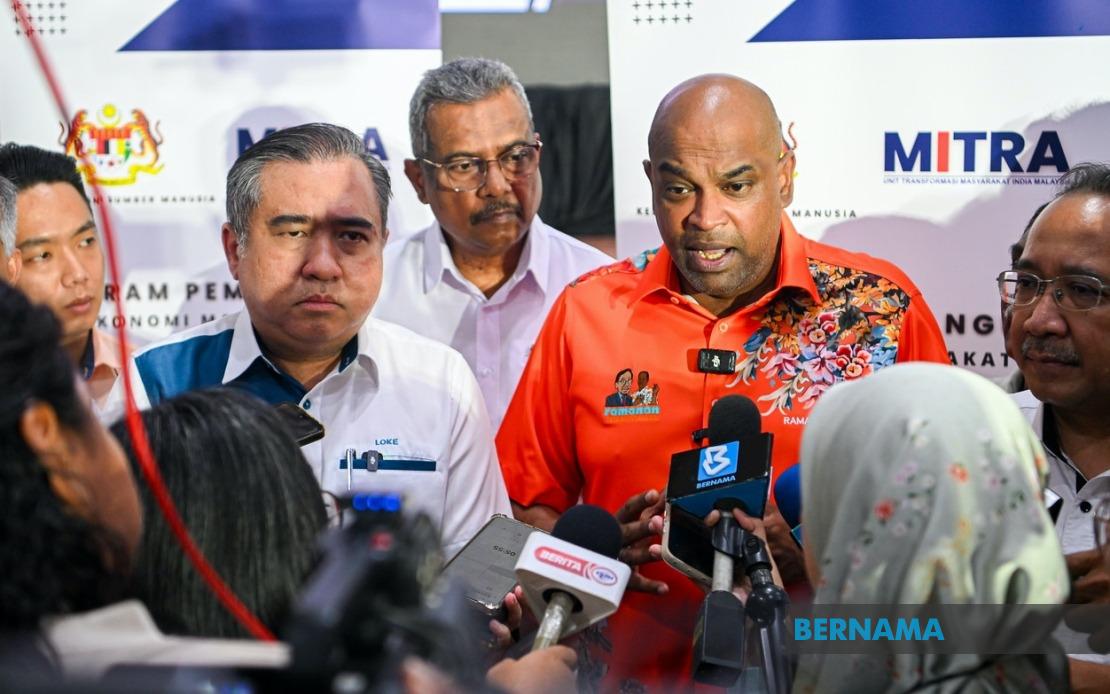
Accusations that the Democratic Action Party (DAP) wields disproportionate influence over Malaysia's government represent a tired political attack devoid of substance, according to DAP secretary-general Anthony Loke. Speaking in Seremban on July 7, Loke pushed back against what has become a recurring criticism of the Pakatan Harapan (PH) coalition, arguing that the narrative misrepresents how the administration actually functions across both federal and state governance structures.
Loke provided a detailed account of the decision-making process within the federal government, emphasizing that all policies emerge from a collaborative framework rather than unilateral direction by any single party. He explained that component members of the coalition—which include DAP alongside UMNO and PKR—each have the opportunity to present their positions during policy discussions before Prime Minister Datuk Seri Anwar Ibrahim makes the final determination. This structure, Loke suggested, reflects the fundamental nature of coalition governance, where multiple parties must negotiate shared ground while preserving a clear hierarchical process for ultimate accountability.
The Transport Minister's remarks address a persistent challenge facing the PH administration since it took office. Opposition voices and political opponents have frequently alleged that DAP, as a non-Bumiputera party with significant parliamentary representation, exerts outsized control over government direction. These claims have particular resonance among Malay-Muslim voters who form a crucial electoral constituency, and they tap into deeper anxieties about minority representation and communal interests within a plural society. By repeatedly raising such concerns, critics aim to erode confidence in the coalition among voters traditionally aligned with race-based politics.
Loke's framing of the issue reveals the coalition's strategic response to these attacks: rather than dismissing them outright, PH leadership attempts to demystify the coalition's operations and present them as transparent and inclusive. He underscored that individual parties contribute substantively to debates, with UMNO and PKR each voicing their distinct perspectives alongside DAP's positions. However, he emphasized that this participatory process culminates in decision-making authority concentrated in the office of the Prime Minister, thereby preserving the constitutional hierarchy and the ultimate political responsibility that flows through the chief executive.
The Negeri Sembilan governance model serves as Loke's empirical example of how this principle functions at state level. Menteri Besar Datuk Seri Aminuddin Harun follows an analogous consultative approach with component parties before finalizing state-level policies and administrative decisions. This consistency across federal and state tiers provides what Loke presented as evidence that DAP participation operates within established protocols rather than circumventing them. The parallel governance structures, if they function as described, would suggest that DAP's role reflects its position as a coalition member with legitimate input rights rather than hegemonic authority.
Loke also addressed companion concerns about communal welfare, specifically rejecting claims that Malay interests face erosion under PH administration in Negeri Sembilan. He noted that the state continues to be administered by a Malay Menteri Besar, a symbolic marker that PH explicitly maintains within its power-sharing arrangements. This fact directly contradicts allegations that non-Bumiputera parties have marginalized Malay political leadership or subordinated Malay-Muslim policy concerns. Loke characterized such allegations as repetitive tactics designed to create fear rather than address substantive governance outcomes.
His assertion that government policies and programmes in Negeri Sembilan have consistently protected community interests, including those of Malays, since PH assumed state control in 2018, shifts the debate toward concrete performance metrics. This rhetorical move invites voters to evaluate the coalition not on the basis of speculative claims about hidden power dynamics but rather on measurable policy implementation and distributional outcomes. For Malaysian readers evaluating PH's track record, Loke's approach implies that community welfare can be verified through observable state performance rather than inferred from organizational structure.
The broader context for Loke's comments reflects intensifying political polarization as Malaysia moves toward potential electoral contests. Opposition forces, particularly those aligned with race-based and religion-centric messaging, have invested substantially in depicting the PH coalition as fundamentally unstable or captured by particular interests hostile to Malay-Muslim majorities. These narratives circulate widely in social media and through alternative political networks, reaching constituencies skeptical of traditional mainstream parties. Loke's public rebuttal attempts to interrupt that narrative circulation and reframe the coalition's internal dynamics for audiences vulnerable to such claims.
The DAP's position within Malaysian politics carries distinct historical and contemporary dimensions that inform this debate. As a Chinese-majority, secular, and left-leaning party, DAP has long faced suspicions from Malay-Muslim voters despite extensive efforts to broaden its appeal and demonstrate commitment to constitutional protections of Bumiputera rights and Islamic institutions. Its alliance with UMNO in the current PH configuration represents an unprecedented realignment in Malaysian politics, one that continues to generate friction and skepticism even among coalition partners. Loke's need to repeatedly defend DAP's non-domineering role suggests that such anxieties remain potent despite governance experience.
For regional observers, the Malaysian coalition's internal management challenges offer insights into the broader difficulties facing ethnically and ideologically diverse democracies. Southeast Asian nations wrestling with plural societies and power-sharing arrangements face similar pressures to balance inclusive governance with reassuring majority communities that their interests remain protected. The specific accusation that DAP dictates government policy, however, reflects Malaysian-particular anxieties rooted in the country's constitutional settlement around Bumiputera protections, Islamic institutions, and Malay political preeminence. How the PH coalition manages these perceptions will significantly influence voter confidence and coalition durability.
Loke's defensive posture, while understandable given the political environment, also reveals the fragility of consensus-based coalition governance in a context of deep communal divisions and historical grievances. His repeated need to clarify decision-making processes and to emphasize collective responsibility suggests that substantial portions of the electorate remain unconvinced that power truly flows through consultative channels rather than shadowy dominance by particular parties. The gap between Loke's description of how the coalition actually functions and how many voters perceive its operations represents an ongoing challenge for PH as it seeks to rebuild and sustain political support.

