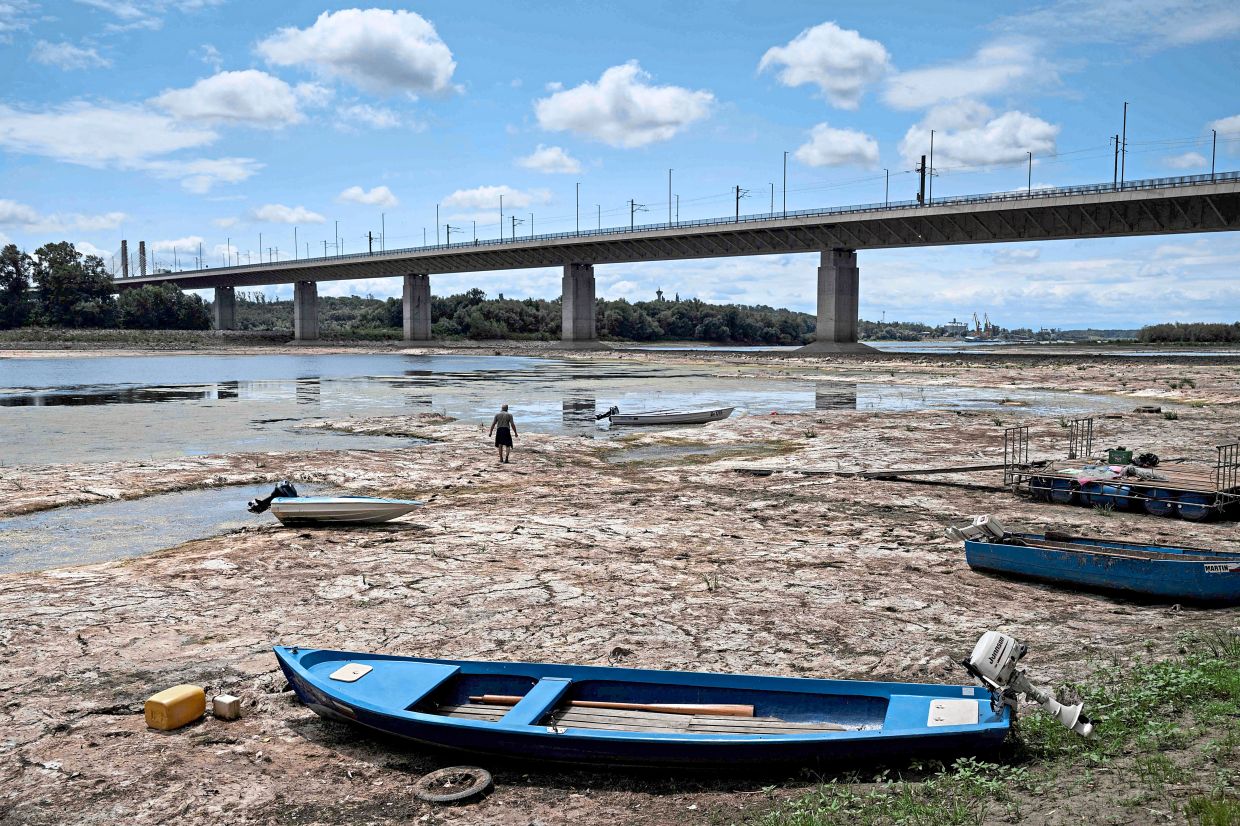
The Danube River, one of Europe's most essential waterways, has reached catastrophically low levels as a prolonged drought and consecutive heat waves grip Central Europe, exposing the region's vulnerability to climate change whilst simultaneously disrupting critical tourism, shipping and energy sectors across a ten-nation corridor stretching from Germany to the Black Sea. The crisis represents the starkest warning yet of how environmental pressures are straining the infrastructure that sustains hundreds of millions of people.
On 29 July, Budapest's water authority recorded an astonishing 23 centimetres at a key measurement point in Hungary's capital—plunging well below the previous historic minimum of 33 centimetres set merely five years earlier in 2018. This dramatic decline within such a short timeframe has shocked observers and policymakers alike, with meteorologists forecasting continued deterioration as temperatures across the region are projected to exceed 38 degrees Celsius and precipitation forecasts offer little relief. The Hungarian Meteorological Service reports that ninety-day rainfall totals have fallen 80 to 130 millimetres below long-term averages across nearly the entire country, painting a picture of systematic water deficit rather than isolated dry patches.
The visual testimony to this ecological transformation has proven striking and deeply unsettling for residents. Photographer Gabor Kertesz documented the exposed bedrock and barren sandbars around Budapest's Margaret Bridge—areas that normally remain submerged throughout the year. His observations capture not merely a statistical phenomenon but a visceral alteration of a landscape that Hungarians have known for generations. The appearance of old shipwrecks and submerged structures serves as an archaeological window into the past whilst simultaneously functioning as a stark reminder of present environmental deterioration. Kertesz's own reflection on these images—questioning where such changes might ultimately lead—articulates the profound uncertainty that grips communities dependent on stable river systems.
The tourism sector, which relies heavily on the Danube's navigability and aesthetic appeal, has suffered immediate and severe consequences. River cruise operators, who typically allow passengers to disembark in Budapest for sightseeing, have been forced to dock vessels substantially further upstream where shallow waters permit passage. This logistical disruption forces tour companies to transport passengers overland to attractions, adding costs and reducing the quality of experiences that justify premium cruise fares. In Bulgaria, authorities conducted a dramatic evacuation of 186 tourists from the Viking Ullur cruise ship on 28 July after the vessel ran aground near Vidin whilst attempting to reach port for supplies. The passengers had exhausted food and water reserves, creating a potentially dangerous humanitarian situation that underscored how rapidly conditions have deteriorated along this critical European corridor.
Commercial shipping has essentially collapsed across much of the Danube's course. Serbia's northern city of Novi Sad has become a graveyard for displaced vessels, with hundreds of small boats and dozens of cargo ships marooned along the dried riverbank. Radovan Segrt, who operates river excursions from his houseboat, reported that water levels have retreated between fifteen and twenty metres from their normal shoreline positions. For operators like Segrt, the consequences are economically catastrophic—the entire summer tourism season has effectively ended, eliminating income streams that typically sustain businesses through the year. The broader commercial shipping industry faces similar paralysis, as cargo transport along the Danube—a vital artery for Central European trade—has become impossible for all but the smallest vessels.
Beyond tourism and commerce, the drought poses immediate threats to nuclear energy production across the region. The Danube provides essential cooling water for reactor facilities in multiple countries, a dependency that becomes critical precisely when power demand peaks during heat waves. In Romania, where the Danube's flow has diminished to approximately 1,630 cubic metres per second—roughly one-third of typical July volumes—authorities have taken the exceptional step of shutting down reactor units at the Cernavoda nuclear power plant for safety reasons, with additional shutdowns announced. Hungary's Paks nuclear facility, which generates nearly half of the country's total electricity, began powered-down operations on 29 July due to inadequate cooling-water availability. The facility had already reduced output from two reactor units in the preceding two days, creating an escalating energy crisis precisely when regional demand for air conditioning and cooling is reaching peak levels. This paradox—where environmental stress reduces electricity supply during maximum consumption periods—threatens economic disruption far beyond the immediate Danube region.
Secondary dangers have emerged alongside the primary economic and energy crises. Budapest authorities closed the Margaret Bridge after discovering an unexploded World War II-era bomb exposed by receding waters at the bridge's foundation. This discovery exemplifies how environmental changes can unearth hazards dormant for decades, creating public safety complications that authorities must address amid existing resource constraints. The exposed riverbed has simultaneously attracted treasure hunters and metal salvagers like Zsolt Horvath, who use powerful magnets to retrieve artifacts from the newly accessible banks. While Horvath acknowledges personal satisfaction in recovering historical objects ranging from radio amplifiers to military ammunition, he recognizes the profound irony of his situation—conditions that enable his hobby represent a curse for virtually everyone else dependent on the river's normal functioning.
The Danube's catastrophic decline reflects broader patterns of climate disruption affecting Western and Central Europe simultaneously. Wildfires are ravaging France and Spain whilst a renewed heat wave bears down on the western portions of the continent, yet hundreds of kilometres eastward, a prolonged drought has created conditions unseen in recorded history. This spatial distribution of climate impacts highlights how modern environmental change operates across continental scales, affecting multiple sectors and countries through interconnected systems. The successive heat waves have dramatically accelerated evaporation from both the river surface and surrounding landscapes, depleting water resources that accumulated through centuries of established precipitation patterns.
For Malaysia and Southeast Asian observers, the Danube crisis offers critical lessons regarding infrastructure vulnerability and climate adaptation. While tropical monsoon systems differ fundamentally from Central European precipitation patterns, the fundamental principle applies universally—critical infrastructure designed around historical climate parameters becomes inadequate when those parameters shift. Southeast Asia's own river systems, hydroelectric facilities, and cooling-dependent industries could face comparable disruptions if monsoon patterns intensify or become more erratic. The regional water-dependent economies of the Mekong Basin and major river systems throughout the region would benefit from examining how European nations are responding to these unprecedented challenges and what protective measures might prove necessary for Asian contexts.
The broader significance of the Danube crisis extends beyond immediate economic disruption to fundamental questions about European energy policy and climate resilience. The fact that the continent's second-largest river has reached record lows despite developed infrastructure and sophisticated management systems demonstrates that conventional adaptation strategies prove inadequate when environmental change accelerates beyond historical precedent. Policymakers across Europe must now confront uncomfortable choices about energy rationing, industrial prioritization, and long-term infrastructure redesign. For a region that has become accustomed to reliable river transport, abundant hydroelectric capacity, and predictable water availability for cooling, the current crisis represents a jarring transition to environmental scarcity as an operational reality rather than a theoretical concern.

