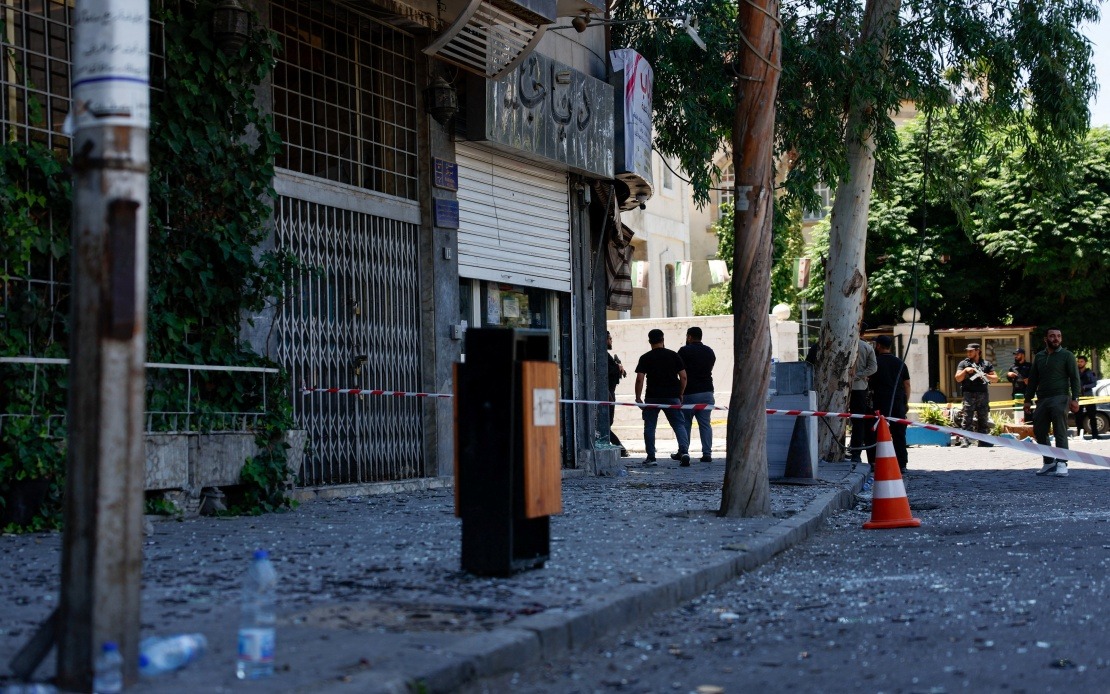
The Syrian capital experienced twin explosions on Tuesday that rippled across central Damascus, leaving at least 18 people wounded and raising immediate security concerns during a sensitive diplomatic moment. Among the injured were four police officers who appeared to be at or near the blast sites. Syrian authorities, through their Interior Ministry, confirmed the dual detonation of improvised explosive devices, though details about the intended targets or perpetrators remained sparse in initial reports.
The British-based Syrian Observatory for Human Rights provided crucial timing details about the attack sequence, noting that the first blast was quickly followed by a substantially more powerful second explosion. Both detonations occurred in close proximity to the hotel where French President Emmanuel Macron was lodging during his groundbreaking visit to the country. The rapid succession suggested either a coordinated attack or a secondary device designed to cause maximum disruption, a tactic sometimes employed to target emergency responders arriving at initial blast sites.
French officials moved swiftly to reassure the international community about Macron's safety. The Élysée Palace in Paris issued a statement confirming that the French leader had not been harmed by the explosions, providing immediate clarity that the security detail protecting the President had maintained an adequate perimeter. The statement underscored that Macron remained secure throughout the incident, allowing the diplomatic mission to proceed as planned.
Macron's arrival in Syria on Monday evening represented a watershed moment in European-Syrian relations, marking the first visit by an EU leader to Damascus since 2010. This visit had already been laden with symbolic significance, signalling a potential shift in the West's approach to Syria following years of international isolation. The timing of the explosions therefore carried additional weight, occurring during what was intended to be a carefully orchestrated reconciliation effort between France and the Syrian government.
At the moment of the blasts, Macron was positioned at the presidential palace where bilateral delegations from both nations were engaged in substantive discussions. French officials noted that the President remained at this secure location, allowing negotiations to continue despite the security incident unfolding elsewhere in the capital. This arrangement allowed the French and Syrian sides to maintain diplomatic momentum while security forces attended to the emergency situation.
Damascus residents experienced considerable alarm as the explosions reverberated through the city centre. The incidents disrupted normal activity and heightened public anxiety in a capital already accustomed to instability from years of conflict. First responders, including ambulances and emergency personnel, mobilized rapidly to the scene, moving victims to medical facilities for treatment. The speed of the emergency response helped prevent a potentially higher casualty count.
Security forces swiftly cordoned off the affected zones, establishing perimeters around the blast sites and restricting access to protect ongoing investigations and prevent further incidents. This security lockdown, while necessary for investigative purposes, further reinforced the tensions underlying Macron's visit. The rapid deployment suggested that Syrian authorities had anticipated the possibility of security disruptions, indicating underlying vulnerabilities in the capital's stability.
The explosions occurred against a backdrop of complex regional dynamics. Macron's visit represented an attempt by France, and potentially the broader European Union, to re-engage with Syria following years of suspension over government conduct and civil conflict. The precise circumstances and motivations behind the Tuesday blasts remained unclear—whether they were politically motivated attacks against the French presence, factional violence unrelated to the visit, or other security threats was not immediately established by authorities.
For Malaysia and Southeast Asian observers, the incident offered instructive lessons about the fragility of diplomatic initiatives in volatile regions and the persistent security challenges facing post-conflict societies. The explosions underscored how quickly security situations can deteriorate in areas with histories of violence, armed factions, and weak state control. Regional governments pursuing diplomatic normalisation with similarly complex neighbours face analogous risks of disruption by spoiler actors opposed to reconciliation efforts.
The incident also highlighted the physical vulnerabilities inherent in high-level diplomatic missions to regions with active security threats. While Macron's security detail successfully protected the French President, the attack demonstrated that even heavily guarded delegations cannot completely insulate themselves from violence in unstable environments. For countries considering expanded engagement in conflict-affected regions, such incidents serve as sobering reminders of the persistent operational risks.
French diplomatic officials would need to balance continuing engagement with Syria against the security realities demonstrated by the explosions. Whether the blasts would accelerate, decelerate, or complicate the broader European normalisation effort with Damascus remained uncertain. The incident suggested that significant constituencies within Syrian society may oppose or seek to disrupt reconciliation with Western powers, a factor that could shape the trajectory of future diplomatic relations throughout the Middle East region.

