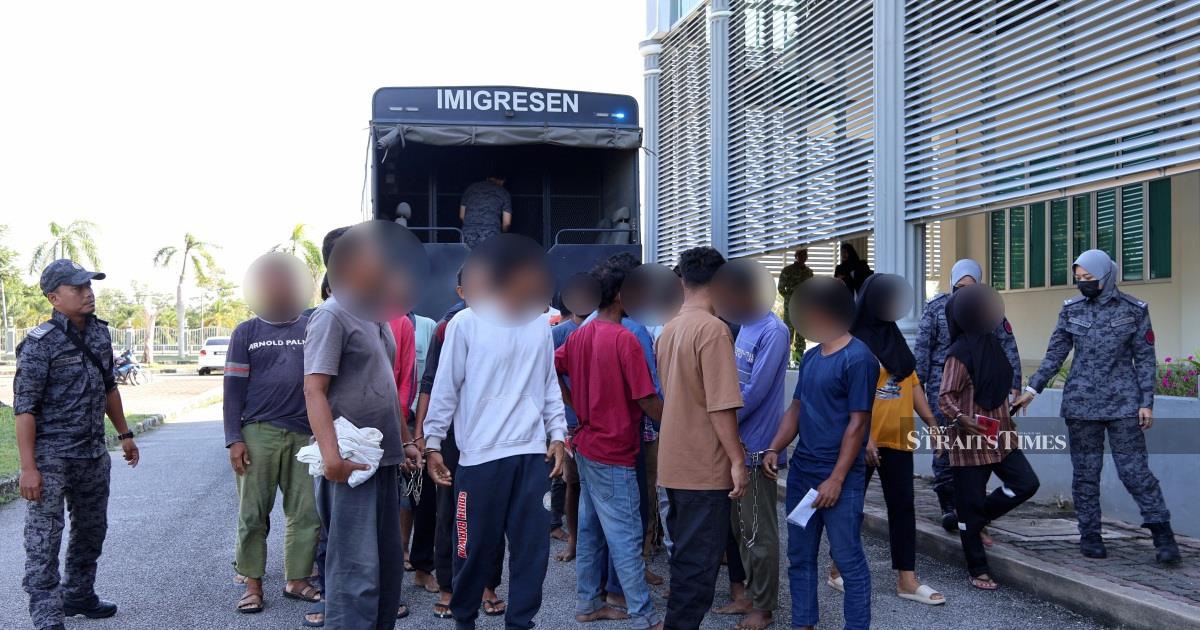
The Sessions Court in Pasir Mas delivered penalties against 29 undocumented migrants today after they each admitted to violating Malaysia's immigration laws, with fines ranging from RM1,000 to RM10,000 depending on the severity of individual offences. The sentences represent the court's continued enforcement action against irregular migration, a persistent challenge facing the country's border management authorities and domestic labour market.
The migrants faced multiple charges reflecting the typical pattern of immigration violations encountered at Malaysia's borders and within its territory. Charges encompassed illegal entry into the country, overstaying beyond authorised periods, and the misuse of travel documentation, each carrying distinct legal consequences. The variety of offences prosecuted underscores the layered nature of undocumented migration, where individuals often commit compounding violations as their status in the country becomes increasingly irregular.
Passir Mas, located in Kelantan state near the Thai border, has emerged as a significant focal point for immigration enforcement activities. The locality's position along a key transit corridor makes it a common entry point for undocumented migrants seeking to reach peninsular Malaysia. The court hearing there reflects immigration enforcement efforts concentrated in border regions where irregular movement is most prevalent and most readily detected by authorities.
The financial penalties imposed serve multiple objectives within Malaysia's immigration enforcement framework. Beyond generating revenue for the state, such fines are intended to deter future immigration violations by imposing immediate economic costs on offenders. The graduated scale, with fines rising to RM10,000 for the most serious breaches, signals that authorities reserve harsher penalties for those committing multiple or more egregious violations.
The decision to prosecute these cases through the formal court system rather than via administrative procedures reflects the gravity with which Malaysian authorities treat organised and repeat immigration offences. While many immigration violations result in deportation without criminal conviction, the Sessions Court pathway indicates these individuals faced charges meeting thresholds for judicial intervention. The guilty pleas suggest either straightforward cases where evidence was conclusive or legal strategies where defendants chose not to contest charges.
Undocumented migration remains a complex issue for Malaysia, balancing security concerns, labour market dynamics, and humanitarian considerations. The country hosts one of Asia's largest migrant populations, with both documented workers and undocumented individuals contributing to various economic sectors. Enforcement actions like this court proceeding target the subset of migrants operating entirely outside legal frameworks, who lack workplace protections and contribute to informal economy dynamics.
The prosecution and sentencing of these 29 individuals forms part of broader immigration control efforts by the Immigration Department and related authorities. Malaysia has implemented various enforcement campaigns targeting migration hotspots, with particular emphasis on border regions and urban areas where irregular migrants congregate. Court convictions create deterrent effects and provide documentation of enforcement commitment, though challenges in sustaining long-term border security and migration management persist.
Kelantan's proximity to Thailand means the state experiences particular migration pressures. Economic disparities between Malaysia and neighbouring countries drive irregular movement, with migrants seeking employment opportunities unavailable in their origin countries. The court proceedings in Pasir Mas represent just one intersection point where migration trajectories encounter immigration law enforcement.
For migrants themselves, the fines imposed represent substantial financial burdens. At between RM1,000 and RM10,000 per person, penalties equate to months of wages for workers in origin countries, creating incentives to comply with immigration regulations. However, enforcement gaps and the continued pull of employment opportunities mean undocumented migration continues despite such consequences.
The guilty plea outcomes suggest relatively efficient case processing, avoiding protracted trials while securing convictions. This approach enables courts to process larger caseloads, though it raises questions about whether all defendants received adequate legal representation and fully understood their rights before admission. Malaysian legal aid systems for migrant defendants remain limited, potentially affecting fairness of proceedings.
Looking forward, the Pasir Mas court proceedings exemplify the enforcement intensity Malaysia maintains on immigration issues. While individual cases address specific violations, systematic solutions to irregular migration require coordinated approaches spanning border management, employer compliance monitoring, and regional cooperation with source and transit countries. The financial penalties imposed today reflect present-focused enforcement rather than preventative strategies addressing root causes of undocumented migration.
These convictions also carry implications for Malaysia's standing on migration management internationally. Visible enforcement demonstrates commitment to border sovereignty and rule of law, important for maintaining public confidence in immigration systems. Simultaneously, how authorities treat apprehended migrants affects Malaysia's humanitarian reputation and relationships with migrant-source nations, particularly in Southeast Asia where people movements cut across national boundaries with increasing frequency.

