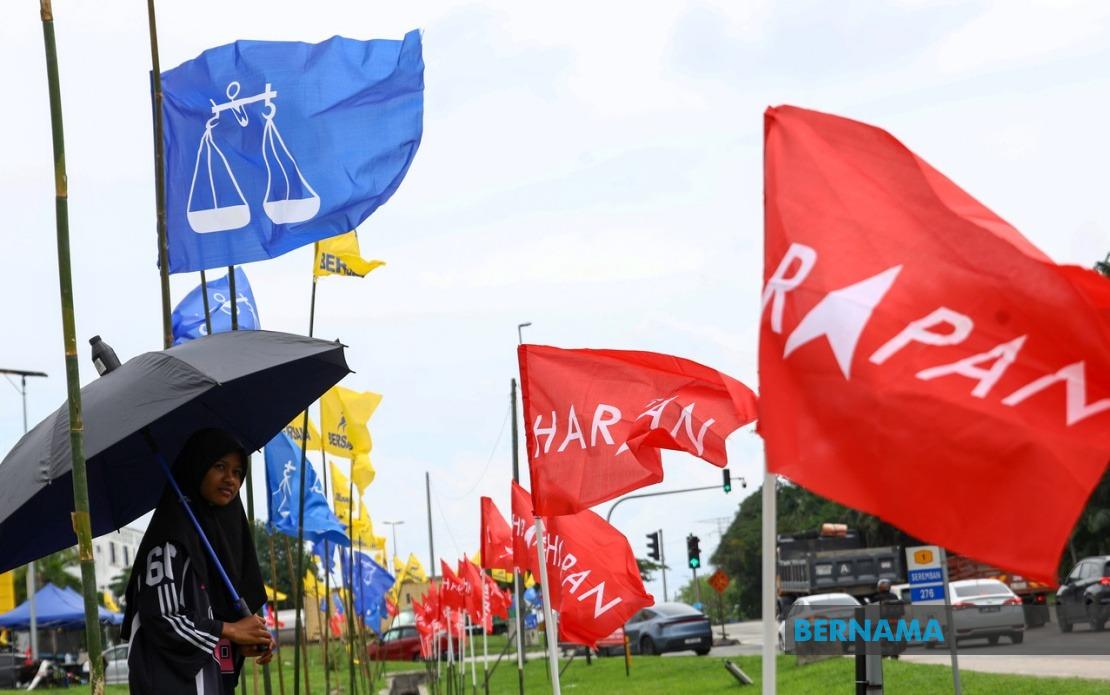
Campaigning for the 16th Johor State Election has intensified in its second week, with Pakatan Harapan and Barisan Nasional deploying distinctly contrasting strategies as both coalitions contest all 56 state seats. The divergence reflects each bloc's assessment of voter priorities and their competitive strengths heading towards the Saturday, July 11 polling day. Where one coalition emphasises broad policy frameworks addressing household concerns, the other is banking on the gravitational pull of recognisable personalities and established party structures to mobilise its base.
Pakatan Harapan's campaign strategy pivots on concrete policy agendas designed to resonate with everyday voter anxieties. The coalition has crafted its messaging around cost of living pressures, stagnating wages, housing affordability, workforce development, and fairer economic distribution. Rather than abstractions about growth rates or foreign investment volumes, PH is framing Johor's development in terms of what ordinary households can actually experience—better incomes, accessible homes, secure jobs, and dependable social safety nets. This approach represents a deliberate repositioning, one that rejects the notion that large-scale economic indicators automatically translate into improved living standards for residents.
The centrepiece of PH's platform is its "Johor For All" manifesto, which outlines an integrated programme targeting domestic wage competitiveness and ensuring that investment returns directly strengthen the welfare and quality of life across Johor's communities. According to political analyst Dr Mohammad Tawfik Yaakub from Universiti Malaya, this strategy reflects PH's conviction that voters are hungry for tangible evidence that development serves them personally, not merely corporate balance sheets or national GDP statistics. The coalition is essentially betting that articulating specific solutions to material problems will prove more persuasive than celebrity endorsements or institutional incumbency.
Barisan Nasional, by contrast, has opted to harness the return of two prominent former figures as catalysts for its campaign momentum. Datuk Seri Hishammuddin Tun Hussein, who previously served as UMNO vice-president, and Khairy Jamaluddin, the former UMNO Youth chief, have both rejoined the party through the "Rumah Bangsa" initiative and are now actively participating in campaign events. BN's calculation appears to rest on the assumption that these recognisable faces carry residual appeal, particularly among UMNO's traditional support base, and can help revive enthusiasm within constituencies where the coalition's standing has eroded.
Hishammuddin's prominence in Johor has not diminished despite years away from frontline politics. According to Assoc Prof Dr Mohd Yusry Ibrahim from the Ilham Centre, Hishammuddin retains substantial influence within the state that could reassure UMNO supporters who have drifted away or become disenchanted with the party's direction. His visible participation may function as a signal that the coalition is regaining stability and direction after turbulent recent years. For BN, this represents an attempt to staunch the bleeding among its traditional constituency through the perceived legitimacy and gravitas that established political figures can confer.
Khairy's reintegration into the campaign addresses a demographic challenge that has vexed BN for some years: young voters. Unlike older generations, younger Malaysians have demonstrated lower levels of party loyalty and are more fluid in their voting patterns, often gravitating towards candidates and personalities they find credible or relatable rather than tribal party affiliation. Khairy enjoys consistent positive regard among this cohort, a rare advantage within UMNO's contemporary leadership. His presence signals that BN is not entirely bereft of appeal to voters under 40, a crucial consideration in a state where demographic composition increasingly favours younger demographics.
Yet emerging analysis suggests that both coalitions may be operating on assumptions about voter behaviour that are rapidly becoming outdated. Dr Mohammad Tawfik cautioned that the modern electorate has grown considerably more discerning and resistant to mere celebrity candidacies. Voters are now evaluating whether parties possess coherent policy platforms, whether candidates demonstrate genuine credibility, and whether proposed solutions address their specific grievances. The days when prominent faces alone could shift electoral outcomes appear to be receding, particularly in urban and semi-urban constituencies where information access is higher and voter sophistication more pronounced.
This shift reflects a broader maturation of Malaysian electoral politics. Voters increasingly demand that politicians demonstrate not just personal charisma or institutional position, but intellectual substance—evidence that they understand problems and have thought through realistic responses. This dynamic potentially favours PH's strategy of leading with policy content, though execution matters enormously. If PH's proposals appear generic or disconnected from actual implementation capacity, the policy-focused approach becomes vulnerable to charges of vacuity. Conversely, BN's reliance on personality requires that Hishammuddin and Khairy's participation translates into genuine enthusiasm rather than mere nostalgic curiosity.
The tension between these approaches also reflects deeper questions about Johor's development trajectory. BN's traditional narrative—that institutional continuity, investment inflows, and economic scale constitute sufficient justification for political support—has demonstrably lost persuasive force among meaningful voter segments. PH's counter-narrative, that growth must be calibrated to reduce inequality and enhance household welfare, taps into legitimate frustration that economic expansion has not benefited all communities proportionately. This philosophical difference will likely prove more consequential than the identities of campaign speakers.
Geographically and demographically, Johor presents a complex electoral landscape. Urban constituencies around Johor Bahru, Skudai, and Kota Tinggi contain younger, more educated voters potentially responsive to detailed policy analysis. Rural and semi-rural areas, particularly in the state's interior, contain traditional BN strongholds where institutional and personality-based appeals retain greater resonance. A coalition's electoral success will likely depend on which camp proves more effective at translating its chosen strategy into concrete gains across these diverse constituencies.
With 172 candidates competing for 56 seats and early voting scheduled for July 7, the final days of campaigning will test both coalitions' capacity to mobilise their bases and persuade persuadable voters. The election represents not merely a contest for state power but a referendum on how Malaysian electoral politics are evolving. Whether voters respond primarily to policy substance or established personalities will offer important signals about the future direction of Malaysian democracy and the premium that electorates place on governance capacity versus political familiarity.

