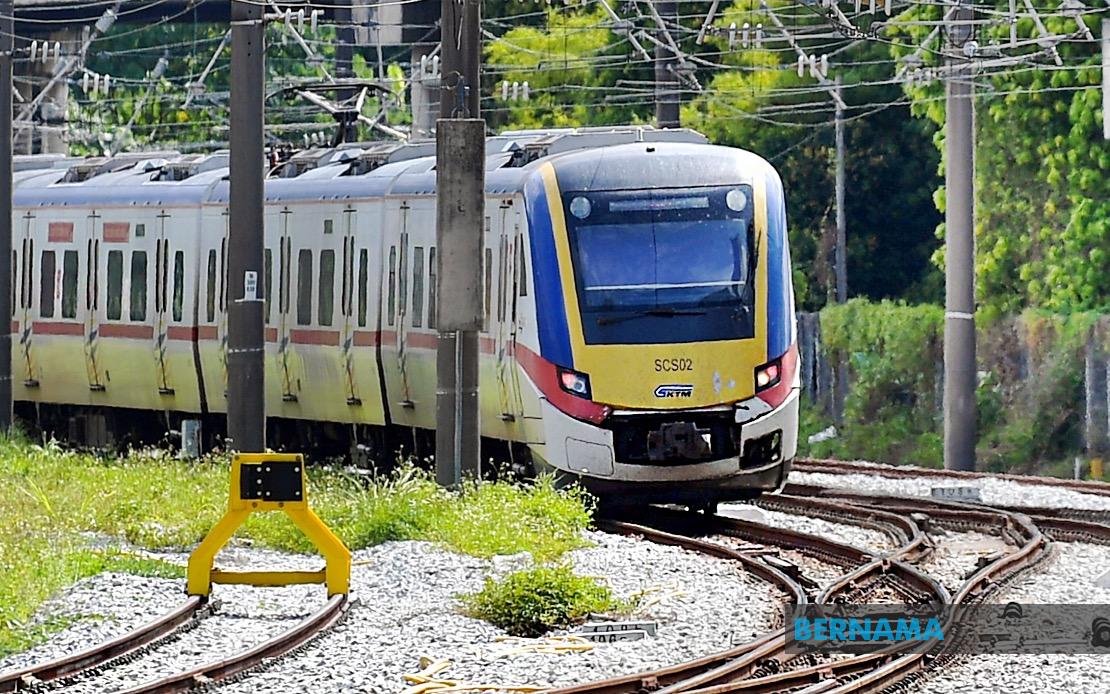
Rail commuters in the Klang Valley faced significant disruptions on July 23 when a wooden structure from a third-party construction project collapsed onto railway tracks, severing power to a critical section of the network and temporarily paralyzing services on both the KTM Komuter and Electric Train Service. The incident occurred near Batang Benar station, where the fallen structure struck the overhead line system that supplies electricity to trains operating between Batang Benar and Labu, prompting Keretapi Tanah Melayu Berhad (KTMB) to immediately suspend all train movements through the affected zone.
The operational chaos that followed rippled across multiple commuter corridors serving Malaysia's busiest urban railway network. Komuter services originating from Pulau Sebang with destinations at KL Sentral were forced to terminate prematurely at Seremban Station, while trains heading toward either KL Sentral or Batu Caves operated only from Bangi Station, effectively creating a substantial gap in service coverage. Between Bangi and Seremban—a stretch encompassing several major stations—no train services operated at all, stranding thousands of daily commuters who depend on this route for their morning and evening journeys.
To mitigate the crisis, KTMB deployed contingency transport arrangements within hours. Three shuttle bus services were activated to bridge the gap created by the suspended rail line, connecting Seremban, Tiroi, Batang Benar, Labu, and Bangi stations and attempting to accommodate passengers unable to complete their journeys by train. For long-distance passengers affected on the ETS network, the operator arranged seven additional shuttle buses positioned at KL Sentral, Bandar Tasik Selatan, Kajang, and Seremban stations, offering an alternative—though considerably slower—means of traveling between major hubs.
The financial concession extended to ETS travellers reflected the severity of the disruption. Passengers who opted not to continue their journeys from their departure station were entitled to full refunds, a measure acknowledging both the inconvenience and the operator's responsibility for maintaining service reliability. However, such compensation offers little solace to the countless commuters whose schedules were upended, particularly those attempting to reach employment centers or connecting to other transport modes within compressed timeframes.
Investigations into the root cause quickly identified systematic failures in safety protocol compliance. KTMB's preliminary findings revealed that a contractor engaged by the Public Works Department (JKR) for a wayleave project had disregarded mandatory safety procedures at multiple stages. Most critically, the contractor submitted incomplete work schedules and failed to provide advance notification to KTMB regarding the specific timing of the bridge construction works that ultimately resulted in the collapse.
The absence of proper coordination exposed gaps in KTMB's Site Entry Permit Standard Operating Procedure, which explicitly requires three technical representatives—drawn from the Regional Engineer, Signalling and Communications, and Electrification departments—to be stationed on-site during construction work once full approval has been granted and all documentation is properly submitted. These representatives serve as monitoring checkpoints, ensuring that contractors maintain safety standards and halt operations immediately if risks materialize. The failure of the contractor to provide accurate timing information meant KTMB's oversight mechanisms could not function as designed.
This incident underscores a recurring vulnerability in Malaysia's rail infrastructure development, where coordination between external contractors and state-owned operators remains inconsistent despite established procedures. The Public Works Department's contractor system, though designed to execute capital improvements and maintenance projects, frequently operates in isolation from the operational requirements of the rail network itself. When contractors prioritize schedule efficiency over protocol adherence, the consequences directly affect hundreds of thousands of daily passengers who have little recourse beyond accepting disruptions as inevitable.
The damage to the overhead line system compounds the operational challenge. KTMB's technical teams immediately began restoration work, but the complexity of repairing powered infrastructure while ensuring absolute safety before trains resume operations typically requires several hours minimum. The overhead line system, which supplies 25 kilovolts of electricity to the trains, demands meticulous inspection for fractures, deformation, or internal damage before power can be safely restored. Any shortcuts in this process risk catastrophic failure or passenger safety compromises.
For Southeast Asian observers, the incident illustrates broader challenges facing the region's rail modernization initiatives. As Malaysia and neighboring countries expand electrified rail networks to reduce congestion and emissions, the human and organizational factors—contractor discipline, inter-agency coordination, and enforcement of safety standards—prove as consequential as infrastructure investment itself. The Klang Valley corridor alone serves approximately 400,000 daily commuters, making reliability not merely convenient but essential to the region's economic functioning.
KTMB's public apology and commitment to prioritizing passenger safety and operational reliability ring hollow without systemic improvements in contractor accountability and pre-construction coordination. The incident occurred not because the infrastructure was inherently fragile, but because a contractor operated outside mandated safety frameworks, and oversight mechanisms proved insufficient to prevent the breach. Moving forward, KTMB faces pressure to strengthen contractor vetting processes, implement stricter penalties for non-compliance, and establish more robust real-time communication channels with construction teams working near critical infrastructure.
Commuters were advised to monitor KTMB's social media channels and consult station staff for the latest service updates, a reminder that information accessibility remains crucial during disruptions. However, the underlying issue remains unchanged: the rail system's vulnerability to external disruptions reveals that Malaysia's transport infrastructure, despite billions in investment, remains susceptible to preventable accidents rooted in poor coordination and inadequate contractor oversight.
The Batang Benar incident will likely prompt a wider audit of how multiple construction projects operate around other sensitive points in Malaysia's rail network. Elevated structures, overhead systems, and track-side work represent persistent risks wherever contractors operate in proximity to active rail lines. Unless enforcement mechanisms are strengthened and contractor incentives realigned toward safety compliance rather than schedule acceleration, similar disruptions will recur with predictable regularity.

