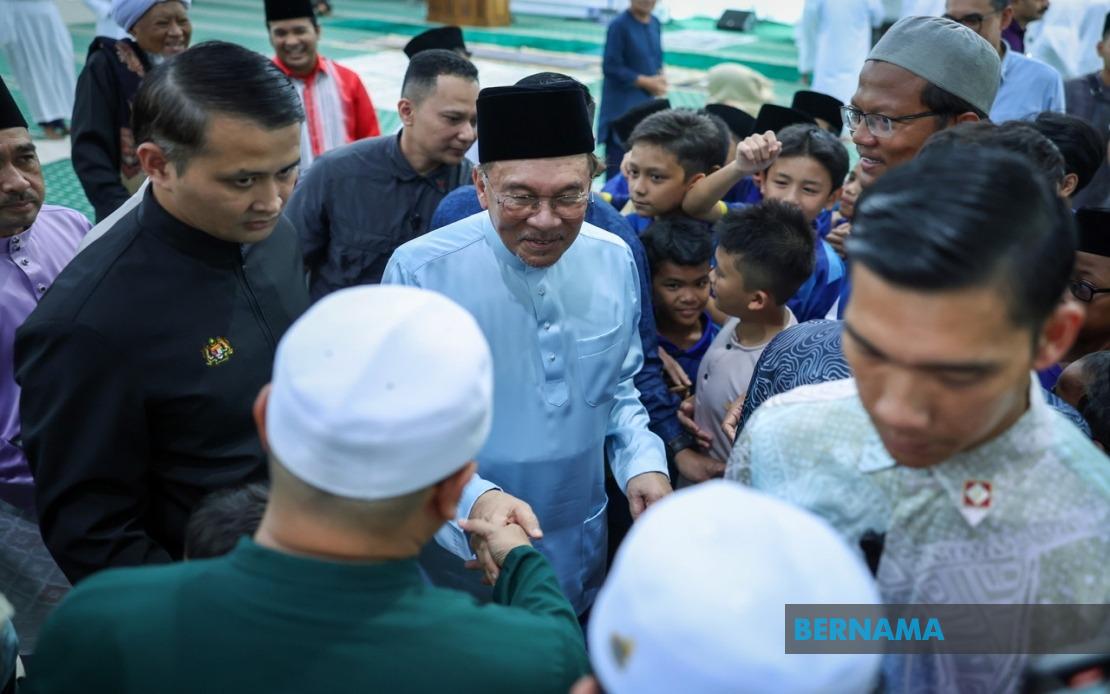
Prime Minister Datuk Seri Anwar Ibrahim has drawn a clear distinction between parliamentary constituency allocations and the personal privileges of elected representatives, emphasising that such funds exist primarily to serve the broader population rather than individual MPs. Speaking after Friday prayers at Masjid Ar-Rasyidin in Alor Gajah, Anwar stressed that government budgets earmarked for constituencies are public resources designed to improve community welfare and infrastructure, rejecting any notion that such money constitutes an MP's prerogative or entitlement.
The Prime Minister's remarks come at a time when several Members of Parliament have lodged complaints about reduced or withheld constituency funding, framing such cuts as punitive measures. Anwar's clarification represents an attempt to reframe the debate around these allocations, positioning them as tools for grassroots development rather than personal privileges contingent on political alignment or party membership. This distinction carries significant weight in Malaysia's political context, where constituency funds have historically served as both instruments of development and sources of political patronage.
According to Anwar, the intended use of these allocations encompasses essential community services and infrastructure improvements. When a constituency receives RM2 million, for instance, such resources should fund educational institutions, religious schools, places of worship, drainage systems, and other pressing local requirements. The Prime Minister indicated that his administration would enforce this principle rigorously to ensure funds reach their intended beneficiaries rather than being diverted toward purposes that primarily benefit sitting MPs or serve as discretionary spending under their control.
The policy underlying this position is not new to Malaysian governance, Anwar noted, suggesting that previous administrations and experienced parliamentarians are already familiar with this framework. His remarks appear calibrated to pre-empt criticism that the current government is arbitrarily cutting funding or weaponising budgetary allocations against political opponents. By framing this as an established principle rather than a novel policy innovation, Anwar attempts to position his government as enforcing longstanding norms rather than introducing punitive measures.
A particularly contentious element of the funding dispute involves opposition MPs who have reportedly received reduced allocations or lost funding entirely. Anwar's statement that "if an MP is now in opposition, we will channel the funds directly to the people" reveals the operational mechanics of this policy. Rather than withholding money from constituencies governed by opposition representatives, the government appears to be redirecting these funds through alternative channels and mechanisms that bypass the sitting MP, effectively circumventing their traditional gatekeeping role in constituency development.
This approach raises important questions about governance and political fairness in Malaysia's democratic system. While Anwar's framing emphasises that all constituents deserve access to public resources regardless of their MP's party affiliation, the practical implementation raises concerns about whether direct channelling bypassing elected representatives might undermine accountability mechanisms or reduce parliamentary oversight of how funds are allocated and utilised within communities. The tension between ensuring equitable resource distribution and maintaining the representative function of MPs remains unresolved in the Prime Minister's explanation.
The constituency funding mechanism has long been a crucial component of Malaysia's political economy, serving as both a source of legitimate development finance and as a tool through which elected officials build grassroots support and consolidate political power. By recasting allocations as community resources rather than MP entitlements, Anwar is attempting to depoliticise what has traditionally been understood as an inherently political process. However, the distinction between principle and practice may prove difficult to maintain, particularly when funding decisions appear to correlate closely with party affiliation and political alignment.
In a separate development, Anwar addressed questions regarding his daughter, PKR deputy president Nurul Izzah, who recently requested to step down from her position. The Prime Minister indicated that she requires time for other commitments and will temporarily reduce her official responsibilities, though she will remain engaged in party activities. This personal matter, while distinct from the constituency allocation issue, speaks to succession planning and internal party management within PKR, Malaysia's second-largest coalition partner in the current government.
The Prime Minister's clarifications on constituency allocations reflect broader governance challenges facing Malaysia's administration. The country's federal structure, combined with a political system in which coalition governments must balance competing party interests and geographical considerations, creates complex incentives around how public resources are distributed. Anwar's effort to establish clear principles governing these allocations suggests recognition that the current system lacks sufficient transparency and may be generating perceptions of partisan decision-making.
For ordinary Malaysians living in constituencies, the implications of this policy shift could be significant. If consistently implemented, directing resources toward community infrastructure and services rather than allowing MPs discretionary control might result in more equitable outcomes. However, the effectiveness of this approach depends heavily on implementation capacity, the integrity of alternative distribution mechanisms, and whether local communities can hold government agencies accountable for ensuring promised developments actually materialise.
The broader regional context is also relevant. Southeast Asian democracies frequently grapple with tensions between centralised resource allocation and local representation, with similar debates occurring in Thailand, the Philippines, and Indonesia. Malaysia's approach to resolving these tensions could set precedents and provide instructive lessons for other regional democracies seeking to balance development objectives with democratic accountability.
Moving forward, the sustainability of Anwar's constituency funding policy will depend on political consensus and whether the opposition accepts this framework without perceiving systematic disadvantage. As Malaysia approaches future elections and as constituent demands for development intensify, the government's ability to demonstrate fair implementation across all constituencies regardless of political composition will be essential to maintaining legitimacy and public confidence in the fairness of resource distribution.

