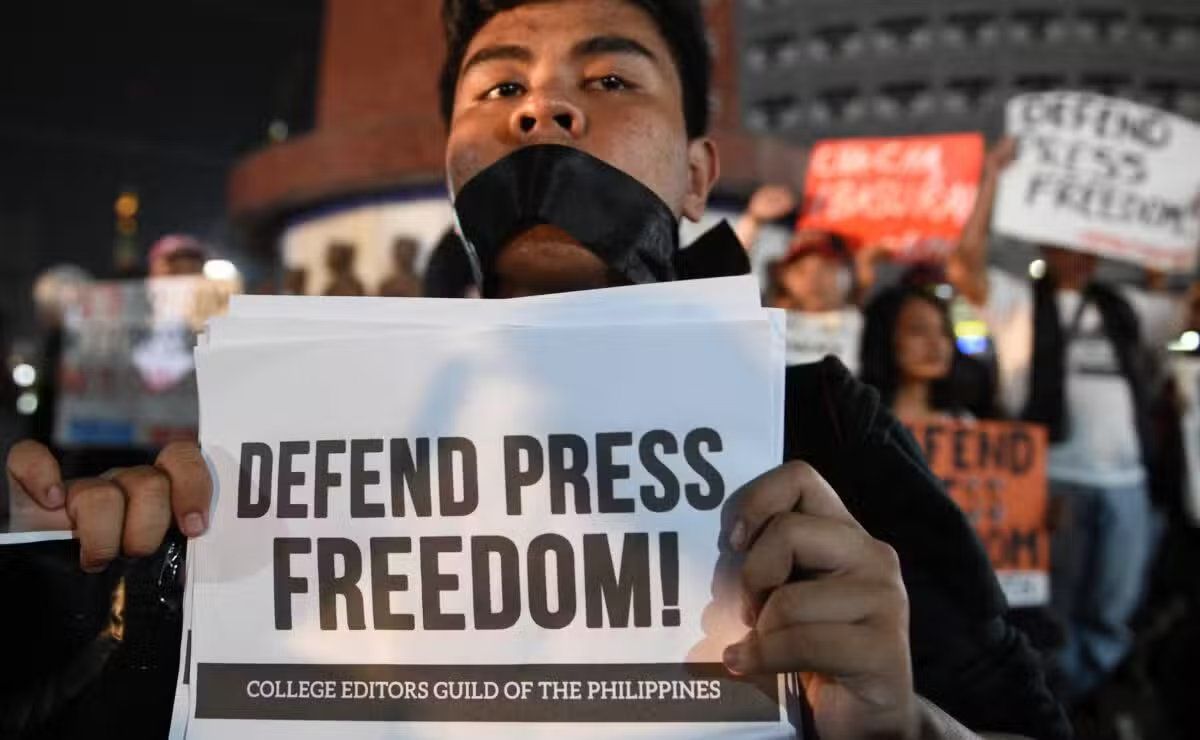
More than four years into President Ferdinand Marcos Jr.'s administration, the Philippine journalism landscape has become increasingly hostile toward media workers, particularly those operating outside Manila's major newsrooms. The National Union of Journalists of the Philippines (NUJP) has compiled documentation of approximately 260 attacks against press representatives during this period, a figure that underscores a deteriorating environment for those tasked with reporting on matters of public interest.
What emerges from closer examination of these incidents is a pronounced vulnerability among a specific segment of the profession. According to NUJP records, more than 180 documented cases involved journalists from community radio stations, provincial newspapers, alternative media platforms and university publications. This concentration reveals a critical disparity: the journalists most exposed to threats and violence are frequently those working for smaller, independently-operated news organisations that lack the institutional backing and financial resources of larger metropolitan press establishments. The pattern suggests that as pressure on media intensifies, the consequences fall disproportionately on those least equipped to withstand them.
The economic realities of provincial journalism compound the danger. Community news organisations typically operate on constrained budgets, which translates into lower salaries for staff, minimal security infrastructure, and limited legal support when journalists face threats or litigation. These workers navigate a landscape where professional hazards are neither unusual nor adequately compensated. Working in remote or less urbanised areas means journalists must often rely on institutional safeguards that simply do not exist, while simultaneously contending with entrenched local political and business interests that may view critical reporting as a threat to their positions.
Yet despite these structural disadvantages, community journalists continue producing coverage that mainstream outlets might overlook or deprioritise. They investigate local governance, track resource allocation, and hold regional officials accountable to their constituents. In doing so, they fulfil a function essential to democracy: ensuring that communities distant from the capital retain access to information about those who wield power over their lives. The NUJP has noted that each statistical entry represents not merely an incident but a human consequence—a journalist, a newsroom, and a public whose relationship to truthful information hangs in the balance.
The case of Jay Lavapiez, a 48-year-old radio broadcaster and station manager of Baskog Radyo in Roxas City, Capiz, illustrates the tangible dangers community journalists encounter. In June of last year, two assailants on a motorcycle ambushed his vehicle, firing four bullets from a 9-millimetre pistol in what authorities treat as an assassination attempt. Prior to this violent incident, Lavapiez and his wife, India, had faced a coordinated legal assault: multiple cyberlibel and libel cases filed simultaneously across three municipalities. This legal campaign followed their reporting on a cemetery project owned by a local official and broader investigations into alleged corruption and abuse of authority. Neither the reporting nor the legal case filing was coincidental; both represent parts of a recognisable pattern whereby journalists who interrogate power face retaliation through multiple channels simultaneously.
Lavapiez has articulated the distinctive pressures that provincial journalists experience. Unlike their counterparts in Metro Manila, who may maintain professional distance from the individuals they cover, community journalists inhabit the same social space as their sources, subjects, and critics. The official they question at a council meeting might be a neighbour encountered at the market the next day. The businessman whose practices they investigate may employ relatives or friends. This absence of physical and social separation intensifies the personal cost of journalism. Provincial journalists cannot simply leave town or transition to different beats; they must continue their work knowing that consequences extend beyond professional repercussions into daily community life.
The compensation structure for community journalism compounds this vulnerability. Provincial media workers earn significantly less than their Manila-based peers, and salaries bear no proportional relationship to the risks they assume. When a journalist in a provincial radio station earns a modest wage yet faces legal harassment, economic threats, online attacks, and potentially lethal violence, the risk-reward calculation becomes stark. This disparity raises uncomfortable questions about the sustainability of community journalism in the Philippines and whether talented journalists will continue pursuing work that places them in danger while offering inadequate financial security.
The death of RJ Ledesma in Toboso, Negros Occidental, underscores the lethal consequences that can materialise. Ledesma was conducting community work and reporting on renewable energy initiatives when he was killed during a military operation that drew condemnation from independent fact-finding missions for alleged indiscriminate fire and serious violations. His death represents an extreme but not isolated instance of how community journalists encounter hazards that extend beyond harassment into fatal violence.
Lavapiez has reflected on the motivations that sustain community journalism despite these conditions. The work, he emphasises, has never centred on financial reward. Rather, community journalists persist because someone must pose difficult questions when public resources are disbursed and ordinary citizens feel unheard by those in power. This commitment to civic function distinguishes community journalism as an act of professional conscience rather than commercial enterprise. Yet the irony is profound: the closer journalists position themselves to their communities, the more vulnerable they become, as visibility within a community inevitably translates into personal exposure.
The consequences extend beyond individual journalists to affect broader public discourse. When community media workers face prosecution, threats, and violence, entire regions lose the capacity to scrutinise local governance. Stories that might reveal corruption, misuse of public funds, or abuse of authority remain untold. Communities become information deserts, reliant on official narratives with no independent voice to challenge them. This suppression of local journalism erodes the distributed networks of accountability that sustain democratic institutions across a geographically dispersed nation like the Philippines.
For Malaysian and broader Southeast Asian readers, the Philippine situation carries cautionary implications. The targeting of community journalists reflects a pattern observable across the region: as national governments tighten media control, local and independent outlets become particularly vulnerable. The concentration of attacks on provincial and alternative media suggests a strategic effort to neutralise reporting precisely where institutional oversight is weakest and official power most concentrated. Understanding these dynamics in the Philippines illuminates comparable threats within Southeast Asia, where similar pressures on community media outlets merit monitoring and advocacy.
Lavapiez has articulated what journalists across the region would recognise as a fundamental request: the freedom to conduct their work without threats, harassment, legal persecution, or physical harm simply for asking questions. This is not a demand for special privilege or exemption from ordinary law, but rather an insistence on the basic professional conditions necessary for journalism to function. The rising toll on Philippine journalists—and the particular vulnerability of those working in communities—represents a challenge not merely to individual news workers but to the democratic infrastructure these journalists sustain.

