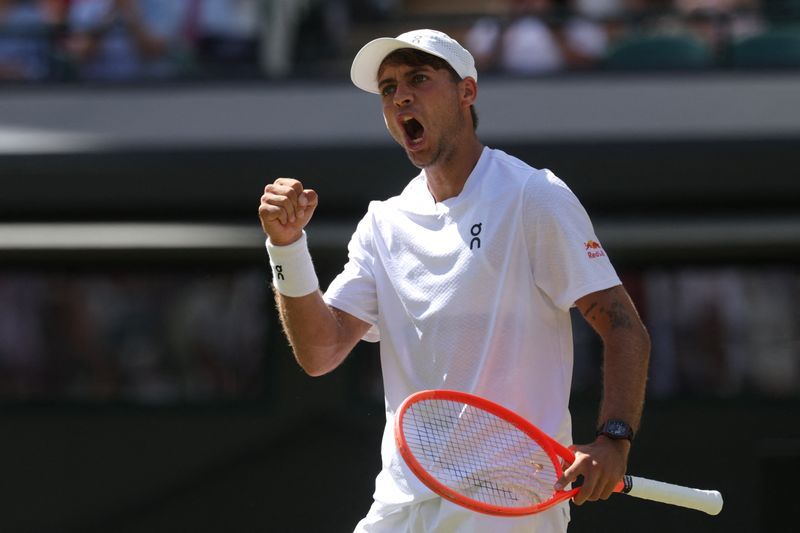
Flavio Cobolli maintained his career-best trajectory through the Grand Slams by dismantling fifth-seeded Alex de Minaur on Monday at Wimbledon, claiming a commanding 7-5 7-6(4) 6-3 victory on Court One to secure his place in the quarter-finals. The Italian ninth seed's return to the last eight at the All England Club marks his second successive appearance at this stage, a remarkable achievement considering his breakthrough to the French Open final merely weeks earlier signalled the acceleration of his ascent within professional tennis.
Cobolli's performance against the Australian underlined a player operating with notable composure under pressure, particularly during the opening set where he engineered a break in the eleventh game through a combination of aggressive play and capitalising on his opponent's mistakes. The opening hour of play saw the Italian establish clear dominance, pocketing the first set in fifty minutes and signalling his intent to build momentum against an opponent traditionally regarded as difficult to break down. De Minaur's reputation for consistency and court coverage offered little respite, yet Cobolli's tactical adjustments and willingness to seize aggressive opportunities proved decisive throughout.
The second set evolved into a tighter affair, illustrating the complications that emerge when two accomplished players meet in the sport's showcase venue. Extreme heat conditions at the All England Club forced two separate stoppages during play when spectators experienced distress, transforming the rhythm and momentum that typically characterises elite tennis competition. Cobolli displayed remarkable mental resilience by recovering from a 2-5 deficit and ultimately prevailing through a tiebreak, demonstrating the psychological fortitude required to navigate unpredictable external disruptions whilst maintaining concentration. Rather than viewing the stoppages as frustrating interruptions, the Italian utilised the breaks to engage with both fans and his opponent, fostering an atmosphere of mutual respect and camaraderie.
The third set witnessed Cobolli surge further ahead, though not without additional complications when he surrendered his serve early before mounting a decisive recovery. He engineered a crucial break in the sixth game before consolidating his advantage through commanding tennis that mixed heavy groundstroke hitting with precision court placement. This capacity to recover from adversity and construct victories through multiple tactical approaches suggests a player whose game has matured considerably, evolving beyond the consistency-based tactics that characterise many emerging professionals into someone capable of imposing aggressive play when circumstances demand.
Cobolli's forthcoming quarter-final opponent will emerge from the contest between Arthur Fery, a British player hoping to sustain momentum on home soil, and Grigor Dimitrov, the Bulgarian veteran whose considerable experience and technical excellence have previously flourished within the Wimbledon environment. The ninth seed's position within the draw presents genuine opportunities for advancement, particularly given the elevated heat conditions that appear to favour younger players with greater physical reserves and mental flexibility. Whether facing Fery or Dimitrov, Cobolli will approach the encounter as neither prohibitive underdog nor presumptive favourite, instead occupying the advantageous middle ground where recent form and confidence combine with genuine opportunity.
When discussing his physical condition and mental approach to the remainder of the tournament, Cobolli acknowledged the cumulative toll that sustained professional tennis imposes upon even elite athletes. His acknowledgment that extended touring schedules have generated fatigue, combined with his obvious delight at progressing in straight sets rather than requiring five-set exertion, reveals a player managing not merely the immediate demands of individual matches but the longer-term sustainability of his performance trajectory. The energy preservation evident in his approach contradicts the aggressive aesthetics that characterise his on-court play, instead suggesting underlying tactical intelligence that recognises the difference between winning matches and maintaining the physical and mental resources necessary for deep tournament runs.
The Italian's casual approach to preparation for his next assignment—deliberately avoiding detailed analysis of the Fery-Dimitrov encounter in favour of pursuing ice cream and savouring his father's cooking—underscores a mentality refreshingly devoid of obsessive preparation methodologies that dominate contemporary professional sport. Cobolli's willingness to embrace downtime and permit his mind respite from constant tactical analysis suggests a player with sufficient confidence in his abilities that he requires no additional stimulus beyond physical recovery and basic match intelligence. This psychological equilibrium, combining fierce competitive intensity during play with genuine relaxation outside competition, may ultimately prove as valuable as any technical refinement or conditioning programme.
Cobolli's emergence as a genuine Grand Slam contender carries particular significance for Italian tennis, extending a legacy that stretches back through Jannik Sinner and Matteo Berrettini to Gabriela Sabatini's celebrated contributions. The ninth seed's achievements challenge the prevailing perception that elite professional tennis remains concentrated within a narrow cohort of established champions, instead suggesting that breakthrough moments arrive through consistent excellence, tactical flexibility, and psychological resilience. His presence in the Wimbledon quarter-finals represents not merely an individual achievement but evidence that the professional game continues evolving, generating unexpected champions from unlikely trajectories and challenging established hierarchies.
The broader implications of Cobolli's advancement extend beyond personal achievement into questions concerning the competitive structure of men's professional tennis. His victories over established opponents like De Minaur demonstrate that the concentration of Grand Slam success among a limited number of players remains impermanent, subject to disruption by competitors offering different stylistic approaches and tactical innovations. As heat conditions continue affecting major tournaments and younger players demonstrate increasing resilience to environmental extremities, the traditional advantages maintained by established champions may require recalibration. Cobolli's calm acceptance of Wimbledon's challenging conditions, combined with his emerging tactical sophistication, suggests a new generation of professionals fundamentally comfortable competing within parameters that previous generations found limiting.

