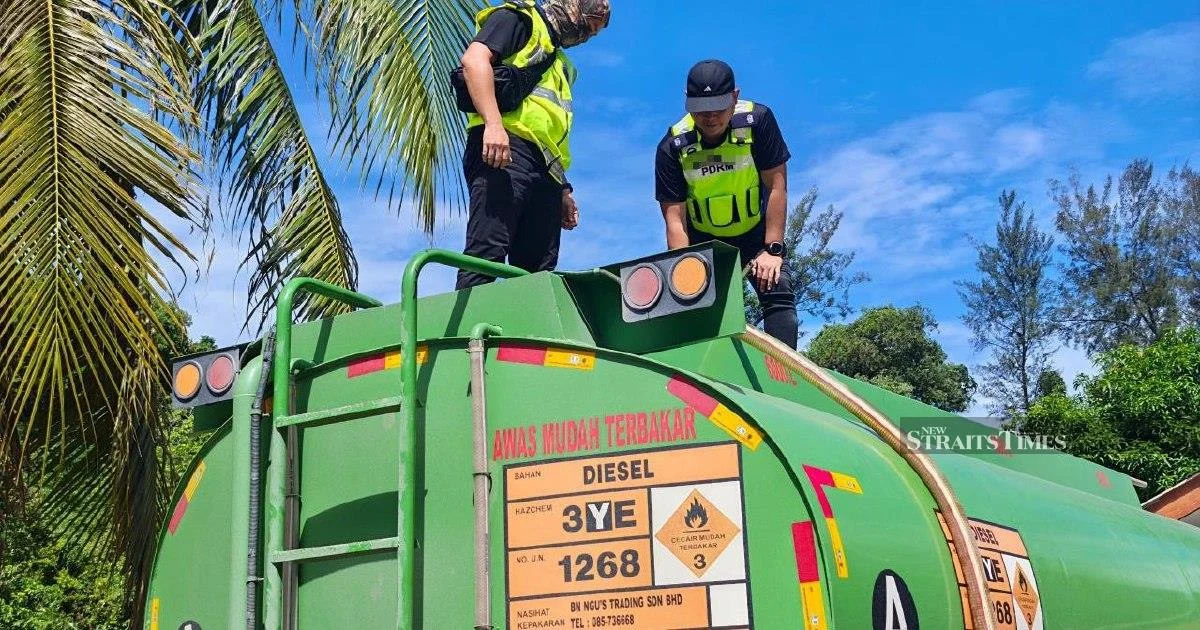
Authorities in Miri have successfully dismantled what investigators describe as a sophisticated fuel diversion operation, uncovering a clandestine diesel depot concealed within a residential bungalow in Tanjung Lobang. The discovery represents a significant blow against what appears to be an organised scheme to illegally redirect government-subsidised fuel, with enforcement agencies seizing approximately 15,000 litres of diesel and detaining four individuals for questioning.
The operation exposed during the raid illustrates growing concerns among Malaysian law enforcement regarding the diversion of subsidised fuel into black-market channels. Subsidised diesel, sold at regulated prices substantially below international market rates, has long been a target for organised criminal syndicates seeking to exploit the price differential for profit. By funnelling subsidised fuel through illicit networks, such operations deprive legitimate users and the government coffers while fuelling underground economies across Southeast Asia.
The choice of a residential property as a concealment site demonstrates the operational sophistication of the network. Rather than targeting obvious industrial or commercial locations that might attract regulatory scrutiny, the syndicate leveraged what appeared to be an ordinary dwelling, allowing the illegal depot to operate largely undetected until the enforcement action. This approach has become increasingly common among fuel trafficking organisations seeking to evade detection by customs and excise authorities.
The 15,000-litre seizure represents substantial inventory, suggesting the operation may have been conducting regular, high-volume transactions. At Malaysian domestic consumption rates, this quantity would supply numerous vehicles or potentially fuel an entire commercial fleet. The magnitude of the haul indicates this was likely not a small-scale opportunistic operation but rather an established enterprise with infrastructure capable of receiving, storing, and distributing considerable quantities of illicit fuel.
The apprehension of four individuals signals that investigators may have been monitoring the operation for some time and had developed sufficient intelligence to conduct a coordinated enforcement action. Each suspect will likely face questioning regarding their respective roles within the syndicate, including sourcing subsidised fuel, managing the concealment location, facilitating distribution, and handling commercial transactions. Malaysian authorities typically pursue charges under fuel subsidy regulations and smuggling statutes, with penalties including substantial fines and potential imprisonment.
For Malaysian consumers and the broader economy, fuel diversion schemes carry tangible consequences. When diverted subsidised fuel reaches export markets or black-market channels, it inflates pressure on legitimate domestic supply chains. This can translate into potential shortages or price volatility at retail pumps, particularly in rural areas like Sarawak where supply chains are already stretched. Additionally, the lost subsidy revenue represents billions in annual leakage across the country, resources that might otherwise fund infrastructure, healthcare, or education initiatives.
The Tanjung Lobang discovery reflects broader challenges facing Malaysian authorities in border regions. Sarawak, with its porous maritime boundaries and proximity to Indonesia and Brunei, has historically served as a transit point for fuel diversion networks. The state's geography makes enforcement inherently complex, with numerous waterways and remote areas providing natural corridors for smuggling operations. Miri, as a coastal district with established port facilities, presents particular vulnerability to such activities.
The incident underscores the need for continued investment in intelligence-gathering capabilities and interagency coordination. Detecting and dismantling fuel diversion networks requires sustained engagement from customs authorities, police special branch units, and intelligence services working in concert. The syndicate's apparent length of operation prior to detection suggests authorities must enhance surveillance techniques and invest in data analytics capable of identifying suspicious fuel distribution patterns across supply chains.
Investigators will likely examine financial records, communication records, and vehicle logs associated with the four suspects to trace the broader network. Understanding how subsidised fuel was initially diverted from legitimate channels into syndicate hands remains critical to disrupting the operation's source. Authorities may also investigate whether the network maintained connections to larger international fuel smuggling organisations operating across the Malaysia-Indonesia-Brunei maritime corridor.
The crackdown reflects government commitment to protecting the fuel subsidy system, though Malaysia has gradually implemented price adjustments and subsidy rationalisation in recent years. As subsidy structures evolve, criminal organisations continuously adapt their tactics. The discovery of increasingly sophisticated concealment methods suggests authorities must remain vigilant and develop counter-strategies proportionate to the operational ingenuity displayed by trafficking networks.
Government enforcement agencies have signalled heightened focus on fuel-related crime in Sarawak, with additional checkpoints and surveillance operations planned across district boundaries. The seizure and arrests serve as deterrent messaging to potential operators, though the underlying economic incentives driving diversion—the substantial profit margins created by price differentials—remain potent factors sustaining illicit fuel markets across Southeast Asia.