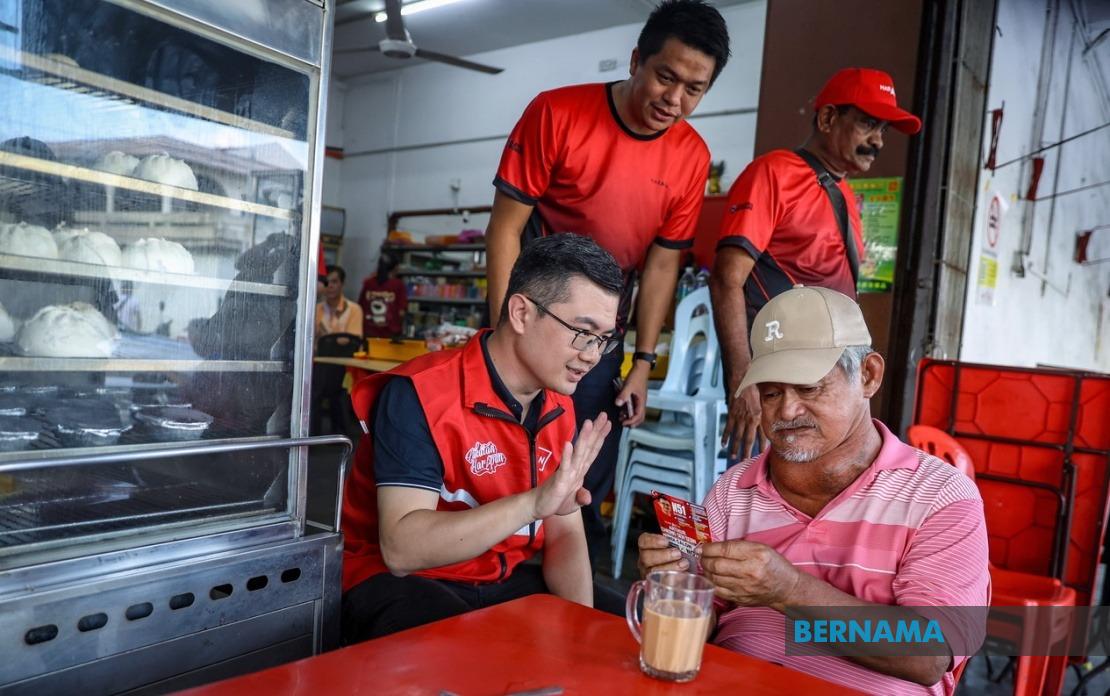
Arthur Chiong Sen Sern, the Pakatan Harapan assemblyman defending the Bukit Batu seat in Johor, is anchoring his re-election bid squarely on nearly two years of demonstrated service across the 49,963-strong constituency. Speaking in Kulai ahead of the 16th Johor State Election, the 36-year-old expressed confidence that his ground-level engagement and delivery of local development projects have built sufficient goodwill to convert his razor-thin 137-vote victory in 2022 into a more decisive result.
Chiong's previous triumph was secured with 9,439 votes in a four-cornered contest, edging out Barisan Nasional's Datuk S. Suppayah, Perikatan Nasional's Tan Heng Choon, and Warisan's Lee Ming Wen. That slim margin—earned in a contest that witnessed significant fragmentation of the vote—has shaped his approach to the current campaign. Rather than relying on broader political narratives, his strategy emphasises tangible improvements residents have witnessed firsthand, from infrastructure upgrades to emergency response during flooding.
The constituency's electoral composition reflects the demographic diversity common across central Johor, incorporating both established Felda settlements and rapidly urbanising areas. Chiong has made deliberate efforts to serve this heterogeneous base without regard to ethnicity, faith, or political affiliation. His recounting of specific initiatives—including a RM20,000 contribution toward futsal court lighting in residential areas—reveals a micro-targeted development approach designed to demonstrate responsiveness to grassroots needs. These facilities continue to serve young people, he noted, suggesting a focus on enduring rather than ephemeral projects.
Flood mitigation has emerged as a cornerstone of his constituent service portfolio. Kampung Rahmat and Kampung Seri Paya, identified as chronic flood hotspots, have reportedly experienced measurable improvement through sustained collaboration between the assemblyman's office and the Department of Irrigation and Drainage. Chiong's pledge to personally mobilise during flood events—positioning himself among the first responders—speaks to a hands-on model of representation that contrasts with more remote or ceremonial approaches to the role. Residents' familiarity with his presence during crises has become a campaign asset, signalling accessibility and commitment.
The upcoming election presents a more complex ballot than the 2022 contest, with the entry of additional contestants fragmenting potential support bases further. Beyond Chiong's challenger from Barisan Nasional—R. Kumaran, the PKR Kulai chief—the field includes M. Premanand representing Ikatan Demokratik Malaysia-MUDA, G. Tamili contesting under Bersama, and independent candidate Kamaruzaman Ali. This five-way contest introduces unpredictability; Chiong's slender prior win offers no assured blueprint for victory, despite his perceived advantages in name recognition and constituency presence.
Chiong has credited Prime Minister Datuk Seri Anwar Ibrahim and the broader Pakatan Harapan leadership for renominating him, framing the decision as validation of his performance. This public acknowledgment serves a dual purpose: it reinforces his legitimacy as the coalition's chosen candidate while also binding him rhetorically to the federal government's policy agenda and popular standing. In Johor, where Pakatan Harapan faces a competitive landscape, such endorsements carry strategic weight.
The feedback Chiong reports receiving from local constituencies appears decidedly favourable, at least according to his own assessment. Communities have recognised his work across various development initiatives, suggesting that his investment in ground presence has yielded measurable returns in terms of political capital. However, electoral outcomes remain uncertain; favourable anecdotal feedback does not guarantee voting patterns, particularly when competing candidates may have launched their own localized outreach programmes.
For Malaysian readers tracking state-level politics, the Bukit Batu race exemplifies broader trends in Johor's electoral dynamics. The seat reflects the consolidation of Pakatan Harapan's position in certain urban and semi-urban constituencies, balanced against persistent competition from both Barisan Nasional and newer entrants like MUDA. Chiong's candidacy tests whether consistent local service and proximity to constituents can overcome the structural advantages enjoyed by larger, better-resourced political machines—a question resonant across peninsular Malaysia's competitive state contests.
The polling date of July 11, with early voting on July 7, approaches as Chiong intensifies his ground campaign. His strategy appears calibrated toward converting latent satisfaction with his constituency work into actual votes, while attempting to prevent opposition consolidation around a single challenger. The test of his approach will come when ballots are counted; whether his incremental development projects and visible presence have shifted underlying electoral preferences remains the pivotal unknown as the campaign enters its final stretch.

