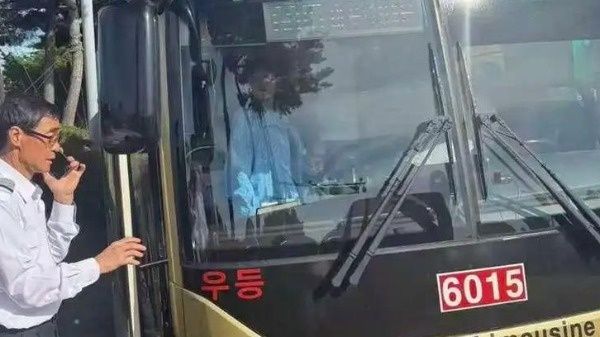
A routine airport transfer in South Korea turned into a life-or-death emergency on Saturday afternoon when the driver of a crowded shuttle bus suddenly lost consciousness, but swift action by a group of Chinese tourists aboard prevented what could have been a catastrophic multi-vehicle collision on Seoul's highways. The No 6015 airport bus, transporting more than a dozen passengers primarily from mainland China towards Incheon International Airport, began veering dangerously after the driver's collapse, scraping against roadside barriers as the vehicle continued at speed through traffic.
Sun Qian, a healthcare professional in her mid-thirties from Nanjing in Jiangsu province, was among the first to react. Positioned in the second row directly behind the driver's cabin, Sun immediately recognised the severity of the situation as the bus lurched unpredictably across its lane. Without hesitation, she lunged forward to seize control of the coach's oversized steering wheel, attempting to stabilise the vehicle's trajectory while the situation unfolded around her in a matter of seconds. Her intervention was not isolated—other passengers simultaneously mobilised to address different aspects of the emergency, demonstrating the kind of coordinated crisis response that transforms potential tragedy into a managed intervention.
While Sun wrestled with the steering mechanism, fellow passengers scrambled to locate and engage the bus's braking systems. The emergency brake button and handbrake were activated within seconds, bringing the vehicle under increasingly manageable control. Despite Sun's admission that she possessed driving experience, the unfamiliar dimensions and weight of the coach's steering apparatus created genuine uncertainty about whether their collective efforts would prove sufficient. The psychological weight of that moment—attempting to prevent a potential collision involving dozens of people on a busy highway—was something each participant would process differently once the immediate crisis subsided.
Du He, Sun's travelling companion and fellow Nanjing resident aged 33, provided crucial additional intervention during the emergency sequence. Recognising that the driver appeared to be in severe distress, Du attempted traditional first-aid techniques, attempting to stimulate the driver through acupressure at the philtrum—a technique rooted in Chinese medical practice. However, within moments it became evident the situation had escalated beyond consciousness or responsiveness; the driver's complexion had turned distinctly purple, suggesting circulatory or respiratory failure. Du's assessment quickly shifted from first aid to emergency life support.
Once the bus had been brought under control and stabilised, the passengers transitioned into performing cardiopulmonary resuscitation in coordinated shifts. Sun, who possessed fluency in Korean language skills that proved invaluable in this moment, used the driver's mobile telephone to contact emergency services, communicating the critical situation to dispatchers in their language while other passengers maintained chest compressions and continued revival attempts. The coordination between language-capable passengers and those performing physical resuscitation highlighted how diverse skill sets within a group become essential during medical emergencies requiring professional intervention.
Despite the passengers' sustained efforts to restore the driver's vital functions, their intervention ultimately proved unsuccessful. According to South Korea's Yonhap News Agency, the driver was transported to hospital in cardiac arrest, where medical teams attempted advanced life support measures for approximately two hours before determining that resuscitation was impossible. Police investigations into the incident remain ongoing as authorities seek to establish whether the collapse resulted from a sudden cardiac event or other medical emergency. The loss, despite the passengers' best efforts, underscored the often-tragic limitations of lay emergency response, however skilled and determined.
The outcome could easily have been far worse, as both Du and Sun emphasised in subsequent interviews. The timing coincided with a period of relatively light traffic on the highway, meaning that the initial loss of vehicle control did not cascade into secondary collisions involving other motorists. A multi-vehicle pile-up on a Seoul expressway could have transformed a medical emergency into a mass casualty incident. The passengers, faced with completing their airport journey, subsequently boarded an alternative bus service and continued towards their flights, though the emotional weight of the preceding events would continue to affect them throughout the day.
The full psychological impact of their ordeal only crystallised once the immediate crisis had passed and normal routines resumed. Du recounted how the adrenaline of action gave way to profound fear only after she had passed through airport security and reached the departure area, when the implications of what might have occurred finally became apparent. This delayed emotional response is common in emergency situations, where survival instincts and task-focused concentration override fear and doubt until the immediate threat has definitively concluded. Looking back on the event, Du described it as resembling a dramatised television scenario rather than lived reality, a disconnect that highlights how extraordinary and surreal such moments feel when experienced directly.
When confronted with widespread praise across Chinese and South Korean social media platforms, both women demonstrated genuine humility about their actions. They characterised their response not as exceptional heroism but as an instinctive reaction that anyone in their position would have undertaken. Du emphasised the importance of collective action and mutual support among compatriots in foreign contexts, reflecting broader themes about diaspora communities and the instinct to protect fellow nationals facing crisis in unfamiliar environments. The rescue operated as genuine teamwork rather than the work of isolated individuals, with multiple passengers contributing essential elements—steering, braking, communication, and resuscitation—that together prevented catastrophe.
The incident has generated considerable discussion across both Chinese and South Korean online communities, with observers from both nations commenting on the passengers' composure despite language barriers and the inherent stress of responding to medical emergencies at highway speeds. South Korean netizens particularly noted the remarkable clarity and swift decision-making demonstrated by foreign visitors operating in an unfamiliar country with limited linguistic resources. Chinese social media users who encountered the women's first-hand account on platforms including Xiaohongshu expressed admiration for their restraint in self-promotion and their emphasis on collective responsibility over individual recognition.
The event carries particular resonance for regional travel communities and tourism industries across East Asia, where the safety and welfare of international visitors remains a priority concern for governments and transportation operators. The story demonstrates both the vulnerability inherent in transit situations where drivers suffer sudden medical episodes and the capacity for ordinary people—tourists, not medical professionals or trained emergency responders—to make life-saving interventions when circumstances demand. For Chinese travellers throughout the region, the incident provides a real-world example of the value of cultural solidarity and mutual support networks, while also highlighting how quickly routine journeys can transform into survival situations requiring collective response.

